

Most international patients don’t contact just one clinic — they contact 5 or more at the same time. And in most cases, the clinic that responds first with a clear, relevant answer wins the patient.
This single behavior explains why many clinics struggle to grow internationally. They apply local strategies — referrals, brand familiarity, and offline reputation — and expect them to work globally. But they don’t. International patients don’t know your clinic; they can’t visit before deciding; and they don’t have trusted local recommendations to rely on.
Instead, they research extensively, compare multiple countries, and evaluate risk far more carefully. According to the WHO, cross-border care introduces additional complexity around continuity, communication, and international patient safety, all of which directly affect how patients choose providers.
How to attract more patients becomes much more specific in a global context. It is no longer just about visibility. It is about reducing uncertainty faster than competitors.
Over the past 10+ years, Bookimed has observed these behaviors at scale, supporting over 1 million patients and working with more than 1,500 clinics globally. What becomes clear is that clinics achieving consistent international volume are not simply “doing better marketing.” They are matching how international patients actually evaluate trust, risk, and outcomes.
Response speed is the single strongest conversion driver
Image by Freepik
International patients do not wait. In most cases, they send inquiries to multiple clinics at once — often five or more — and compare responses in real time.
From a behavioral standpoint, this corresponds to patient access research published in JAMA, showing that delays in communication lower perceived reliability and increase drop-off rates.
On Bookimed, this pattern is visible in practice. Clinics that respond within minutes — with a meaningful, case-specific answer — regularly outperform those that respond hours later.
A meaningful response usually includes: acknowledgement of the patient’s condition; a preliminary treatment direction; and distinct next steps. This is where many clinics misunderstand how to attract patients to your clinic — they focus on generating inquiries, but lose patients in the first interaction.
Price transparency reduces uncertainty and improves decision quality
One of the most common mistakes clinics make when thinking about how to attract more patients to your clinic is hiding pricing behind contact forms. In international healthcare, this creates friction.
Patients comparing treatment options across countries are already evaluating cost differences. Research referenced in The Lancet shows that transparency improves decision confidence, particularly when combined with quality indicators.
On Bookimed, clinics that provide approximate price ranges; treatment packages; and clear inclusions consistently receive more qualified inquiries. This is particularly important for in-demand specialties such as dentistry, where clinics often ask how to attract new patients to your dental practice in a competitive international market.
Transparency does not lessen perceived value — it reduces hesitation.
Review recency matters more than total volume
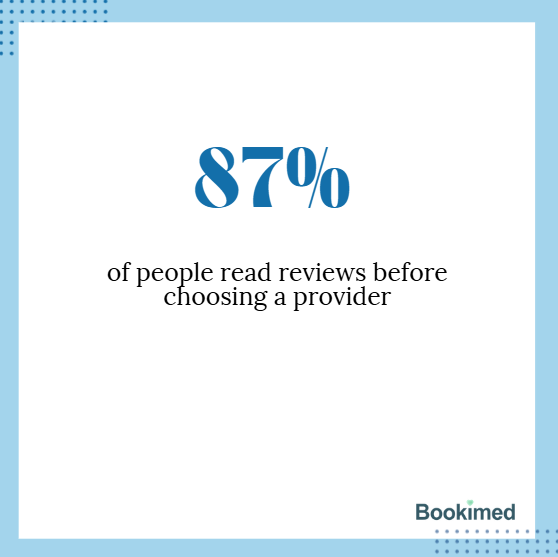
Patient trust in healthcare is strongly tied to social proof. Studies show that 87% of people read reviews before choosing a provider. But international patients evaluate reviews differently.
They are not just asking whether a clinic is good. They are asking whether it is active now.
Clinics that want to understand how to attract new patients internationally need to focus on two things: recency; relevance.
Bookimed’s review ecosystem shows that clinics that maintain a steady flow of recent feedback convert significantly better than those that rely on older reputation signals.
Platform visibility and accreditation reinforce trust
International patients rarely rely on one single source of information. They cross-check everything.
They evaluate:
platforms;
clinic websites;
accreditation bodies;
Organizations such as Joint Commission International and Global Healthcare Accreditation play a key role in establishing credibility, particularly for hospitals that accept international patients.
At the same time, services such as Bookimed provide structured comparison and discovery. This is critical for clinics trying to understand how to attract patients to a hospital beyond their local market. Bookimed processes hundreds of thousands of patient engagements annually, acting as a bridge between patient intent and clinic selection.
High-performing clinics do not choose between channels — they combine visibility, validation, and accreditation.
Language capability directly impacts conversion
Language is one of the most underestimated factors in international patient acquisition.
Communication barriers reduce patient engagement, increase safety incidents, and cause more distress. Research shows that poor communication is linked to about 25% of safety issues, while language barriers make risks feel higher. Strong patient engagement becomes especially important when communication is limited.
In practice, this means clinics with limited language support struggle to convert international demand — even if their clinical quality is high.
Clinics that consistently attract international patients invest in:
multilingual communication;
structured international patient services;
dedicated international patient coordinator roles;
These are not support functions — they are part of conversion infrastructure.
Bookimed’s model reflects this approach by guiding patients through the process in their preferred language, guaranteeing clarity at every stage.
Visual documentation replaces the physical visit
International patients cannot visit a clinic before booking. Instead, they rely on visual evidence to assess quality and safety.
This is directly linked to international patient safety. Patients look for signals that the clinic meets high standards — not just in outcomes, but also in the environment and processes.
High-performing clinics provide:
full clinic walkthroughs;
visibility of treatment areas;
doctor introductions;
real patient testimonials;
Video content plays a key role here, as it allows patients to understand multiple aspects of care quickly. The earliest Bookimed analysis shows that video greatly speeds up decision-making.
This is not a marketing problem — it’s a trust infrastructure problem
The question is frequently framed as how to attract more patients or how to attract patients to your clinic. But at an international level, the real question is different: How do you reduce uncertainty faster than competitors?
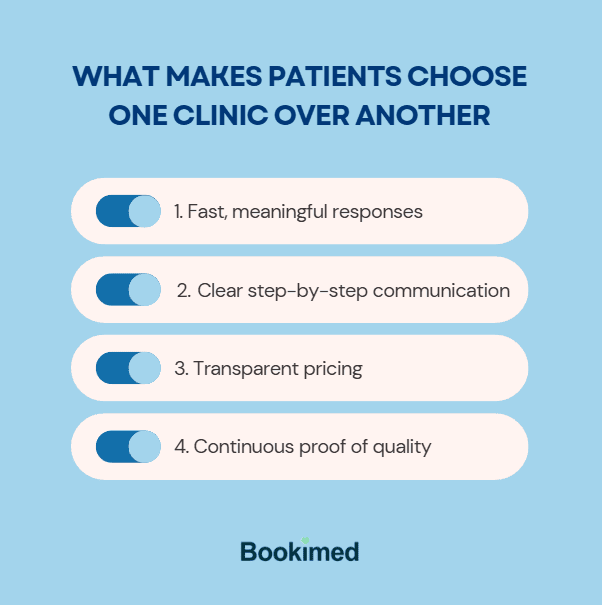
Clinics that consistently achieve high international volume don’t just follow standard best practices — they execute them in very specific ways:
They respond faster — with substance. Not generic replies, but case-aware responses that include a preliminary treatment outline; estimated timelines; or illustrations of similar cases.
They communicate clearly — through structure. Usually via a dedicated international patient coordinator, so patients always understand the next step — what to prepare; how long it takes; what to expect on arrival.
They deliver transparent information — especially on pricing. Realistic ranges; clear inclusions; no “contact us for details” barriers — which is critical when solving how to attract more patients to your clinic internationally.
They show continuous proof of quality — not one-time credibility. Recent reviews; patient video testimonials (UGC); before-and-after cases with context; active responses to feedback — all strengthening trust and international patient safety.
These are not marketing tactics. They are systems aligned with international patient safety goals and patient expectations.
Bookimed evaluates partner clinics against these same standards and connects them to over 700,000 annual patient engagements, providing the infrastructure to convert global demand into real treatment journeys.
👉 To learn more or become a partner
Image Sources
Banners – created using resources from Freepik
All medical content on this page is prepared by authors with specialized medical education and reviewed by certified physicians in the relevant field. Medical review by Fahad Mawlood, Medical Editor & Data Scientist.
Last updated: October, 2026.
- Statistics: Figures are based on Bookimed’s internal database October 2026, which includes analysis of 12,450 patient requests across accredited clinics in .
- Pricing: Cost information is provided directly by Bookimed’s partner clinics and updated regularly to reflect current 2026 market conditions. Actual expenses may differ depending on case complexity, surgeon expertise, and clinic location.
- Clinical Data: Treatment outcomes and patient satisfaction figures are collected from Bookimed’s verified clinic database and supported by data from peer-reviewed medical sources such as PubMed, The Lancet, JAMA, and NEJM (2023–2026).
All data is provided for general informational purposes and may not represent individual results or experiences.
- Hu Y., Ngai C. S.-b., Jiang R. Communication Strategies to Promote Patient Engagement in Telemedicine: Systematic Review (Preprint). Journal of Medical Internet Research. 2025. URL: https://doi.org/10.2196/85456 (date of access: 17.04.2026).
- Local Consumer Review Survey 2020 - BrightLocal. BrightLocal. URL: https://www.brightlocal.com/research/local-consumer-review-survey-2020/ (date of access: 17.04.2026).
- Meyer A. N. D., Scott T. M. T., Singh H. Adherence to National Guidelines for Timeliness of Test Results Communication to Patients in the Veterans Affairs Health Care System. JAMA Network Open. 2022. Vol. 5, no. 4. P. e228568. URL: https://doi.org/10.1001/jamanetworkopen.2022.8568 (date of access: 17.04.2026).
- World Health Organization (WHO). World Health Organization (WHO). URL: http://www.who.int/ (date of access: 17.04.2026).