

Every patient journey in cross-border healthcare starts the same way: a message. "Can you help me get this treatment?" What happens in the next few minutes decides almost everything. Reply fast, in the patient's language, with something concrete, and the conversation continues. Reply six hours later with a generic line, and the patient is already talking to someone else.
Now multiply that single message by more than a million inquiries, across 32+ countries and 10+ languages. That is the real problem in healthcare coordination. Not a shortage of demand, and not a shortage of good clinics. It is the gap between first contact and a clear, personalized offer. No human team can hold that gap open for everyone, instantly, around the clock.
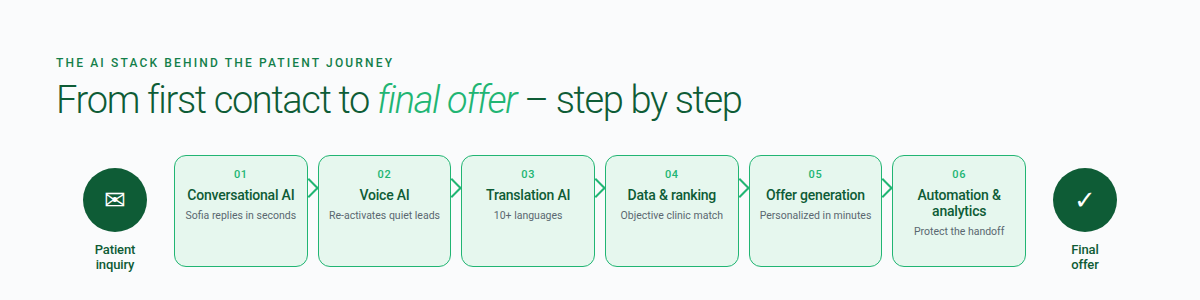
What is new is that this gap is no longer one problem with one owner. It is a chain of steps, and there is now a mature AI tool for each of them. Below is the stack that closes the gap – step by step. This is what we have learned running it at scale at Bookimed.
Why This Matters Now: The Numbers
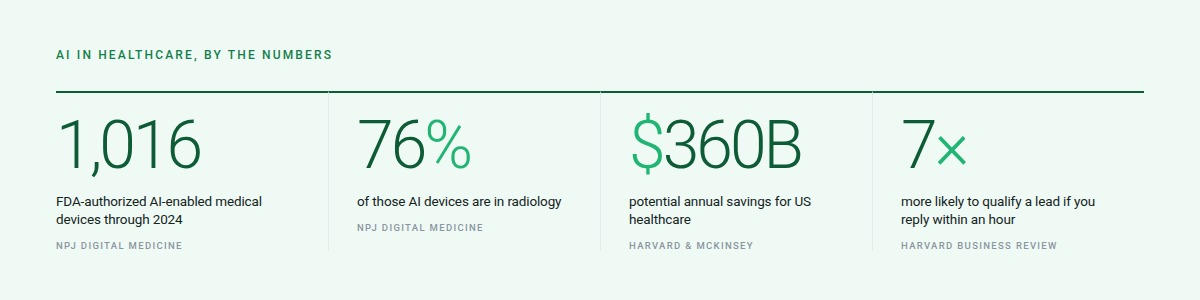
This shift is documented, not hype. The US FDA has authorized more than a thousand AI-enabled medical devices. A peer-reviewed taxonomy in npj Digital Medicine (Nature) counts 1,016 authorizations through 2024, covering 736 unique devices. Roughly 76% sit in radiology, a sign that regulated, high-stakes AI is already mainstream in clinical settings.
The bigger prize, though, is operational. Harvard and McKinsey researchers estimate AI could save US healthcare up to $360 billion a year. McKinsey's 2025 healthcare survey shows generative AI crossing from pilots into everyday production. In 2024 the World Health Organization issued formal governance guidance for large multi-modal AI models in health. That is the clearest sign yet that AI in care has moved from novelty to infrastructure.
One pattern runs through all of it: the highest-return uses are not diagnosis-replacement. They are administrative and patient-engagement tasks – the first-contact-to-offer work that decides whether a patient stays.
Sources:
- npj Digital Medicine / Nature – FDA AI device taxonomy
- Harvard–McKinsey – $360B potential savings
- McKinsey – generative AI in healthcare, 2025
- Stanford HAI – 2025 AI Index Report
- WHO – 2024 guidance on large multi-modal models
The Gap That Costs Healthcare the Most
Every inbound patient is really two problems at once. Speed: respond now, before the patient moves on. Scale: respond to everyone, not just the leads a coordinator reaches before the end of a shift. Solve one and miss the other, and patients still leak out. The AI stack below is worth assembling only because each layer attacks both at the same time.
Stage 1 – First Contact: Conversational AI
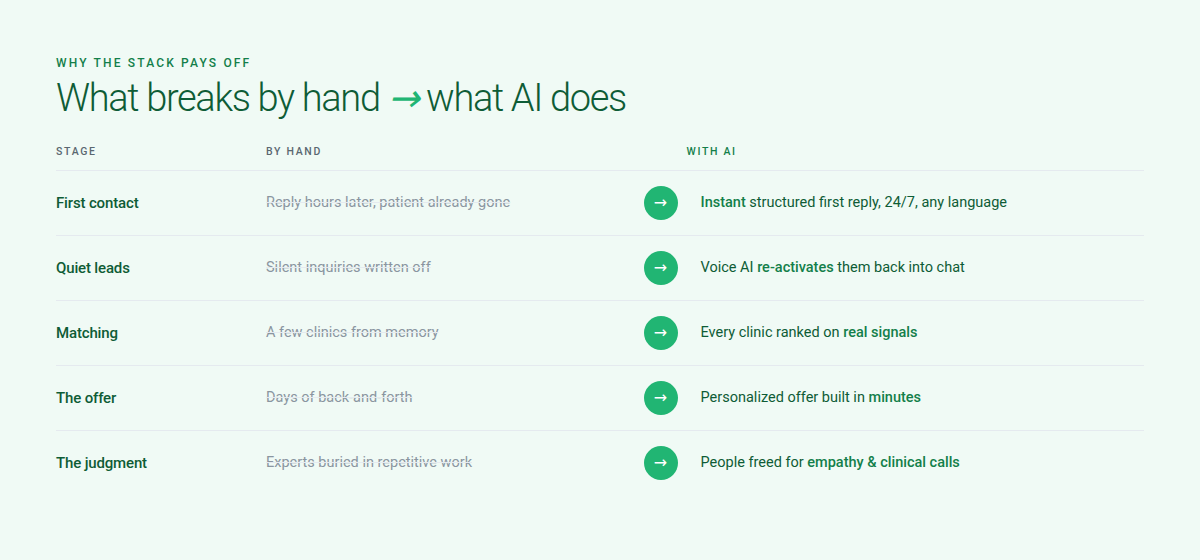
The first reply is the highest-leverage moment in the entire journey. It is also the moment a human team cannot guarantee at 3 a.m. across a dozen time zones. This is what modern conversational AI platforms are built for. They send an instant, structured first response that asks the right questions instead of parking the patient on hold. The stakes are measurable. Reply within an hour and you are nearly 7x more likely to qualify the lead (Harvard Business Review).
At Bookimed, every inquiry meets Sofia – an AI medical coordinator – within seconds, in the patient's own language. Sofia asks the procedure, the destination, and the documents a clinic will need. That turns a cold form submission into a live conversation before it can go stale. The lesson is blunt: a conversation that actually starts is worth far more than one that stalls.
For your clinic: an instant auto-reply that asks the first real question is the cheapest conversion win available.
Stage 2 – Reaching the Patients Who Go Quiet: Voice AI
A large share of inquiries never start a chat at all, or drop out halfway. Chasing them by hand does not scale. AI voice agents exist for exactly this. They call a lead who submitted a request but never replied, and route them back into a conversation.
We use AI voice for one job only – re-activating patients who went silent. It is not a channel for closing deals by phone. It brings them back into chat, where the real matching happens. The success metric is simple: did the patient come back into the conversation?
For your clinic: a short "still interested?" nudge revives leads you already paid to acquire.
Stage 3 – Speaking Every Patient's Language: Translation and Localization AI
Cross-border care is multilingual by definition. A patient in São Paulo and a clinic in Istanbul do not share a language. Hiring native speakers for every market does not scale. Real-time translation and localization AI removes that wall.
Bookimed supports 10+ languages across its coordinators and content. A patient is met in their own language from the first message. No one is handed a form in English and left to translate it themselves.
For your clinic: meet each patient in their own language from message one.
Stage 4 – Matching at Scale: Data and Ranking Engines
A human coordinator can know a few dozen clinics well. A recommendation and ranking engine can weigh all of them at once, on real signals rather than memory. That layer turns a directory into a match.
Bookimed's edge here is verified data. That means 1,500+ accredited clinics across 32+ countries, plus prices, satisfaction scores, and outcomes from over a million inquiries. An objective ranking algorithm scores each clinic on patient demand, satisfaction, price availability, response speed, and profile completeness. It returns a short, relevant shortlist. The patient gets a match, not a search result.
For your clinic: rank clinics on outcomes, reviews and response time, not on memory.
Stage 5 – The Final Offer: Document and Proposal Generation
Once the case is clear, the offer still has to be built. Done by hand, that is a chain of back-and-forth over several days. AI document-generation tools collapse it into minutes – assembling matched options, prices, and inclusions into one clean document.
At Bookimed, AI assembles the offer itself. That means matched clinics, direct clinic prices with no patient markup, and a plain breakdown of what each procedure includes. It lands while the patient is still paying attention.
For your clinic: send a clear, itemized offer the same day, not next week.
Stage 6 – Making It Repeat: Workflow Automation and Conversation Analytics
None of the above holds together on its own. Workflow-automation platforms wire the steps into one flow, and conversation-analytics tools tell you where patients drop and why.
Analytics taught us one thing above all. The moment AI hands a patient to a human is where value is won or lost. Instrument that handoff, and protect it.
For your clinic: staff the AI-to-human handoff first, because that is where revenue leaks.
The Line AI Does Not Cross
Here is the part the "AI replaces everyone" headlines miss. Medical decisions are not a logistics problem. Some work stays human. Reassuring a frightened patient, or reading between the lines of a vague symptom description. Judging whether a case needs a second opinion. At Bookimed all of it stays with medically-trained coordinators who hold medical degrees.
The division of labor is the whole point. AI takes the fast, repeatable, endless work – the instant reply, the qualification, the offer assembly, the follow-up. That buys back the one resource experts never have enough of – time. It points that time at the conversations where judgment and empathy change the outcome. That is what "AI-first" should mean in healthcare: not fewer people, the same people, freed from the queue.
The Takeaway: How to Assemble Your Own Stack
For any clinic or health system watching patients slip out of a slow intake process:
- Start at first contact. An instant, useful first reply beats a perfect reply that arrives hours late. Conversational AI is the highest-return layer to add first.
- Add reach, then language. Voice AI recovers the patients who go quiet; translation AI removes the market boundary.
- Match on data, not memory. Rank options on real signals – demand, satisfaction, price, response time.
- Automate the offer, not the judgment. Compress first-contact-to-offer from days to minutes, and keep clinicians on the decisions only they can make.
- Instrument the handoff. The AI-to-human moment is where the whole chain succeeds or fails.
Where to Take It Next
Bookimed already runs this stack across a network of 1,500+ accredited clinics in 32+ countries. If you would rather plug in than build it, you get an AI medical coordinator, data-driven matching, and same-day offers. All of it goes in front of your international patients from day one.
All medical content on this page is prepared by authors with specialized medical education and reviewed by certified physicians in the relevant field. Medical review by Fahad Mawlood, Medical Editor & Data Scientist.
Last updated: October, 2026.
- Statistics: Figures are based on Bookimed’s internal database October 2026, which includes analysis of 12,450 patient requests across accredited clinics in .
- Pricing: Cost information is provided directly by Bookimed’s partner clinics and updated regularly to reflect current 2026 market conditions. Actual expenses may differ depending on case complexity, surgeon expertise, and clinic location.
- Clinical Data: Treatment outcomes and patient satisfaction figures are collected from Bookimed’s verified clinic database and supported by data from peer-reviewed medical sources such as PubMed, The Lancet, JAMA, and NEJM (2023–2026).
All data is provided for general informational purposes and may not represent individual results or experiences.