Medical disclaimer
Surgery vs stereotactic radiotherapy for stage I lung cancer: what a two-center study found
13 min read
Prepared by Bookimed editorial team
Facts checked by the Bookimed editorial team based on scientific sources

Share with AI


The named clinic is an author affiliation. The study patients were not established as patients treated at that clinic.
Key takeaways
- The study compared 93 patients who had surgery with 64 who had SBRT, treated between 2010 and 2022.
- Five-year overall survival was 58% after surgery and 49% after SBRT, and the authors reported no statistically significant differences.
- The SBRT group had more comorbidities (93% vs. 56%), so the two groups were not alike at the start.
- Distant metastasis occurred more often after SBRT (28.1% vs. 15.1%, p = 0.006).
- Anadolu Medical Center appears only as an author affiliation; the abstract does not say the patients were treated there.
The question this study addresses
This retrospective two-center cohort study, published in BMC cancer in 2026, compared surgical resection with SBRT in patients with clinical stage I non-small cell lung cancer (NSCLC). The authors looked at overall survival, disease-free survival, local control and locoregional control. Median follow-up was 57 months after surgery and 48 months after SBRT. The authors concluded that outcomes were comparable, that SBRT remains an effective option for patients who cannot have surgery, and that surgery offers pathological staging. They call for prospective randomized trials. The abstract does not say where the patients were treated. Anadolu Medical Center is listed through one author's affiliation only.
- The situation
- Adults with clinical stage I non-small cell lung cancer, an early-stage lung cancer, treated either with surgery or with SBRT.
- The treatment
- Surgical resection (including a substantial proportion of thoracotomy procedures) compared with stereotactic body radiotherapy (SBRT).
What this evidence cannot establish
- The study is retrospective and not randomized, and the SBRT group had a higher burden of comorbidities (93% vs. 56%).
- Histological confirmation was unavailable for a subset of SBRT patients; a sensitivity analysis of confirmed cases (n = 143) gave consistent results.
- Anadolu Medical Center appears only as an author affiliation, and the abstract does not say where the patients were treated.
Patient groups in the published study
93 patients · Published study group
Stage I lung cancer treated with surgery
- Indication
- Clinical stage I non-small cell lung cancer
- Treatment
- Surgical resection, including a substantial proportion of thoracotomy procedures
93 patients in the surgical group of the two-center cohort.
Patients with clinical stage I NSCLC who were treated with surgical resection.
Surgical resection of the lung cancer. The abstract notes that the group included a substantial proportion of thoracotomy procedures, reflecting routine clinical practice.
Five-year overall survival
58%
93 patients · Study group
5 years
Distant metastasis
15.1%
93 patients · Study group
not stated
Reported risks
- Study-wide: the abstract does not report complications or mortality for either group.
Limits of this evidence
- Exact numbers of patients with each event, the surgical approaches in detail, and where the patients were treated are not stated.
- Five-year overall survival (58%) and distant metastasis (15.1%) are group results, not a forecast for any one patient.
For a clinic assessment
- Imaging reports and any biopsy or pathology reports
- Recent medical history, including other conditions and medicines
64 patients · Published study group
Stage I lung cancer treated with SBRT
- Indication
- Clinical stage I non-small cell lung cancer (histology unconfirmed in a subset)
- Treatment
- Stereotactic body radiotherapy (SBRT)
64 patients in the SBRT group of the two-center cohort.
Patients with clinical stage I NSCLC who were treated with SBRT. This group had a higher burden of comorbidities (93% vs. 56% in the surgical group).
Stereotactic body radiotherapy (SBRT), a form of radiation treatment aimed at the tumor.
Five-year overall survival
49%
64 patients · Study group
5 years
Distant metastasis
28.1%
64 patients · Study group
not stated
Reported risks
- Study-wide: the abstract does not report toxicity or side effects for either group.
Limits of this evidence
- SBRT dose and fractionation, toxicity, local control values, and where the patients were treated are not stated.
- Five-year overall survival (49%) and distant metastasis (28.1%) are group results, and the groups differed at baseline.
For a clinic assessment
- Imaging reports and any biopsy or pathology reports
- Records showing other health conditions and any earlier treatment
50 patients · Published study group
Stage I lung cancer treated with SBRT, with the diagnosis confirmed by biopsy
- Indication
- Clinical stage I non-small cell lung cancer with tissue (biopsy) confirmation
- Treatment
- Stereotactic body radiotherapy (SBRT)
These patients had early-stage lung cancer confirmed by tissue diagnosis. They were treated with SBRT instead of surgery. This is the cohort used in the study's check of its main results.
Stereotactic body radiotherapy, which is high-dose radiation delivered in a small number of sessions.
Estimated overall survival at 60 months
54.7%
50 patients · Study group
60 months (estimated rate)
Limits of this evidence
- Retrospective study. Treatment was not randomly assigned.
- SBRT patients were older and had more other illnesses than surgical patients, so the groups are not directly comparable.
- The 60-month rate is a Kaplan–Meier estimate, not a count of patients.
For a clinic assessment
- Imaging reports and any biopsy or pathology reports
- Recent medical history, including other conditions and medicines
Results and limits of the study
Five-year overall survival was 58% after surgery and 49% after SBRT. Median overall survival, disease-free survival, local control and locoregional control numerically favored surgery, but none of the differences were statistically significant (p > 0.05). The SBRT group had a higher burden of comorbidities (93% vs. 56%), which may partly explain the gap. A sensitivity analysis of histologically confirmed cases gave consistent results. These are group results from past patients and do not predict what will happen for you.
Stage I lung cancer treated with surgery: Five-year overall survival
58%
93 patients · Study group
5 years
Stage I lung cancer treated with surgery: Distant metastasis
15.1%
93 patients · Study group
not stated
Stage I lung cancer treated with SBRT: Five-year overall survival
49%
64 patients · Study group
5 years
Stage I lung cancer treated with SBRT: Distant metastasis
28.1%
64 patients · Study group
not stated
Risks reported by the source
- Distant metastasis, meaning cancer spread to other parts of the body, occurred in 15.1% of the surgery group and 28.1% of the SBRT group (p = 0.006).
Limitations and unknowns
- Where the patients were treated is not stated in the abstract.
- Complications, toxicity and mortality are not reported in the abstract.
- SBRT dose and fractionation are not stated.
- Follow-up for distant metastasis is not stated.
What to clarify in your treatment plan
Before booking, ask the clinic whether it offers radiotherapy for lung cancer and which team would review your scans and records. Clarify which records the team needs and how your case would be assessed. Ask what the clinic's own role is, since the study does not show that its patients were treated there.
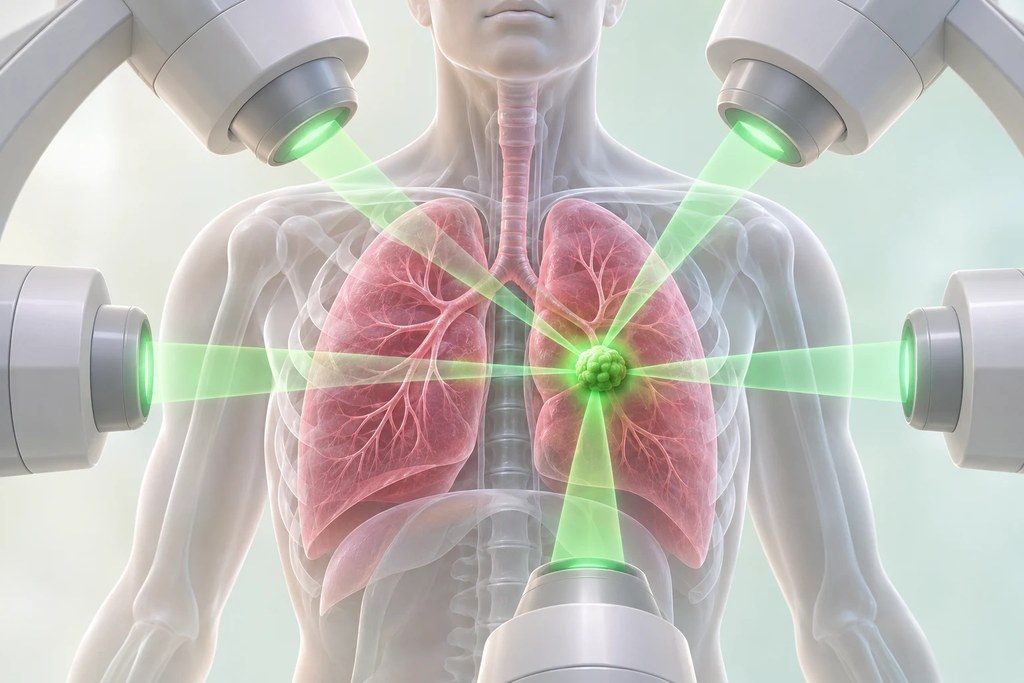
Anadolu Medical Center: clinic profile
- Anadolu Medical Center appears in this study as an author affiliation: Author 4 (Rashad Rzazade) lists Johns Hopkins Medicine Anadolu Medical Center.
- The abstract does not say where the patients were treated, so this page does not describe them as patients of the clinic.
- The clinic profile is available on Bookimed.
Safety and recovery: general information
General patient guidance, provided separately from the case evidence. Follow your treating team's instructions.
Possible side effects
- Radiation treatment can cause fatigue, nausea and vomiting, loss of appetite and weight loss, and skin changes in the treated area.
Ask the care team which of these are likely for your treatment plan.
- Radiation to the chest may damage the lungs and cause a cough, problems breathing and shortness of breath. These usually improve after treatment, but sometimes may not go away completely.
Report any new breathing problems to your care team.
- The esophagus may be exposed to radiation, which can cause a sore throat and trouble swallowing during treatment.
Tell your team if swallowing becomes difficult.
- Radiation may increase the chance of developing a different cancer.
Discuss this long-term consideration with your doctor.
Recovery and aftercare
- You should be able to continue your daily routine after external beam radiation therapy (EBRT).
Confirm with the clinic what to expect for your own schedule.
- Radiation treatments to the lungs are most often given 5 days a week for 5 to 7 weeks, but this can vary based on the type of EBRT and the reason it is given.
Ask how long your own plan would last.
Suitability and cautions
- Radiotherapy may be used as the main treatment when a person is not healthy enough for surgery, does not want surgery, or the tumor cannot be removed because of its size or location.
Your doctor decides which option fits your case.
- Radiotherapy may also be used if you are unable to have surgery, or after surgery to stop the cancer coming back.
Bring your full history to the consultation.
When to contact the clinic
- You develop a cough, problems breathing or shortness of breath after chest radiation.
Contact your care team promptly.
- You have a sore throat or trouble swallowing during treatment.
Contact your care team promptly.
- Skin changes in the treated area go beyond mild redness to blistering and peeling.
Contact your care team.
- Any side effect is more severe than you expected.
Let your care team know.
How treatment at the clinic usually goes
| 1 | Send your records to the coordinatorShare imaging reports, any biopsy or pathology reports, and a recent medical history with the Bookimed coordinator, including other conditions and medicines. |
|---|---|
| 2 | The clinic reviews your caseThe coordinator passes your records to Anadolu Medical Center. The clinic's team decides whether it can assess your case and what it would propose. |
| 3 | Agree the treatment planYou receive the clinic's plan and can ask about the treatment type, the team, what is included and what is not. Nothing is booked until you agree. |
| 4 | Treatment and stayIf you go ahead, the clinic carries out the planned treatment. The coordinator helps with arrangements for your stay, and the clinic explains the schedule for your plan. |
| 5 | Follow-up at homeYou get written discharge information and a follow-up plan to share with your home doctors. Report new symptoms, such as breathing problems, to your care team. |
Price in the clinic's Bookimed offers
Historical quotation
$6,500
Based on 1 documented case. This is not a current clinic quotation.
Package prices from the clinic's offers in the Bookimed catalog for this procedure. Your own price depends on the clinic's review of your medical records.
Included
- Kidney cancer, metastatic lesions in the lungs
Not confirmed
- The final price for your plan is confirmed in the clinic's written quotation.
What to ask Anadolu Medical Center
- Do you treat early-stage lung cancer at your center, and which specialists would review my scans and records?
- Do you offer stereotactic body radiotherapy (SBRT), surgery, or both for stage I non-small cell lung cancer?
- What is the clinic's own role in the study that lists your center as an author affiliation, and were any of the study's patients treated at your center?
- Which records do you need from me, and is a biopsy or pathology report required before you can assess my case?
- How would my other health conditions affect the choice between surgery and radiotherapy?
- Which side effects are likely with the treatment you would propose, and when should I contact your team?
- What follow-up would you recommend after treatment, and how can my home doctors take part?
- Your catalog lists a lung-related offer for metastatic lesions from kidney cancer. Does it apply to my diagnosis, or do you need a separate assessment for stage I lung cancer?
Request a personal plan from the clinic
Ask Anadolu Medical Center about radiotherapy for lung cancer and what records it needs
Bookimed can pass your imaging and medical records to the clinic's coordinator and ask whether and how the clinic assesses early-stage lung cancer cases. The clinic's team decides whether any treatment fits your case.
Ask the clinic for a current, itemized quotation. Published evidence does not establish package inclusions or a current price.
Frequently asked questions
Who ran this study and where were the patients treated?
The study was a retrospective two-center cohort study published in BMC cancer in 2026, and the abstract does not say where the patients were treated. The author affiliations include Süreyyapaşa Chest Diseases and Thoracic Surgery Training and Research Hospital, Göztepe Prof. Dr. Süleyman Yalçın City Hospital, and Johns Hopkins Medicine Anadolu Medical Center. Anadolu Medical Center is listed through one author's affiliation, so it should not be read as the treatment site. Bookimed did not run the study.
Was surgery better than SBRT for stage I lung cancer in this study?
Surgery numerically favored on several measures, but the differences were not statistically significant. Median overall survival, disease-free survival, local control and locoregional control leaned toward surgery. Five-year overall survival was 58% after surgery and 49% after SBRT. The SBRT group also had more comorbidities (93% vs. 56%), so the groups were not equal at the start. The authors concluded that outcomes were comparable and called for randomized trials.
Does this study show what would happen to me?
No, the study reports group results from past patients and cannot forecast your own outcome. It was retrospective, patients were not randomly assigned, and the SBRT group had a higher burden of comorbidities. Your result depends on your own diagnosis, health and treatment plan, which only your doctors can assess. Use this page to prepare questions for a consultation, not to choose a treatment.
Is distant metastasis more common after SBRT?
In this study, yes: distant metastasis occurred in 28.1% of the SBRT group and 15.1% of the surgery group (p = 0.006). Distant metastasis means the cancer spread to other parts of the body. The SBRT group had a higher burden of comorbidities (93% vs. 56%), and the abstract does not state the follow-up for this outcome. Ask your doctor how these findings apply to your situation.
What is SBRT and who is it usually used for?
The abstract describes stereotactic body radiotherapy (SBRT) as an established alternative for patients with stage I non-small cell lung cancer who are medically inoperable or decline surgery. The authors say it remains an effective option for medically inoperable patients. The abstract does not give the dose or the number of sessions, and it does not say Anadolu Medical Center delivered the treatment. Ask the clinic whether it offers SBRT.
What does surgery offer that SBRT does not, according to the authors?
The authors say surgery offers the advantage of pathological staging in eligible individuals. In this study, histological confirmation was unavailable for a subset of SBRT patients, so the team ran a sensitivity analysis of 143 confirmed cases, and the results were consistent. Anadolu Medical Center appears only as an author affiliation, so ask its team how it would confirm a diagnosis.
Which records should I send to the coordinator?
Prepare imaging reports, any biopsy or pathology reports, and a recent medical history with other conditions, medicines and earlier treatment. Bookimed can pass these to the Anadolu Medical Center coordinator, and the clinic's team decides whether any treatment fits your case. Other conditions matter here: in the study, 93% of the SBRT group had comorbidities, compared with 56% of the surgery group.
Does the study report side effects of SBRT?
No. The abstract does not report complications, toxicity or mortality for either group. General medical sources on chest radiation list fatigue, nausea, skin changes, cough, shortness of breath, and a sore throat or trouble swallowing. Ask Anadolu Medical Center which of these are likely with the plan it proposes for you, and when to contact the team.
When might radiotherapy be used instead of surgery?
Medical sources say radiotherapy may be the main treatment when a person is not healthy enough for surgery, does not want surgery, or the tumor cannot be removed because of its size or location. Your doctor decides which option fits. Anadolu Medical Center's team would review your scans and records before saying whether any option suits your case.
How long were patients followed in this study?
Median follow-up was 57 months in the surgery group and 48 months in the SBRT group. Five-year overall survival was 58% after surgery and 49% after SBRT, and the differences were not statistically significant. The abstract does not state the follow-up for distant metastasis. These are group results and do not predict your own outcome at Anadolu Medical Center or elsewhere.
Sources and scope
This page was prepared from the published abstract of the study (PMID 41981405) and the numbers extracted from it. Safety information comes from named medical sources about radiotherapy, not from the study.
- 1. Erdizci et al. – Comparison of prognosis between patients undergoing surgical resection and stereotactic ablative radiotherapy for early-stage lung cancer.
Retrospective two-center cohort study: surgery vs SBRT · 2026
157 adults with clinical stage I non-small cell lung cancer: 93 had surgery and 64 had SBRT, treated 2010-2022.
Follow-up: Median 57 months (surgery) and 48 months (SBRT)
Only the abstract was used, so details on treatment sites, complications, toxicity and radiation dose are not available.
- 2. American Cancer Society
- 3. Cleveland Clinic
- 4. NHS
- 5. Anadolu Medical Center on Bookimed
Scope and limitations
- A research summary is not an individual medical recommendation.
- Group results describe the study participants, not a forecast for any one patient.
Related procedures
About the editorial team
Prepared by
Bookimed editorial teamFacts checked by the Bookimed editorial team based on scientific sources
Bookimed prepares evidence summaries from published medical sources and anonymized care records. The clinic and any doctors named on this page are identified separately in their own sections.