Medical disclaimer
Bypass Through a Small Left Chest Incision vs Full Sternotomy: Study Summary
11 min read
Prepared by Bookimed editorial team
Facts checked by the Bookimed editorial team based on scientific sources

Share with AI


The named clinic is an author affiliation. The study patients were not established as patients treated at that clinic.
Key takeaways
- The study compared two groups of adults with multivessel coronary artery disease: 132 had the small-incision approach and 130 had full sternotomy.
- Mean cardiopulmonary bypass time was 152.24 minutes in the small-incision group and 102.24 minutes in the sternotomy group.
- Mean cross-clamping time was 86 minutes in the small-incision group and 62 minutes in the sternotomy group.
- Intensive care and hospital stays were shorter in the small-incision group, and one patient died in each group.
- The abstract does not say where the patients were treated, so this page does not link the results to Hisar Intercontinental Hospital's own care.
The question this study addresses
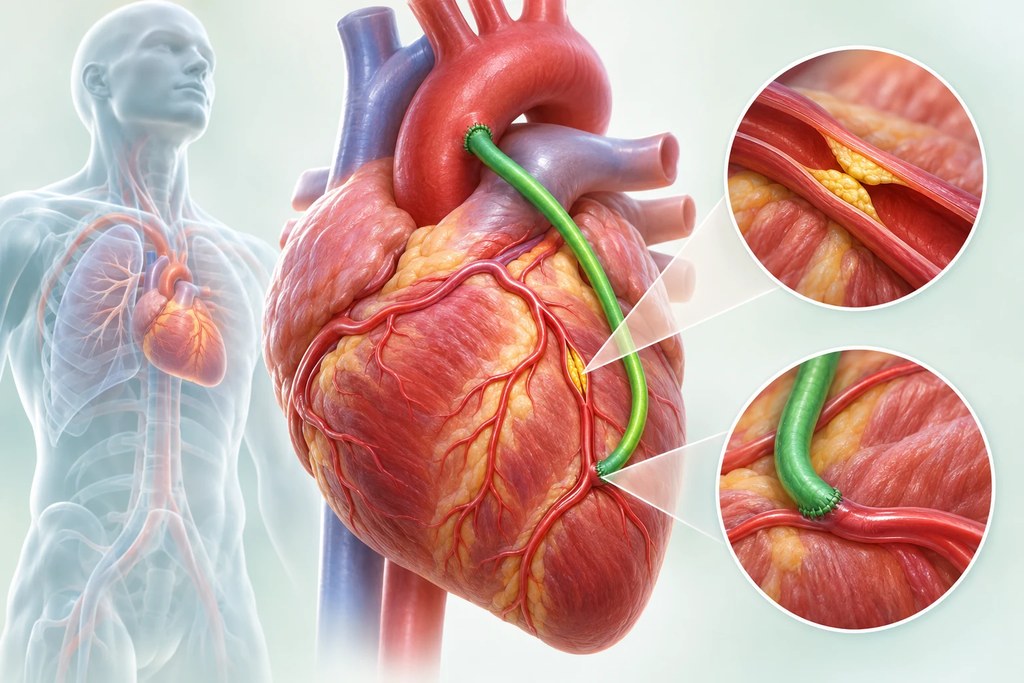
This retrospective comparison looked at on-pump bypass surgery for several blocked heart arteries. One group had surgery through a small left chest incision (left anterior mini-thoracotomy) and the other through a full breastbone incision (sternotomy). On-pump means a heart-lung machine, called cardiopulmonary bypass, supports the body during surgery. The small-incision group had longer cardiopulmonary bypass and cross-clamping times. Cross-clamping means the aorta is clamped during the operation. The same group had shorter intensive care and hospital stays. Bookimed did not run the study. One author lists Hisar Intercontinental Hospital, Istanbul, and the abstract does not say where patients were treated.
- The situation
- Adults with multivessel coronary artery disease who needed bypass surgery.
- The treatment
- Minimally invasive coronary artery bypass grafting (CABG) through a left anterior mini-thoracotomy, compared with conventional CABG through a full sternotomy, both on-pump.
What this evidence cannot establish
- The abstract does not say where the patients were treated. The clinic appears only as an author affiliation, so these results are not a record of care at Hisar Intercontinental Hospital.
- The study is retrospective, so patients were not assigned to the two approaches by chance.
- Study years, follow-up length, graft numbers and the actual intensive care and hospital stay values are not stated in the abstract.
Patient groups in the published study
132 patients · Published study group
Bypass surgery for several coronary vessels through a small left chest incision
- Indication
- Multivessel coronary artery disease
- Treatment
- Minimally invasive multivessel CABG via left anterior mini-thoracotomy (on-pump)
132 adult patients in Group I.
Adults with several blocked coronary arteries who needed bypass surgery.
Bypass grafting through a small incision on the left side of the chest while a heart-lung machine supported the circulation. Mean cardiopulmonary bypass time was 152.24 minutes and mean cross-clamping time was 86 minutes. In this group, six patients needed a repeat operation because of bleeding.
Mean cardiopulmonary bypass time (Group I)
152.24 ± 36.4 minutes
132 patients · Study group
Plus/minus as reported by the source
not stated
Mean cross-clamping time (Group I)
86 ± 13.2 minutes
132 patients · Study group
Plus/minus as reported by the source
not stated
Reported risks
- Study-wide: one patient died in each group (P=0.82). The abstract does not give a mortality figure for this group alone.
Limits of this evidence
- Follow-up length and the actual intensive care and hospital stay values are not stated.
- The abstract does not say where these patients were treated.
For a clinic assessment
- Recent heart imaging and angiography reports
- Current medication list and any earlier heart surgery records
130 patients · Published study group
Bypass surgery for several coronary vessels through a full breastbone incision
- Indication
- Multivessel coronary artery disease
- Treatment
- Conventional on-pump CABG with full sternotomy
130 adult patients in Group II.
Adults with several blocked coronary arteries who needed bypass surgery.
Conventional bypass grafting through a full breastbone incision with heart-lung machine support. Mean cardiopulmonary bypass time was 102.24 minutes and mean cross-clamping time was 62 minutes. In this group, seven patients needed a repeat operation because of bleeding.
Mean cardiopulmonary bypass time (Group II)
102.24 ± 19.4 minutes
130 patients · Study group
Plus/minus as reported by the source
not stated
Mean cross-clamping time (Group II)
62 ± 21.4 minutes
130 patients · Study group
Plus/minus as reported by the source
not stated
Reported risks
- Study-wide: one patient died in each group (P=0.82). The abstract does not give a mortality figure for this group alone.
Limits of this evidence
- Follow-up length and the actual intensive care and hospital stay values are not stated.
- The abstract does not say where these patients were treated.
For a clinic assessment
- Recent heart imaging and angiography reports
- Current medication list and any earlier heart surgery records
Results and limits of the study
Cardiopulmonary bypass time (P < 0.001) and cross-clamping time (P < 0.001) were significantly longer in the small-incision group. Intensive care stay (P=0.005) and hospital stay (P=0.004) were significantly shorter in that group. The authors conclude the small-incision approach is effective and reliable, citing less drainage, less blood transfusion need, faster return to daily life and better cosmetic results. These are group findings and not a forecast for any individual patient.
Bypass surgery for several coronary vessels through a small left chest incision: Mean cardiopulmonary bypass time (Group I)
152.24 ± 36.4 minutes
132 patients · Study group
Plus/minus as reported by the source
not stated
Bypass surgery for several coronary vessels through a small left chest incision: Mean cross-clamping time (Group I)
86 ± 13.2 minutes
132 patients · Study group
Plus/minus as reported by the source
not stated
Bypass surgery for several coronary vessels through a full breastbone incision: Mean cardiopulmonary bypass time (Group II)
102.24 ± 19.4 minutes
130 patients · Study group
Plus/minus as reported by the source
not stated
Bypass surgery for several coronary vessels through a full breastbone incision: Mean cross-clamping time (Group II)
62 ± 21.4 minutes
130 patients · Study group
Plus/minus as reported by the source
not stated
Risks reported by the source
- Repeat operations for bleeding: six patients in the small-incision group and seven in the sternotomy group.
- Perioperative death: one patient in each group (P=0.82).
Limitations and unknowns
- Where the patients were treated is not stated.
- The study years and the length of follow-up are not stated.
- The actual intensive care and hospital stay values are not given in the abstract.
- The number of grafts per patient is not stated.
What to clarify in your treatment plan
Before booking, ask the clinic whether it offers bypass surgery through a left anterior mini-thoracotomy and which surgeon would perform it. Ask what tests and records the surgical team needs to judge your situation, how many days to plan in the city, and how follow-up care is arranged after you return home.
Hisar Hospital Intercontinental: clinic profile
- One author of the study lists Hisar Intercontinental Hospital, Istanbul, as an affiliation. The abstract does not say where the patients were treated.
- The Hisar Hospital Intercontinental profile is available on Bookimed.
Hisar Hospital Intercontinental
Istanbul, Turkey
4.5/5 · 267 Bookimed reviews (current clinic profile)
Ali Fedakar: doctor profile
- Ali Fedakar is an author of the study and lists the Department of Cardiovascular Surgery, Hisar Intercontinental Hospital, Istanbul, as his affiliation.

Safety and recovery: general information
General patient guidance, provided separately from the case evidence. Follow your treating team's instructions.
Possible side effects
- Coronary bypass surgery can carry risks such as infection, heart attack, stroke, heart rhythm problems, kidney failure and lung failure.
Ask the surgical team which of these risks matter most for your health history.
- As with any surgery, bleeding, infection and death may occur.
Ask how the team monitors for bleeding and infection after surgery.
Recovery and aftercare
- You may spend 3 to 7 days in the hospital after the operation.
Ask what length of stay the clinic expects for your case.
- It may take 4 to 6 weeks to start feeling better after surgery.
Plan time away from work and travel with your surgeon's guidance.
- You may not see the full benefits of surgery for 3 to 6 months.
Ask what follow-up visits are advised during this time.
When to contact the clinic
- Signs of infection or bleeding after surgery, including at the chest wound, can be serious.
Contact your surgical team promptly if you notice them.
How treatment at the clinic usually goes
| 1 | Send your records to the coordinatorShare recent heart imaging and angiography reports, your current medication list and any earlier heart surgery records. The Bookimed coordinator passes them to Hisar Hospital Intercontinental. |
|---|---|
| 2 | Surgeon review and the clinic's planThe clinic's surgical team reviews your records and decides which approach, if any, suits you. You receive their plan and can ask questions before you decide. |
| 3 | TreatmentIf you go ahead, the surgeon performs the bypass operation the team chose for you. The clinic explains the technique and what it means for your case. |
| 4 | Hospital stayYou stay under the care of the surgical team, who monitor you for bleeding and infection. Ask the clinic what length of stay it expects for you. |
| 5 | Follow-up at homeAfter you return home, you continue with the follow-up visits the surgeon advises. Ask the coordinator how the clinic stays in contact and what to do if you notice warning signs. |
Price in the clinic's Bookimed offers
Historical quotation
$20,000
Based on 1 documented case. This is not a current clinic quotation.
Package prices from the clinic's offers in the Bookimed catalog for this procedure. Your own price depends on the clinic's review of your medical records.
Included
- Robotic Coronary Artery Bypass Surgery (CABG) – da Vinci Surgical Package
Not confirmed
- The final price for your plan is confirmed in the clinic's written quotation.
What to ask Hisar Hospital Intercontinental
- Do you perform bypass surgery through a left anterior mini-thoracotomy, and which surgeon would operate on me?
- Is the robotic da Vinci bypass package your surgeons offer suitable for my heart anatomy, and how does it differ from a small left chest incision?
- What tests and records does your surgical team need to judge whether I am a candidate?
- How many days should I plan to stay in the hospital and in the city, based on my case?
- How does your team monitor for bleeding after surgery, and what happens if a repeat operation is needed?
- What does the package include, and what costs fall outside it?
- How is follow-up arranged after I return home, and who answers my questions?
- Which risks matter most for my health history, such as infection, rhythm problems or kidney problems?
Request a personal plan from the clinic
Ask Hisar Hospital Intercontinental about coronary bypass surgery options and a surgeon review
Bookimed can pass your heart reports to the clinic coordinator and ask whether the surgical team can review your case. The clinic decides which approach, if any, is suitable.
Ask the clinic for a current, itemized quotation. Published evidence does not establish package inclusions or a current price.
Frequently asked questions
Who ran this study and where were the patients treated?
The abstract does not say where the patients were treated. Ali Fedakar, one of the authors, lists the Department of Cardiovascular Surgery at Hisar Intercontinental Hospital, Istanbul, and another author is listed at Kırklareli. Because the clinic appears only as an author affiliation, this page does not claim the patients were treated at Hisar Hospital Intercontinental. Bookimed did not run the study.
Did the small-incision approach shorten hospital stay?
Yes, in this study the small-incision group had a significantly shorter hospital stay (P=0.004) and intensive care stay (P=0.005) than the full sternotomy group. The abstract does not give the actual number of days. These are group results from a retrospective comparison, so they do not predict your own recovery.
Was the small-incision operation longer?
Yes, the heart-lung machine and aortic clamp were used for longer in the small-incision group. Mean cardiopulmonary bypass time was 152.24 minutes versus 102.24 minutes, and mean cross-clamping time was 86 minutes versus 62 minutes. Both differences were significant (P < 0.001). The abstract does not explain what these longer times mean for individual patients.
How many patients died or needed a repeat operation for bleeding?
One patient died in each group (P=0.82). Six patients in the small-incision group and seven in the sternotomy group had a repeat operation because of bleeding. The abstract gives no further detail on these cases. Ask the surgical team how they would assess these risks for you.
What records should I send to Hisar Hospital Intercontinental before a heart surgery review?
Hisar Hospital Intercontinental's surgical team needs recent heart imaging and angiography reports, your current medication list and any records of earlier heart surgery. Bookimed can pass these to the clinic coordinator and ask whether the surgeons can review your case. The clinic decides which approach, if any, is suitable, so send complete records and expect follow-up questions from the team.
Does Hisar Hospital Intercontinental offer bypass through a small left chest incision?
The study abstract does not say where patients were treated, so it does not confirm that Hisar Hospital Intercontinental offers this approach. The clinic's catalog lists robotic coronary artery bypass surgery as a da Vinci package, with Faruk Gencoglu as the doctor. Ask the coordinator directly whether a left anterior mini-thoracotomy is available and which surgeon would perform it.
What is the robotic bypass offer from Hisar Hospital Intercontinental?
Hisar Hospital Intercontinental lists Robotic Coronary Artery Bypass Surgery (CABG) as a da Vinci Surgical Package, with Faruk Gencoglu named as the doctor. This is a different technique from the one compared in the study, which used a left anterior mini-thoracotomy. Ask the clinic what the package includes, what it leaves out, and whether your heart anatomy suits it.
Does the study show the small-incision approach is safer?
Not by itself. The study was retrospective, so patients were not assigned to the two approaches by chance. One patient died in each group (P=0.82), and six patients in the small-incision group and seven in the sternotomy group needed a repeat operation for bleeding. Hisar Hospital Intercontinental's surgeons can explain how these group findings apply to your own heart and health history.
What did the authors say about drainage, transfusion and appearance?
The authors, one of whom lists Hisar Hospital Intercontinental as an affiliation, concluded that the small-incision approach brought less drainage, less need for blood transfusion, faster return to daily life and better cosmetic results. The abstract gives no figures for these points. Ask the surgical team at Hisar Hospital Intercontinental how they would apply this to your case.
How long is recovery after coronary bypass surgery?
General MedlinePlus information says you may spend 3 to 7 days in the hospital, and it may take 4 to 6 weeks to start feeling better. Full benefits may take 3 to 6 months. These are not results of the study. Ask Hisar Hospital Intercontinental what stay it expects for your case and what follow-up it advises at home.
Sources and scope
This page was prepared from the published abstract, with numbers taken only from the abstract and its structured summary. General safety and recovery points come from MedlinePlus quotes and are not results of this study.
- 1. Sicim et al. – Left Anterior Mini-Thoracotomy vs. Conventional Sternotomy in On-Pump Multivessel Coronary Revascularization.
Retrospective comparison of two surgical groups · 2025
Adults with multivessel coronary artery disease needing on-pump bypass surgery: 132 in Group I and 130 in Group II.
Follow-up: Not stated in the abstract
Only the abstract was used, so study years, follow-up length, treatment setting and detailed patient data are not available.
- 2. MedlinePlus (U.S. National Library of Medicine)
- 3. Hisar Hospital Intercontinental on Bookimed
- 4. Ali Fedakar on Bookimed
Scope and limitations
- A research summary is not an individual medical recommendation.
- Group results describe the study participants, not a forecast for any one patient.
Related procedures
About the editorial team

Prepared by
Bookimed editorial teamFacts checked by the Bookimed editorial team based on scientific sources
Bookimed prepares evidence summaries from published medical sources and anonymized care records. The clinic and any doctors named on this page are identified separately in their own sections.