Medical disclaimer
Pacemaker Outcomes at Three Years: Sick Sinus Syndrome vs Atrioventricular Block
12 min read
Prepared by Bookimed editorial team
Facts checked by the Bookimed editorial team based on scientific sources

Share with AI


The named clinic is an author affiliation. The study patients were not established as patients treated at that clinic.
Key takeaways
- The study followed 192 adults who received a permanent pacemaker, 65 with sick sinus syndrome and 127 with atrioventricular block.
- Symptomatic improvement was comparable: 85.6% in the sick sinus group and 83.5% in the atrioventricular block group.
- Left ventricular ejection fraction declined significantly over three years in both groups.
- Heart chamber changes differed: the sick sinus group showed enlargement and more mitral regurgitation, while the atrioventricular block group had stable chamber dimensions.
- The abstract does not say where patients were treated, and group results are not a forecast for any individual.
The question this study addresses
This retrospective observational study compared three-year outcomes in adults who had a permanent pacemaker implanted between January 2018 and December 2020. Patients were assessed at baseline, one month, six months, one year and three years. The authors conclude that symptomatic benefit and clinical outcomes were similar, while cardiac remodeling patterns and mortality predictors differed, which supports follow-up tailored to the cause of the slow heart rhythm. One author lists Istanbul Arel University Memorial Bahcelievler Hospital as an affiliation, but the first listed affiliation is Siyami Ersek Hospital and the abstract does not state the treating hospital.
- The situation
- Adults with a slow heart rhythm (bradyarrhythmia) caused either by sick sinus syndrome or by atrioventricular block.
- The treatment
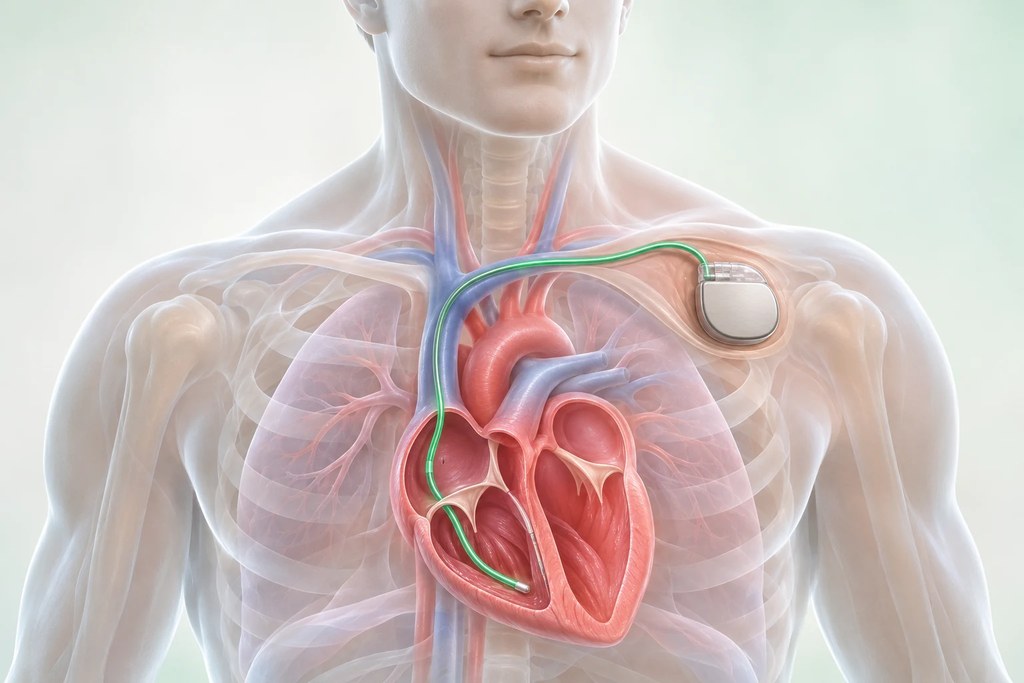
- Permanent pacemaker implantation, followed by echocardiography, pacemaker-recorded data and clinical review up to three years.
What this evidence cannot establish
- Memorial Bahçelievler Hospital appears only as an author affiliation; the abstract does not say where the patients were treated.
- The study is retrospective and observational, so it shows associations in past records, not what a pacemaker will do for a new patient.
- The abstract does not state the pacing mode, and follow-up time is not given for every outcome.
Patient groups in the published study
65 patients · Published study group
Pacemaker for sick sinus syndrome
- Indication
- Sick sinus syndrome (SSS), a slow heart rhythm problem.
- Treatment
- Permanent pacemaker implantation.
65 adult patients with sick sinus syndrome.
These patients were followed for three years after implantation. Left ventricular ejection fraction fell from 57.2% to 54.3%. Left atrial diameter rose from 31.3 to 38.8 mm, left ventricular end-diastolic diameter rose from 45.2 to 51.0 mm, and mitral regurgitation prevalence rose from 26.2% to 64.6%.
A permanent pacemaker was implanted. The treating hospital and pacing mode are not stated.
Left ventricular ejection fraction at 3 years (mean)
54.3 ± 8.3 %
65 patients · Study group
Plus/minus as reported by the source
3 years
New-onset atrial fibrillation
41.5%
65 patients · Study group
not stated
Rehospitalization
50.8%
65 patients · Study group
not stated
All-cause mortality
13.8%
65 patients · Study group
not stated
Mitral regurgitation prevalence at 3 years
64.6%
65 patients · Study group
3 years
Limits of this evidence
- Comparisons with the atrioventricular block group are group-level only.
- Follow-up time for new-onset atrial fibrillation (41.5%), rehospitalization (50.8%) and all-cause mortality (13.8%) is not stated.
For a clinic assessment
- Recent echocardiogram report and ECG or rhythm monitoring results
- List of current medicines, including any beta-blocker, and prior heart history
127 patients · Published study group
Pacemaker for atrioventricular block
- Indication
- Atrioventricular block (AVB), a problem with electrical signals passing between the upper and lower heart chambers.
- Treatment
- Permanent pacemaker implantation.
127 adult patients with atrioventricular block.
These patients were followed for three years after implantation. Left ventricular ejection fraction fell from 55.5% to 53.0%, while chamber dimensions stayed stable despite a high ventricular pacing burden (above 90%). Symptomatic improvement was 83.5%, rehospitalization 58.3% and all-cause mortality 11.8%.
A permanent pacemaker was implanted. The treating hospital and pacing mode are not stated.
Symptomatic improvement
83.5%
127 patients · Study group
not stated
Rehospitalization
58.3%
127 patients · Study group
not stated
All-cause mortality
11.8%
127 patients · Study group
not stated
Limits of this evidence
- The abstract gives no numeric values for chamber dimensions, only that they were stable.
- Mortality predictors in this group included coronary artery disease, beta-blocker therapy and left atrial volume, but the abstract gives no further detail.
For a clinic assessment
- Recent ECG and echocardiogram reports
- Records of coronary artery disease or other heart conditions and the current medicine list
Results and limits of the study
Both groups showed significant declines in left ventricular ejection fraction over three years (p < 0.001 in each). Symptomatic improvement was comparable (85.6% vs 83.5%, p=0.84), as were new-onset atrial fibrillation (41.5% vs 37.0%, p=0.54), rehospitalization (50.8% vs 58.3%, p=0.38) and all-cause mortality (13.8% vs 11.8%, p=0.69). Mortality predictors differed: mitral regurgitation severity in the sick sinus group, and coronary artery disease, beta-blocker therapy and left atrial volume in the atrioventricular block group.
Pacemaker for sick sinus syndrome: Left ventricular ejection fraction at 3 years (mean)
54.3 ± 8.3 %
65 patients · Study group
Plus/minus as reported by the source
3 years
Pacemaker for sick sinus syndrome: New-onset atrial fibrillation
41.5%
65 patients · Study group
not stated
Pacemaker for sick sinus syndrome: Rehospitalization
50.8%
65 patients · Study group
not stated
Pacemaker for sick sinus syndrome: All-cause mortality
13.8%
65 patients · Study group
not stated
Pacemaker for sick sinus syndrome: Mitral regurgitation prevalence at 3 years
64.6%
65 patients · Study group
3 years
Pacemaker for atrioventricular block: Symptomatic improvement
83.5%
127 patients · Study group
not stated
Pacemaker for atrioventricular block: Rehospitalization
58.3%
127 patients · Study group
not stated
Pacemaker for atrioventricular block: All-cause mortality
11.8%
127 patients · Study group
not stated
Risks reported by the source
- Left ventricular ejection fraction declined significantly over three years in both groups (57.2% to 54.3% in the sick sinus group and 55.5% to 53.0% in the atrioventricular block group, p< 0.001 in each).
- Mitral regurgitation prevalence in the sick sinus group rose from 26.2% to 64.6%.
- Left atrial diameter in the sick sinus group rose from 31.3 to 38.8 mm, and left ventricular end-diastolic diameter rose from 45.2 to 51.0 mm.
- New-onset atrial fibrillation occurred in 41.5% of the sick sinus group and 37.0% of the atrioventricular block group.
- Rehospitalization occurred in 50.8% of the sick sinus group and 58.3% of the atrioventricular block group.
- All-cause mortality was 13.8% in the sick sinus group and 11.8% in the atrioventricular block group.
Limitations and unknowns
- Where the patients were treated and by which surgeons.
- Which pacing mode was used.
- Follow-up time for several individual outcomes.
- How these group results apply to any single patient.
What to clarify in your treatment plan
Before booking, ask the clinic which pacing approach it would consider and which tests it would want first, such as an ECG and an echocardiogram. Ask how follow-up is organized after implantation and how the cause of your slow heart rhythm would shape that follow-up. Bring your existing medical records so the team can review them.
Memorial Bahçelievler Hospital: clinic profile
- Memorial Bahçelievler Hospital appears in the study as an author affiliation: Author 1, Haşim Tüner, lists Istanbul Arel University Memorial Bahcelievler Hospital.
- The abstract does not say where the patients were treated, and the first listed affiliation is Siyami Ersek Hospital.
- The clinic's profile is available on Bookimed.
Safety and recovery: general information
General patient guidance, provided separately from the case evidence. Follow your treating team's instructions.
Possible side effects
- Possible complications of pacemaker surgery may include abnormal heart rhythms, bleeding and infection. A punctured lung or a puncture of the heart can occur but are described as rare.
Ask the clinic how it prevents and monitors these complications.
- Pacemaker fitting is described as a common procedure where serious problems are unlikely, but an infection can sometimes occur afterwards.
Ask how wound care is handled and whom to call about the wound.
Recovery and aftercare
- Gentle arm movements can usually be done within the first few days, but full recovery may take a few weeks or months.
Ask the clinic for its own activity guidance for your situation.
- Many people with pacemakers can return to regular activities within a few days.
Confirm with the clinic what applies to you, including work and travel.
Suitability and cautions
- Pacemakers may be used for people whose heart beats too slowly, a condition called bradycardia. A leadless pacemaker may be offered for a slow heartbeat (bradyarrhythmia).
Only a cardiologist can say whether a pacemaker fits your case.
When to contact the clinic
- Contact the clinic or a doctor if the wound becomes more swollen, tender or red, if blood, pus or clear liquid leaks from it, if you have a very high temperature or feel hot, cold or shivery, or if earlier symptoms return or get worse.
Redness may be harder to see on brown or black skin.
- Seek urgent help for severe difficulty breathing, a tight or heavy chest, pain spreading to the arms, back, neck or jaw, very pale, blue or grey lips or skin, or sudden confusion.
Do not wait for a scheduled appointment if these occur.
How treatment at the clinic usually goes
| 1 | Send your recordsYou send your ECG and echocardiogram reports, your current medicine list and your heart history to the Bookimed coordinator. The coordinator passes them to Memorial Bahçelievler Hospital. |
|---|---|
| 2 | The clinic's planThe clinic's cardiologists review your records and say which extra tests they want and which treatment they would consider. They decide whether a pacemaker is appropriate for you. |
| 3 | TreatmentIf the doctors recommend a procedure, they explain it to you and agree the date with you through the coordinator. The pacing approach and the details of the procedure come from the clinic. |
| 4 | Hospital stayThe clinic monitors your recovery after the procedure and explains wound care, arm movement and what to avoid. It tells you when you can leave and travel. |
| 5 | Follow-up at homeYou keep up the device checks and echocardiograms the clinic recommends. The study suggests follow-up should fit the cause of the slow heart rhythm, so share the results with your home cardiologist. |
Price in the clinic's Bookimed offers
Historical quotation
$22,500
Based on 1 documented case. This is not a current clinic quotation.
Package prices from the clinic's offers in the Bookimed catalog for this procedure. Your own price depends on the clinic's review of your medical records.
Included
- catheter ablation using the method of three-dimensional electroanatomic mapping
Not confirmed
- The final price for your plan is confirmed in the clinic's written quotation.
What to ask Memorial Bahçelievler Hospital
- Is my slow heart rhythm caused by sick sinus syndrome or atrioventricular block, and how does that change your follow-up plan?
- Which pacing mode would you consider for me, and why?
- Which tests do you want before deciding, such as an ECG and an echocardiogram?
- How often will you check my left ventricular ejection fraction and heart chamber size after implantation?
- How will you monitor me for new atrial fibrillation, and what happens if it appears?
- How do my beta-blocker, coronary artery disease or mitral regurgitation affect your plan?
- How do you handle wound care and infection warning signs, and who do I call from abroad?
- How will you share my device data and reports with my cardiologist at home?
Request a personal plan from the clinic
Ask Memorial Bahçelievler Hospital about pacemaker evaluation and follow-up for slow heart rhythm
Send your records to the Bookimed coordinator, who passes them to the clinic and asks which tests and follow-up plan it would suggest. The clinic's doctors decide whether a pacemaker is appropriate.
Ask the clinic for a current, itemized quotation. Published evidence does not establish package inclusions or a current price.
Frequently asked questions
Who ran this study and where were the patients treated?
The abstract does not say where the patients were treated. Author 1, Haşim Tüner, lists Istanbul Arel University Memorial Bahcelievler Hospital, but the first listed affiliation is Siyami Ersek Hospital. Memorial Bahçelievler Hospital therefore appears here only as an author affiliation, and the study patients should not be assumed to have been treated there. Bookimed did not run the study and only summarizes the published abstract.
Did symptoms improve after a pacemaker in this study?
Yes, most patients reported symptomatic improvement in both groups. It was 85.6% in the sick sinus syndrome group and 83.5% in the atrioventricular block group, and the difference was not significant (p=0.84). These are group results from a retrospective study. They are not a promise or forecast of how any individual patient will respond.
How did the two groups differ after three years?
Their heart structure changed differently. In the sick sinus group, left atrial diameter, left ventricular end-diastolic diameter and mitral regurgitation prevalence increased significantly. The atrioventricular block group kept stable chamber dimensions despite a ventricular pacing burden above 90%. Both groups had a significant decline in left ventricular ejection fraction. Rehospitalization and all-cause mortality were similar between groups.
Does this study show a pacemaker is right for me?
No, the study cannot tell you that. It describes outcomes in 192 adults grouped by the cause of their slow heart rhythm, and the authors suggest follow-up tailored to that cause. Whether a pacemaker suits you depends on your own tests and a cardiologist's assessment. Use the study as background for questions to ask the clinic, not as a prediction.
How common was new atrial fibrillation after a pacemaker in this study?
New-onset atrial fibrillation was reported in 41.5% of the sick sinus group and 37.0% of the atrioventricular block group, and the difference was not significant (p=0.54). The abstract does not state the follow-up time for this outcome. Ask Memorial Bahçelievler Hospital how it would watch for rhythm changes in your case.
What did the study report about deaths and what predicted them?
All-cause mortality was 13.8% in the sick sinus group and 11.8% in the atrioventricular block group (p=0.69). Predictors differed: mitral regurgitation severity in the first group, and coronary artery disease, beta-blocker therapy and left atrial volume in the second. Ask Memorial Bahçelievler Hospital how your own heart history would be weighed.
How often were patients readmitted to hospital in the study?
Rehospitalization was 50.8% in the sick sinus group and 58.3% in the atrioventricular block group, and the difference was not significant (p=0.38). The abstract does not give the follow-up time or the reasons for readmission. Ask Memorial Bahçelievler Hospital what follow-up it plans so that problems are caught early.
Did the heart's pumping strength change after the pacemaker?
Left ventricular ejection fraction declined significantly in both groups over three years (p< 0.001 in each). In the sick sinus group it went from 57.2% to 54.3%, and in the atrioventricular block group from 55.5% to 53.0%. Ask Memorial Bahçelievler Hospital how often it would repeat an echocardiogram to follow this.
What heart rhythm treatment does Memorial Bahçelievler Hospital list on Bookimed?
The clinic's catalog lists catheter ablation using three-dimensional electroanatomic mapping, with Yasin Cakilli named as the doctor. That is a different treatment from a pacemaker, and the study does not cover it. Ask the coordinator for the current price and whether it could apply to your rhythm problem.
Which records should I send to the coordinator before asking Memorial Bahçelievler Hospital?
Send your recent ECG or rhythm monitoring results and your latest echocardiogram report. Add a list of current medicines, including any beta-blocker, and records of coronary artery disease or other heart conditions. With these, the doctors at Memorial Bahçelievler Hospital can review your case and say which tests and follow-up plan they would suggest.
Sources and scope
This page was prepared from the published abstract of the study and its structured numbers, with safety information paraphrased from the cited public health sources. Bookimed did not conduct the study.
- 1. Polat et al. – Clinical Outcomes Following PM Implantation: A 3-Year Comparative Study of Sick Sinus Syndrome and Atrioventricular Block.
Retrospective observational comparative study · 2026
192 adults with a pacemaker: 65 with sick sinus syndrome and 127 with atrioventricular block.
Follow-up: Three years, with assessments at baseline, one month, six months, one year and three years
Only the abstract was used, so details on pacing mode, treating hospital and some follow-up times are not available.
- 2. MedlinePlus (U.S. National Library of Medicine)
- 3. NHS
- 4. NHLBI, NIH
- 5. Memorial Bahçelievler Hospital on Bookimed
Scope and limitations
- A research summary is not an individual medical recommendation.
- Group results describe the study participants, not a forecast for any one patient.
Related procedures
About the editorial team
Prepared by
Bookimed editorial teamFacts checked by the Bookimed editorial team based on scientific sources
Bookimed prepares evidence summaries from published medical sources and anonymized care records. The clinic and any doctors named on this page are identified separately in their own sections.