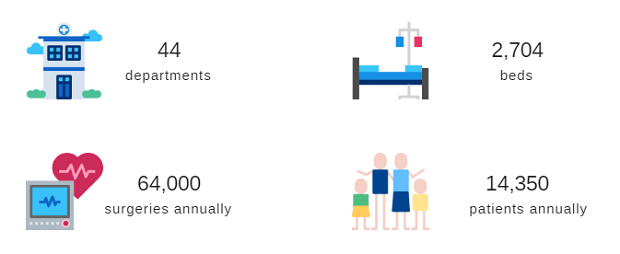
Asan Hospital was opened in 1989. It consists of specialized 44 departments, the Organ Transplant Center, Heart Institute, Cancer Institute, and Children's Hospital.
The medical center is located in Seoul, a 5-minute walk from the Olympic Park. Incheon International Airport is 70 km away from Asan.
Advantages of Asan Medical Center
- No.1 hospital regarding organ transplant in South Korea. Asan Hospital is the leading center for kidney, liver, pancreas, and heart transplants according to KONOS, Korean Network for Organ Sharing. The leadership of the hospital is explained by the organ transplant number and high success rate.
- No.1 hospital in South Korea regarding the number of operations for 30 common diseases, 6 types of cancer and organ transplants.
- Innovative medical equipment. Asan Hospital is equipped with the latest medical devices — MRI, CT, and PET-CT for accurate diagnostics, Da Vinci robotic system for sparing surgery through incisions up to 1 cm, GammaKnife to destroy tumors without surgery.
- International Department. Each patient has a personal coordinator who will arrange a transfer, a consultation with a doctor; accompany you during the diagnostic and treatment procedures.
Asan in figures
Asan surgeons are specialists in the kidney, liver, pancreas, heart, lung, and cornea transplants.
8 teams of doctors are responsible for the transplantation of a particular organ. The teams consist of specialists in internal medicine, pediatricians, surgeons, anesthesiologists, transplantologists, assistant surgeons, and nurses.
The doctors of the center were the 1st in South Korea to perform the following operations:
- pancreatic and kidney transplantation (1992)
- kidney and liver transplant (1999)
- heart and kidney transplantation (2005)
- transplant of the pancreas part and kidney from a living donor (2006)
- heart and liver transplantation (2007)
- liver and lung transplantation
- liver, heart and lung transplantation during one operation (2015).
Liver Transplant Center
Asan Liver Transplant Center is one of the best in South Korea according to the number and success rate of the performed operations.
Among the achievements of Liver Transplant Center’s doctors are:
- the 1st donor liver transplant to a child in South Korea (1994)
- the 1st transplant of a liver part from a living donor in South Korea (1994)
- the 1st liver transplant from a living donor (2000).
Liver transplant success rate at Asan
98% is a success rate of liver transplant at Asan. This means that the organ has replanted and the patient’s health condition is stable for 1 year after the surgery.
For comparison, the average success rate of transplants in Korean hospitals is 84% according to the Korea Network for Organ Exchange (Korea Network For Organ Sharing — KONOS). The average success rate in the world is 88% according to the United Network for Organ Sharing (UNOS).
The Heart Institute was founded in 1989. Nowadays, it consists of 3 specialized departments: cardiology, cardiac and vascular surgery.
Achievements of Asan doctors:
- the 1st mitral balloon valvuloplasty (a method to treat constricted heart valves) in South Korea (1989)
- the 1st coronary artery stenting in South Korea (1991)
- the 1st operation to install a bioresorbable coronary stent in South Korea (2015).
Operations and procedures
- Percutaneous coronary intervention (PCI) is a minimally invasive procedure that is performed through a small puncture in the skin. It is indicated for patients with angina pectoris and ischemic heart disease. Every year, Asan cardiologists conduct 2,000 PCIs.
- Transcatheter aortic valve replacement (TAVR). This is a procedure to replace the affected heart valve using a catheter (thin tube) inserted through the vessels. The success of the procedure is 98% at Asan.
- Coronary artery bypass surgery. During the operation, doctors sew a vessel around the affected artery. This allows the heart pumping blood without in a normal way. As a result, a patient gets rid of chest pains. Every year, doctors perform 300 coronary artery bypass surgeries.
- Heart transplantation. 45% of all heart transplants in South Korea are performed by Asan surgeons. They have conducted more than 600 successful heart transplants.

Operation at Asan, South Korea
The Cancer Institute includes 15 specialized centers. The largest ones are the Blood Cancer and Bone Marrow Transplantation Center, the Lung Cancer Department, and the Breast Cancer Department.
Oncologists in Asan Hospital specialize in the treatment of lung, stomach, intestines, lymphatic system, pancreas, liver, head and neck cancers.
When a tumor type is determined, doctors prescribe chemotherapy and/or targeted therapy. Targeted drugs destroy only malignant cells without affecting healthy ones. A patient avoids side effects such as stomach ache, hair and nail loss.
Radiation therapy is performed at Radiation Oncology Center. It is prescribed as a separate method of treatment or in combination with chemotherapy.
Statistics
- 1,500 laparoscopic (through small incisions) tumor removals per year
- 1,900 surgeries in case of gastric cancer annually
- 95% is a success rate of laparoscopic interventions on the stomach
- 2,500 patients with bowel cancer are treated annually
- 2,000 surgeries for patients with breast cancer every year. In 70% of cases, the breast is preserved. In other cases, doctors perform an organ reconstruction using implants.

Surgical intervention at Asan, South Korea
Services for international patients at Asan
International Center
There is the International Center on Asan premises. A coordinator will accompany you at all stages of diagnosis and treatment.
Transfer
Asan Medical Center offers patients a free airport-clinic transfer.
Accommodation
Patients stay in 1-, 2-bed wards.
Infrastructure
Asan Medical Center covers 85,000 m² area. There are a supermarket, restaurants, a concert hall, bookstores, and flower shops on the territory.



 The clinic is not accepting new requests
 Average answering time – 5 minutes
