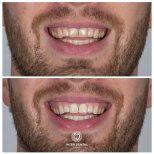
Why UK and US Patients Travel to Turkey for Teeth Whitening: The 6% Peroxide Law
Teeth whitening in Turkey uses gel that's legally far stronger than anything a UK dentist can apply. That single difference, not just the lower price, is the real reason patients fly in for a brighter smile.
In the UK, the rules are strict. The Dentists Act 1984 and EU cosmetic-product law cap whitening products sold over the counter at 0.1% hydrogen peroxide. Even a registered dental professional can't legally apply more than 6% hydrogen peroxide for cosmetic whitening. Anything above that ceiling is prohibited, according to the British Dental Association.
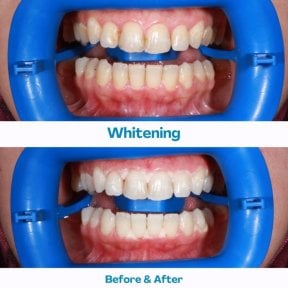
Turkish clinics work under different rules. They're allowed to use high-concentration clinical gels, typically 25% to 40% hydrogen peroxide, applied with a protective resin barrier over your gums. The ADA confirms that professional-strength agents consistently outperform home products. Home kits, by comparison, sit at just 3% to 7.5%.
The bottom line: 6% maximum in the UK versus 25–40% in Turkey. A single supervised 30 to 60 minute session at that strength removes stains far more powerfully. The protective gum barrier is standard, so higher strength doesn't mean a higher-risk visit.
Prices help too. In our work matching UK and US patients with Turkish clinics, professional teeth bleaching here usually runs around $300 to $350. That's roughly half the US range of around $600 to $1,200, and below the UK range of around $500 to $1,200. Bookimed lists current offers from verified clinics in one place.
In-Office vs At-Home vs OTC Whitening: The Clinical Numbers
Maybe you're weighing a Turkish clinic against the strips in your bathroom drawer. The gap is clearest in plain numbers. Dentists measure color change with a value called Delta E, written ΔE. A higher ΔE simply means your teeth shifted further toward white, which makes it the clearest yardstick for comparing methods.
| Method | Concentration | Color shift (ΔE) | Shades brighter |
|---|
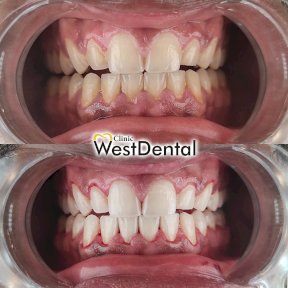
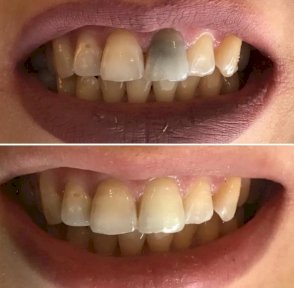
| In-office (clinic) | 35 to 40% hydrogen peroxide | ΔE ≈ 3.3 | 5 to 8 shades, one session |
| Dentist take-home trays | 10 to 16% carbamide peroxide | ΔE ≈ 2.0 | 3 to 5 shades, 1 to 2 weeks |
| OTC strips and gels | 3 to 7.5% hydrogen peroxide | lowest | 2 to 5 shades, 2 to 4 weeks |
The contrast holds up in the lab. A peer-reviewed lab study found that low-strength over-the-counter agents whiten far less than professional ones. Concentration and formula drive the color change you can actually see.
There's a deeper reason in-office wins. Strips work mainly on surface stains. High-concentration gel penetrates deeper enamel and breaks down the intrinsic stains left by coffee, tea, red wine, and aging.
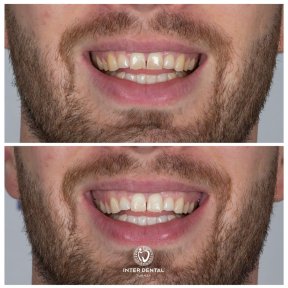
Patients notice the difference. A YEG Clinic patient put it simply: "my teeth are now 2 to 3 shades lighter, noticeable yet natural" (a Czech patient, 5/5). Across Bookimed's Turkish whitening clinics, patients give an average rating of 4.6/5, according to verified Bookimed reviews.
Laser and LED Whitening: What Clinical Evidence Shows
Many clinics advertise laser or LED light as the upgrade that makes teeth whiter. The clinical evidence tells a calmer story, and knowing it can save you money.
Most light and laser systems add no real long-term whitening over the gel alone, according to the American Dental Association. The bright "wow" effect right after a laser session is largely temporary dehydration. Heat draws moisture out of the enamel, so teeth look lighter briefly. The true color change from oxidation only becomes clear 2 to 6 weeks later.
Light and laser also raise the temperature inside the tooth, which can increase sensitivity afterward. However, cold-light LED systems such as BEYOND limit that heat. Either way, gel strength and the dentist's technique, not the lamp, drive your final result. Paying a large premium for laser activation adds little lasting color.
Sensitivity is the most common side effect, and it's usually mild and short-lived. The Cleveland Clinic confirms whitening is safe under professional supervision. Most tingling settles within 1 to 3 days.
Ask your clinic upfront whether they apply remineralizing agents:
- Potassium nitrate – a mineral salt that calms nerve sensitivity.
- CPP-ACP – a milk-derived calcium paste that helps enamel recover.
Among Bookimed partner clinics, LED-based whitening is available at SUAVE Dental Clinic, WestDent Clinic, and Hospitadent. Standalone laser whitening in Turkey runs around $100 to $300, against roughly $600 to $1,200 in the US. You can review options for the laser teeth whitening in Turkey on the Bookimed website.
Whitening Before Crowns or Veneers: The Correct Sequence
This is the question that trips up the most patients, especially anyone planning a fuller smile makeover in Turkey. The order of treatment matters, and getting it wrong means paying twice.
What whitening gel can and cannot change
Whitening gel only works on natural teeth. Hydrogen peroxide lightens teeth by oxidizing the organic pigments trapped inside porous natural enamel, according to Johns Hopkins Medicine. It has zero effect on man-made dental materials. Porcelain crowns, ceramic or zirconia veneers, and composite fillings won't budge a single shade.
The golden rule: whiten your natural teeth first, then place or replace restorations to match the new, brighter shade.
The 7–14 day window before restorations
There's a built-in pause in the correct sequence:
- Whiten the natural teeth to your target shade.
- Wait 7 to 14 days for the color to settle.
- Then cement the crowns, veneers, or bonding.
That 7 to 14 day wait isn't optional. Fresh whitening leaves residual oxygen in the enamel that temporarily weakens how well bonding glue grips. A PubMed study confirms that bond strength recovers once the oxygen clears over 7 to 14 days. Skip the wait and your new veneers may not hold. Not a small repair.
Already have crowns or veneers?
Already have restorations and want a brighter smile? Whitening alone won't help, since it can't lighten the man-made material. The ADA's guidance is to whiten the natural teeth first, then replace the existing crowns or veneers to match the new shade. One practical tip: avoid abrasive whitening toothpastes on porcelain, as the gritty particles scratch the glaze and make it pick up stains faster.
Whitening plus veneers is one of the most common combinations Turkish patients book, so plan it in order.
Veneers in Turkey run around $350 to $650, with zirconia around $400 to $700 and Emax around $450 to $750, according to Bookimed pricing data. The US range is roughly $1,200 to $2,400. The Bahçeşehir University Dental Hospital lists a whitening package for about $350. It bundles scaling, polishing, a panoramic X-ray, and clinic transfer. A clean way to whiten before any restoration work. To plan the second stage, see veneers in Turkey.
How to Verify a Turkish Dental Clinic Before You Book
Choosing a clinic from abroad feels daunting, but the legal checks are now clear. Two requirements are non-negotiable, and both are quick to verify.
Mandatory checks (legal authorization)
Since April 2025, any clinic treating international patients must be registered on the HealthTürkiye portal, the Turkish Ministry of Health's official digital register. If a clinic isn't listed there, it isn't legally authorized to treat foreign patients. The same law requires these clinics to carry complication insurance, a formal financial safety net rather than a verbal promise.
Certification and credentials to request
A few credentials signal a serious clinic. TUSKA accreditation comes from Turkey's national health-quality body, which reviews clinical outcomes, complaint rates, and patient satisfaction. It becomes mandatory for all international-patient facilities by the end of 2026. Your treating dentist should be registered with the Turkish Dental Association, the body that enforces professional ethics and training. ISO 9001 and JCI marks add an extra layer of quality and patient-safety assurance where available.
Who should consult a dentist first
Whitening isn't the right first step for everyone. The following patients should consult a dentist first:
- Patients under 16.
- Those who are pregnant or breastfeeding.
- Anyone with untreated decay, active gum disease, or significantly worn enamel.
Whitening works best on healthy teeth, and treating the underlying issue first usually delivers the same bright result safely. Ask about candidacy during your consultation.
Red flags to watch for
- No written, itemized treatment plan before you travel.
- Refusal to name the exact whitening material brand and its origin.
- High-pressure demands for a deposit before any clinical consultation.
- Prices far below the normal Turkish market average.
- No clear aftercare plan in writing for issues that arise after you fly home.
This is the work Bookimed does for you. Our team pre-screens every partner clinic for authorization and accreditation before listing it, so you compare verified options in one place. Clinics that skip the HealthTürkiye step never make our list. Across the network of 120+ verified Turkish dental clinics, patients rate their coordinators 4.8/5. Accredited partners include:
- WestDent Clinic – ISO 9001 and Turkish Medical Association, rated 4.8/5 across 150+ reviews.
- KLİNİKEN – BQDC, AAED, and AAID member, official Straumann and Ivoclar Vivadent provider.
- Hospitadent Dental Group – TEMOS and ISO accredited, serving 100,000 patients a year.
Takeaways
- Turkey allows clinical gels at 25 to 40% hydrogen peroxide, versus a 6% legal cap in the UK.
- In-office whitening brightens teeth by 5 to 8 shades in one session – compared to 2 to 5 shades with strips.
- Laser and LED add little lasting color, so gel strength and dentist technique decide your result.
- Whiten natural teeth first, wait 7 to 14 days, then place crowns or veneers to match.
- Confirm HealthTürkiye registration and complication insurance, both mandatory since April 2025.