Medical disclaimer
TAVR, Open Surgery or Medication for Aortic Stenosis With Cardiogenic Shock
10 min read
Prepared by Bookimed editorial team
Facts checked by the Bookimed editorial team based on scientific sources

Share with AI


The named clinic is an author affiliation. The study patients were not established as patients treated at that clinic.
Key takeaways
- The study followed 431 adults with severe aortic stenosis and cardiogenic shock, treated between 2016 and 2022 at tertiary care hospitals.
- In-hospital mortality was 20.6% with TAVR, 32.8% with surgical valve replacement and 60.8% with medication only.
- The authors report that TAVR was associated with a lower mortality risk than surgery or medication.
- Acute kidney injury, need for a pacemaker and mechanical circulatory support were each linked to worse prognosis.
- These are group results from a retrospective study and do not predict any individual patient's outcome.
The question this study addresses
Researchers reviewed records of 431 adults admitted with severe aortic stenosis (a narrowed aortic valve) and cardiogenic shock (the heart cannot pump enough blood) at tertiary care hospitals with a cardiovascular surgery department. They compared in-hospital mortality across three groups: TAVR, surgical aortic valve replacement (SAVR) and medical treatment (MT). Quironsalud Madrid appears only as the affiliation of a first author. The abstract does not say which hospitals treated the patients, so the patients are not shown to have been treated at the clinic.
- The situation
- Adults with severe aortic stenosis who were in cardiogenic shock when admitted to hospital.
- The treatment
- TAVR (107 patients), SAVR (64 patients) or medical treatment without valve replacement (260 patients), with in-hospital mortality as the main outcome.
What this evidence cannot establish
- The study is retrospective and observational, so the groups may differ in ways the abstract does not describe.
- The abstract does not say which hospitals treated the patients, so the link to Quironsalud Madrid is an author affiliation only.
- Follow-up after discharge and complication rates by group are not stated.
Patient groups in the published study
107 patients · Published study group
Shock patients treated with TAVR
- Indication
- Severe aortic stenosis with cardiogenic shock
- Treatment
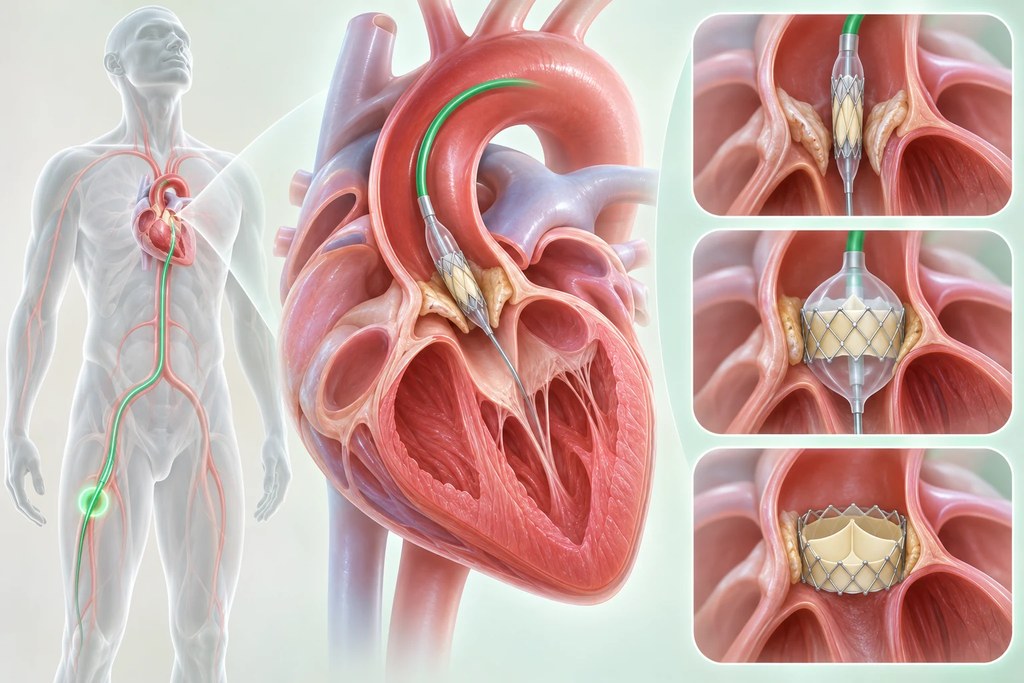
- Transcatheter aortic valve replacement (TAVR)
107 adults in the TAVR group
Adults with severe aortic stenosis who were in cardiogenic shock during a hospital admission.
A new valve placed through a catheter, without open-heart surgery.
In-hospital mortality
20.6%
107 patients · Study group
in-hospital
Reported risks
- Study-wide: acute kidney injury, need for pacemaker stimulation and mechanical circulatory support were independently linked to worse prognosis across all groups.
Limits of this evidence
- Follow-up after discharge and complication rates by group are not stated.
- Which hospitals treated these patients is not stated.
For a clinic assessment
- Recent heart imaging reports and the aortic stenosis diagnosis
- Discharge summaries from any recent admission for heart failure or shock
64 patients · Published study group
Shock patients treated with open-heart valve surgery
- Indication
- Severe aortic stenosis with cardiogenic shock
- Treatment
- Surgical aortic valve replacement (SAVR)
64 adults in the SAVR group
Adults with severe aortic stenosis who were in cardiogenic shock during a hospital admission.
Open-heart surgery to replace the aortic valve.
In-hospital mortality
32.8%
64 patients · Study group
in-hospital
Reported risks
- Study-wide: acute kidney injury, need for pacemaker stimulation and mechanical circulatory support were independently linked to worse prognosis across all groups.
Limits of this evidence
- Follow-up after discharge and complication rates by group are not stated.
- Which hospitals treated these patients is not stated.
For a clinic assessment
- Cardiology reports and imaging of the aortic valve
- List of current medications and prior heart procedures
260 patients · Published study group
Shock patients treated with medication only
- Indication
- Severe aortic stenosis with cardiogenic shock
- Treatment
- Medical treatment without valve replacement
260 adults in the medical treatment group
Adults with severe aortic stenosis who were in cardiogenic shock during a hospital admission.
Medical treatment without valve replacement.
In-hospital mortality
60.8%
260 patients · Study group
in-hospital
Reported risks
- Study-wide: acute kidney injury, need for pacemaker stimulation and mechanical circulatory support were independently linked to worse prognosis across all groups.
Limits of this evidence
- The specific medications used are not stated.
- Follow-up after discharge is not stated.
For a clinic assessment
- Current medication list and recent cardiology notes
- Reports explaining why valve replacement was or was not chosen
Results and limits of the study
Across all 431 patients, in-hospital mortality was 46.6%. It was 20.6% in the TAVR group, 32.8% in the SAVR group and 60.8% in the medical treatment group. In the multivariate analysis, TAVR (OR 0.14) and SAVR (OR 0.26) were each independently associated with a reduced risk of mortality. The authors conclude that TAVR was associated with a lower mortality risk than SAVR and medical treatment.
In-hospital mortality, all patients
46.6%
431 patients · Whole cohort
in-hospital
Risks reported by the source
- Acute kidney injury, need for pacemaker stimulation and mechanical circulatory support were independently associated with worse prognosis across the whole study.
Limitations and unknowns
- Outcomes after discharge are not stated.
- Complication rates for each group are not stated.
- Which hospitals treated the patients is not stated.
- How the groups differed at the start, and why each treatment was chosen, is not described in the abstract.
What to clarify in your treatment plan
Before booking, ask the clinic whether it treats patients in this situation and which team would assess the case. Clarify which records it needs, such as imaging and recent hospital reports. Ask how it would explain the options of TAVI, open surgery and medication for your own case.
Quironsalud Madrid: clinic profile
- Quironsalud Madrid appears in this study as an author affiliation: Hospital Universitario Quironsalud Madrid is listed for a first author.
- The abstract does not say where the patients were treated, so they are not shown to have been treated at the clinic.
- The clinic profile is available on Bookimed.
Safety and recovery: general information
General patient guidance, provided separately from the case evidence. Follow your treating team's instructions.
Possible side effects
- NHLBI, NIH lists risks of TAVR that can include bleeding where the catheters were inserted, injury to the kidneys or heart, a poorly fitting valve that leaks, need for a permanent pacemaker, and stroke.
Ask the care team which of these risks may apply to you.
- Coronary artery obstruction may occur after TAVR. NHLBI, NIH describes it as rare but life-threatening.
Ask how the team checks for this risk before the procedure.
Recovery and aftercare
- According to NHLBI, NIH, the hospital stay after TAVR may be short, depending on the approach used, and a return to daily activities such as exercise and driving may be possible within weeks.
Recovery in shock is not described in the study, so ask what to expect in your case.
Suitability and cautions
- NHLBI, NIH notes that if the femoral artery is too small or damaged, blood vessels in the chest may be used to guide the tube to the heart.
Ask whether your vessels affect the choice of approach.
- NHLBI, NIH says a healthcare provider may explain the risks and benefits of both TAVR and open-heart surgery.
Ask for a comparison of both options for your situation.
When to contact the clinic
- Bleeding or other problems where the catheters were inserted, or signs of kidney or heart injury, can be risks of TAVR.
Contact the treating team promptly if you notice such problems after a procedure.
How treatment at the clinic usually goes
| 1 | Send your records to the coordinatorYou share recent heart imaging reports, the aortic stenosis diagnosis, discharge summaries from any recent admission, and your current medication list with the Bookimed coordinator. |
|---|---|
| 2 | The clinic reviews your caseThe coordinator passes your records to Quironsalud Madrid and asks whether its team can review them. The clinic decides whether it can assess you and what it would propose. |
| 3 | Your personal planThe clinic explains which options it sees for your case, such as TAVR, open surgery or medication, and the risks and benefits of each. You can ask follow-up questions through the coordinator. |
| 4 | TreatmentIf you and the clinic agree on a plan, the team carries out the chosen treatment. The approach depends on your heart, your vessels and your condition on admission. |
| 5 | Hospital stayThe care team monitors you after treatment, including kidney function, heart rhythm and any need for circulatory support. The length of stay depends on the approach and on how you recover. |
| 6 | Follow-up at homeYou get discharge documents and a follow-up plan to share with your cardiologist at home. Contact the treating team if you notice bleeding or other problems after the procedure. |
What to ask Quironsalud Madrid
- Does your team treat patients with severe aortic stenosis and cardiogenic shock, and which specialists would assess my case?
- Were the patients in the published study treated at your hospital, or is the link only an author affiliation?
- Which records do you need from me to review my case, and in what form?
- How would you decide between TAVR, open surgery and medication for me, and what are the risks of each in my situation?
- How do you check for kidney injury, the need for a pacemaker and the need for mechanical circulatory support, which the study linked to worse prognosis?
- Do my blood vessels affect which TAVR approach you could use?
- What would the hospital stay and monitoring look like for my case?
- What follow-up do you recommend once I am back home, and who should I contact if problems appear?
Request a personal plan from the clinic
Bookimed has no published package for this treatment at this clinic yet. A Bookimed coordinator can request a personal treatment plan and price from the clinic.
Bookimed coordinators can pass your medical records to the clinic and ask whether its team can review your case. The clinic decides on any treatment.
Ask the clinic for a current, itemized quotation. Published evidence does not establish package inclusions or a current price.
Frequently asked questions
Who ran this study and where were the patients treated?
The abstract does not say where the patients were treated. It describes a retrospective multicentre study of tertiary care hospitals with a cardiovascular surgery department. Quironsalud Madrid appears only because Hospital Universitario Quironsalud Madrid is listed as the affiliation of a first author. Bookimed did not run the study, and the patients are not shown to have been treated at the clinic.
Did TAVR lead to lower mortality than surgery in this study?
Yes, in-hospital mortality was lower with TAVR. It was 20.6% in the TAVR group, 32.8% in the SAVR group and 60.8% in the medical treatment group. The authors describe this as an association in a retrospective study. These are group results and do not forecast what would happen to any one patient.
Which factors were linked to worse outcomes?
Three factors were independently linked to worse prognosis: acute kidney injury, need for pacemaker stimulation and mechanical circulatory support. The abstract reports these across the whole study, not for each treatment group separately. Complication rates by group are not stated, so ask the treating team how these factors could apply to you.
How many patients were included and when?
The study included 431 adults treated between 2016 and 2022: 107 in the TAVR group, 64 in the SAVR group and 260 in the medical treatment group. Overall in-hospital mortality was 46.6%. Follow-up after discharge is not stated in the abstract.
What is cardiogenic shock in this study?
In this study, cardiogenic shock means the heart cannot pump enough blood. The researchers looked at adults who had severe aortic stenosis, a narrowed aortic valve, and were in shock when admitted to hospital. If you are asking Quironsalud Madrid about a similar situation, it is the clinic's team that judges your own case.
What kind of study is this?
This is a retrospective observational study. It included patients aged 18 or older with severe aortic stenosis and cardiogenic shock, admitted to tertiary hospitals with a cardiovascular surgery department between 2016 and 2022. Patients were grouped by whether they received TAVR, surgical valve replacement (SAVR) or medical treatment.
Source: Ferrera et al., PubMed 40784369
What did the study measure?
The main outcome was in-hospital mortality, the share of patients who died during the same hospital stay.
Source: Ferrera et al., PubMed 40784369
Did every patient have valve surgery?
No. Of 431 patients, 107 (24.8%) had TAVR, 64 (14.8%) had SAVR and 260 (60.3%) received medical treatment only. Overall in-hospital mortality was 46.6%.
Source: Ferrera et al., PubMed 40784369
Which factors were linked to a higher risk of death?
Acute kidney injury, the need for pacemaker stimulation and the use of mechanical circulatory support were each independently associated with a worse prognosis in this study.
Source: Ferrera et al., PubMed 40784369
Can these results predict my own outcome?
No. The study reports associations in a retrospective group of patients. Treatment was not randomly assigned, so the groups may differ in their condition before treatment. Your own risk needs to be assessed by your cardiology team.
Source: Ferrera et al., PubMed 40784369
Sources and scope
This page was prepared from the published abstract and a structured summary of its reported numbers. Safety information paraphrases NHLBI, NIH sources, and Bookimed did not run the study.
- 1. Ferrera et al. – Treatment of severe aortic stenosis and cardiogenic shock: outcomes of TAVR vs SAVR and medical therapy.
Retrospective observational multicentre study · 2025
431 adults with severe aortic stenosis and cardiogenic shock admitted to tertiary care hospitals, 2016 to 2022
Follow-up: In-hospital only; follow-up after discharge is not stated in the abstract
Only the abstract was used, so details on patient selection, hospitals, medications and later follow-up are missing.
- 2. NHLBI, NIH
- 3. Quironsalud Madrid on Bookimed
Scope and limitations
- A research summary is not an individual medical recommendation.
- Group results describe the study participants, not a forecast for any one patient.
Related procedures
About the editorial team
Prepared by
Bookimed editorial teamFacts checked by the Bookimed editorial team based on scientific sources
Bookimed prepares evidence summaries from published medical sources and anonymized care records. The clinic and any doctors named on this page are identified separately in their own sections.