Medical disclaimer
Stent Graft Repair of Penetrating Aortic Ulcers at Vienna General Hospital
11 min read
Prepared by Bookimed editorial team
Facts checked by the Bookimed editorial team based on scientific sources

Share with AI


The source identifies treatment at the named clinic. Study results describe this cohort, not a predicted individual outcome.
Key takeaways
- The study followed 40 patients with a complicated, nonacute penetrating aortic ulcer (PAU) in the thoracic aorta: 21 had tubular repair and 19 had scalloped repair.
- Clinical success was reached in all 40 patients (100%).
- Reintervention was needed in 2 of 21 patients in the tubular group and 1 of 19 in the scalloped group.
- One aortic-related death, from the abdominal aorta, occurred in the scalloped group.
- Mean follow-up was 63 months for tubular repair and 53 months for scalloped repair. These are group results, not a forecast for any one patient.
The question this study addresses
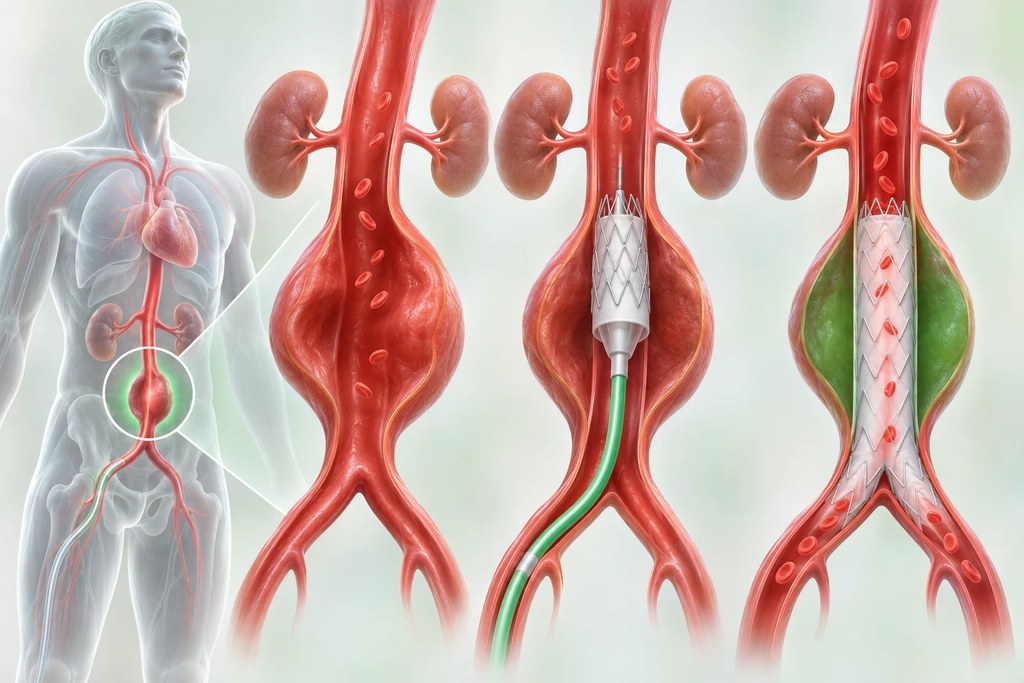
This single-center retrospective study looked back at patients with complicated, nonacute penetrating aortic ulcers who had thoracic endovascular aortic repair (TEVAR), a stent graft placed inside the aorta through blood vessels. It compared a standard tubular graft with a scalloped graft (scTEVAR), which has a notch at its upper end so the graft can seal closer to the heart. The authors reviewed 212 TEVAR procedures and included 21 tubular and 19 scalloped patients. Patient and ulcer characteristics were similar, but the landing zone, the aortic segment where the graft seals, was significantly more proximal in the scalloped group (p=0.0001). The patients were treated at Vienna General Hospital, Medical University of Vienna, the same hospital as this page's clinic.
- The situation
- Adults with a complicated, nonacute penetrating aortic ulcer of the thoracic aorta, some with ulcers closer to the heart.
- The treatment
- Thoracic endovascular aortic repair with a tubular stent graft, or with a scalloped stent graft (scTEVAR) that lengthens the proximal sealing zone.
What this evidence cannot establish
- This was a retrospective study at a single center, so it cannot show that one graft type is better than the other.
- The patients were treated at the same hospital as this page's clinic, so the page describes that team's own results and Bookimed did not run the study.
- The abstract does not give the years of treatment or the individual complication rates.
Patient groups in the published study
21 patients · Published study group
Penetrating aortic ulcer treated with a standard tubular stent graft
- Indication
- Complicated penetrating aortic ulcer (nonacute)
- Treatment
- Tubular thoracic endovascular aortic repair (TEVAR)
21 patients
Adults with a complicated, nonacute penetrating aortic ulcer in the thoracic aorta, treated at Vienna General Hospital.
A standard tubular stent graft placed inside the aorta through blood vessels. Mean follow-up was 63 months. Reintervention was needed in 2 of 21 patients.
Reintervention
2 / 219.5%
21 patients · Study group
mean 63 months
Limits of this evidence
- The abstract does not give mortality for this group separately or individual complication rates.
- The years of treatment are not stated.
For a clinic assessment
- Recent CT or other aortic imaging reports and images
- Current medication list and past vascular or heart surgery records
19 patients · Published study group
Penetrating aortic ulcer treated with a scalloped stent graft (more proximal ulcer)
- Indication
- Complicated penetrating aortic ulcer (nonacute) with a more proximal landing zone
- Treatment
- Scalloped TEVAR (scTEVAR)
19 patients
Adults with a complicated, nonacute penetrating aortic ulcer in a more proximal position, where the sealing zone had to start closer to the heart.
A scalloped stent graft, with a notch at its upper end to lengthen the proximal sealing zone. Mean follow-up was 53 months. Reintervention was needed in 1 of 19 patients, and 1 of 19 had an aortic-related death from the abdominal aorta.
Reintervention
1 / 195.3%
19 patients · Study group
mean 53 months
Aortic-related mortality (abdominal aortic)
1 / 19
19 patients · Study group
mean 53 months
Limits of this evidence
- The abstract does not give all-cause mortality for this group or individual complication rates.
- The years of treatment are not stated.
For a clinic assessment
- Recent CT or other aortic imaging reports and images
- Records of any earlier aortic or supra-aortic (neck vessel) procedures
Results and limits of the study
Clinical success was reached in all 40 patients (100%). Over mean follow-up of 63 months for tubular repair and 53 months for scalloped repair, clinical success stayed stable in all patients. The authors conclude that both approaches gave similar clinical success and aortic survival with acceptable complication and reintervention rates, and that scalloped repair safely lengthens the proximal sealing zone. These are results for the study groups, not a promise for any one patient.
Clinical success
40 / 40100%
40 patients · Whole cohort
mean 63 (TEVAR) and 53 (scTEVAR) months
Risks reported by the source
- Reintervention was needed in 2 of 21 patients in the tubular group and 1 of 19 in the scalloped group.
- One of 19 patients in the scalloped group had an aortic-related death, from the abdominal aorta.
Limitations and unknowns
- The abstract does not state the years in which patients were treated.
- Individual complication rates are not given in the abstract.
- All-cause mortality for the scalloped group, and mortality for the tubular group, are not given separately.
- It is unclear how these results apply to a patient whose ulcer, health, or anatomy differs from this group.
What to clarify in your treatment plan
Before booking, ask the clinic which graft type would be considered for your imaging, and who would review your scans. Ask what follow-up and imaging schedule it uses, and how repeat procedures are handled. Ask how the team would arrange care if you travel from abroad.
Vienna General Hospital (AKH): clinic profile
- The study patients were treated at Vienna General Hospital, Medical University of Vienna, the same hospital as this page's clinic, and the first author is affiliated with it.
- The Vienna General Hospital (AKH) profile is available on Bookimed.
Marek Ehrlich: doctor profile
- Marek Ehrlich is the ninth author of the study, listed with the Department of Cardiac Surgery, Medical University of Vienna.

Safety and recovery: general information
General patient guidance, provided separately from the case evidence. Follow your treating team's instructions.
Possible side effects
- Surgery has risks and side effects, which your doctor or surgeon should discuss with you.
Ask the team to go through the risks that apply to your own case before you decide.
When to contact the clinic
- Sudden, severe pain in your tummy or back, struggling to breathe, pale or grey skin, or loss of consciousness can be signs of an emergency; the NHS advises calling 999 in the UK.
Call your local emergency number right away rather than contacting the clinic first.
- Tummy or back pain that does not go away or keeps coming back, or a lump in your tummy, may need medical review; the NHS advises seeing a GP.
See a doctor promptly and tell them about your aortic condition and any earlier repair.
How treatment at the clinic usually goes
| 1 | Send your records to the coordinatorShare recent CT or other aortic imaging reports and images, your medication list and any past vascular or heart surgery records with the Bookimed coordinator, who passes them to Vienna General Hospital (AKH). |
|---|---|
| 2 | The clinic reviews your scansThe clinic's doctors look at your imaging and decide whether stent graft repair is relevant to you and which graft type, tubular or scalloped, they would consider. |
| 3 | Receive the treatment planThe coordinator sends you the clinic's plan and answers to your questions, so you can decide whether to travel. |
| 4 | Stent graft repairIf the team recommends it, the stent graft is placed inside the aorta through blood vessels (TEVAR or scalloped TEVAR). |
| 5 | Hospital stay and dischargeThe team monitors you in hospital and explains the follow-up and imaging schedule to use after you go home. |
| 6 | Follow-up at homeYou have check-ups and imaging at home as the clinic advises and stay in touch with the coordinator. Seek urgent care for sudden severe back or tummy pain. |
What to ask Vienna General Hospital (AKH)
- Based on my scans, would you consider a tubular or a scalloped stent graft, and why?
- Who at Vienna General Hospital (AKH) will review my imaging, and can I speak with that doctor before I travel?
- How many patients with a penetrating aortic ulcer like mine has your team treated with each graft type?
- What are the risks of this repair for my own anatomy and health, including repeat procedures?
- What follow-up visits and imaging do you advise, and how long should I stay in Vienna before flying home?
- If I need a repeat procedure after I go home, how would your team handle it?
- Do I need any neck-vessel (supra-aortic) procedure before or with the stent graft?
- Which records from my home doctors do you need, and can my local team share follow-up scans with you?
Ask Vienna General Hospital (AKH) for an opinion on stent graft repair of an aortic ulcer
Bookimed has no published package for this treatment at this clinic yet. A Bookimed coordinator can request a personal treatment plan and price from the clinic.
Bookimed can pass your imaging reports and questions to the clinic coordinator. The clinic's doctors then decide whether this kind of repair is relevant to you.
Ask the clinic for a current, itemized quotation. Published evidence does not establish package inclusions or a current price.
Frequently asked questions
Who ran this study and where were the patients treated?
The study was run by a team at Vienna General Hospital, Medical University of Vienna, and the patients were treated there. It was a single-center retrospective study, and the first author's affiliation is that hospital. No other treating hospital is named in the abstract. Bookimed did not run or fund the study. This page summarizes the published abstract and adds the clinic profile for readers who want to ask about this type of care.
Did the stent graft repair work for these patients?
Clinical success was reached in all 40 patients (100%), and it stayed stable over follow-up. Mean follow-up was 63 months for the tubular group and 53 months for the scalloped group. Reintervention was needed in 2 of 21 tubular patients and 1 of 19 scalloped patients. These are results for the study groups only and do not predict what would happen for you.
What is the difference between tubular and scalloped repair?
A tubular graft is a standard stent graft, while a scalloped graft (scTEVAR) has a notch at its upper end. According to the abstract, the scalloped graft lengthens the proximal sealing zone, so it can address ulcers closer to the heart. In this study the landing zone was significantly more proximal in the scalloped group (p=0.0001). The abstract does not say which graft suits an individual patient, which a treating team would decide.
Were there any deaths or repeat procedures in the study?
Yes, there was one aortic-related death, from the abdominal aorta, among the 19 scalloped patients. Reintervention, meaning a repeat procedure, was needed in 2 of 21 tubular patients and 1 of 19 scalloped patients. The abstract describes the complication rates as acceptable but does not give individual complication rates. Ask the clinic to explain the risks and the chance of repeat procedures for your own situation.
What is a penetrating aortic ulcer?
The abstract studies complicated, nonacute penetrating aortic ulcers (PAUs) in the thoracic aorta. Vienna General Hospital (AKH) treated these patients with stent grafts placed inside the aorta through blood vessels. The abstract does not give a full definition of the condition. The clinic's doctors can explain what a PAU means on your own imaging and whether it counts as complicated.
How many patients had a scalloped graft at Vienna General Hospital (AKH)?
Of 212 TEVAR procedures reviewed at Vienna General Hospital (AKH), the study included 40 patients: 21 with tubular TEVAR and 19 with scalloped TEVAR. Patient and ulcer characteristics were similar between the groups. The landing zone was significantly more proximal in the scalloped group (p=0.0001). These are group figures and do not say which graft would suit you.
How long were patients followed after repair at Vienna General Hospital (AKH)?
The study reports a mean follow-up of 63 months for tubular TEVAR and 53 months for scalloped TEVAR among patients treated at Vienna General Hospital (AKH). Over that time clinical success stayed stable in all patients. A mean is an average, so individual follow-up varied. Ask the clinic what follow-up schedule it would set for you.
Did patients at Vienna General Hospital (AKH) need extra procedures on the neck vessels?
The abstract says the tubular and scalloped groups had a similar number and types of supra-aortic revascularization procedures. These are procedures on the vessels that supply the head and arms. It does not give counts or say which patients needed them. Ask Vienna General Hospital (AKH) whether your anatomy would call for such a procedure.
Is the scalloped graft proven to be better than the tubular graft?
No. The Vienna General Hospital (AKH) study was retrospective and done at a single center, so it cannot show that one graft is better. The authors report similar clinical success in both groups and say the scalloped graft safely lengthens the proximal sealing zone for ulcers closer to the heart. The treating team chooses the graft for each patient.
What should I send to Vienna General Hospital (AKH) to get an opinion?
Bookimed can pass your records to the clinic coordinator at Vienna General Hospital (AKH). Useful items are recent CT or other aortic imaging reports and images, your current medication list, and records of past vascular or heart surgery. The clinic's doctors then decide whether this kind of repair is relevant to you.
Sources and scope
This page was prepared from the published abstract of the study and its extracted results, and it adds general NHS safety guidance. Bookimed did not run the study or review the full paper.
- 1. Kupferthaler et al. – Endovascular Repair of Penetrating Thoracic Aortic Ulcers Using Tubular Stent Grafts Versus Stent Grafts With a Proximal Scallop.
Retrospective single-center comparative cohort study · 2024
40 adults with a complicated, nonacute penetrating aortic ulcer of the thoracic aorta
Follow-up: Mean 63 months (tubular TEVAR) and 53 months (scTEVAR)
The abstract is a short summary of a retrospective single-center study and omits details such as treatment years and individual complication rates.
- 2. NHS
- 3. Vienna General Hospital (AKH) on Bookimed
- 4. Marek Ehrlich on Bookimed
Scope and limitations
- A research summary is not an individual medical recommendation.
- Group results describe the study participants, not a forecast for any one patient.
About the editorial team
Prepared by
Bookimed editorial teamFacts checked by the Bookimed editorial team based on scientific sources
Bookimed prepares evidence summaries from published medical sources and anonymized care records. The clinic and any doctors named on this page are identified separately in their own sections.