

Men facing intimate health challenges often struggle in silence, yet studies reveal these concerns are common. Around half of men aged 40 to 70 experience some degree of erectile dysfunction (ED), according to the Massachusetts Male Aging Study. And around 45% of all men feel insecure about their size. However, modern penile implants offer proven solutions with a satisfaction rate of over 90%, according to SMSNA.
Below, we answer the key questions: Which is the best penile implant for my situation? What brand to choose? What about enlargement options? We'll examine each option with clinical data to help you make an informed decision about this treatment.
Best implants by category:
- Best for ED: Three-piece inflatable penile prosthesis, with satisfaction rates over 90% for patients and partners.
- Best for enlargement: Dermal matrix or silicone implants.
- Best brands: AMS 700, Coloplast Titan, Rigicon, Peniflex, MegaDerm.
Key Takeaways
- Costs abroad. Turkey: $4,500–$7,500. Thailand: $3,000–$6,800. Mexico: $4,500–$8,000. US baseline: $20,000–$30,000.
- Top brands. AMS 700, Coloplast Titan, and Rigicon cover the full range of inflatable and malleable devices.
- Durability. Most implants keep working for 10–15 years before a replacement is considered.
Table of Contents
- Types of Penile Implants (and Which One’s the Best)
- Best Penile Implant Brands
- Selection Guide: Which Factors to Consider When Choosing a Penile Implant?
- Surgical Approaches and Recovery: What to Expect
- Where to Get the Best Penile Implant
- FAQ
Types of Penile Implants (and Which One’s the Best)
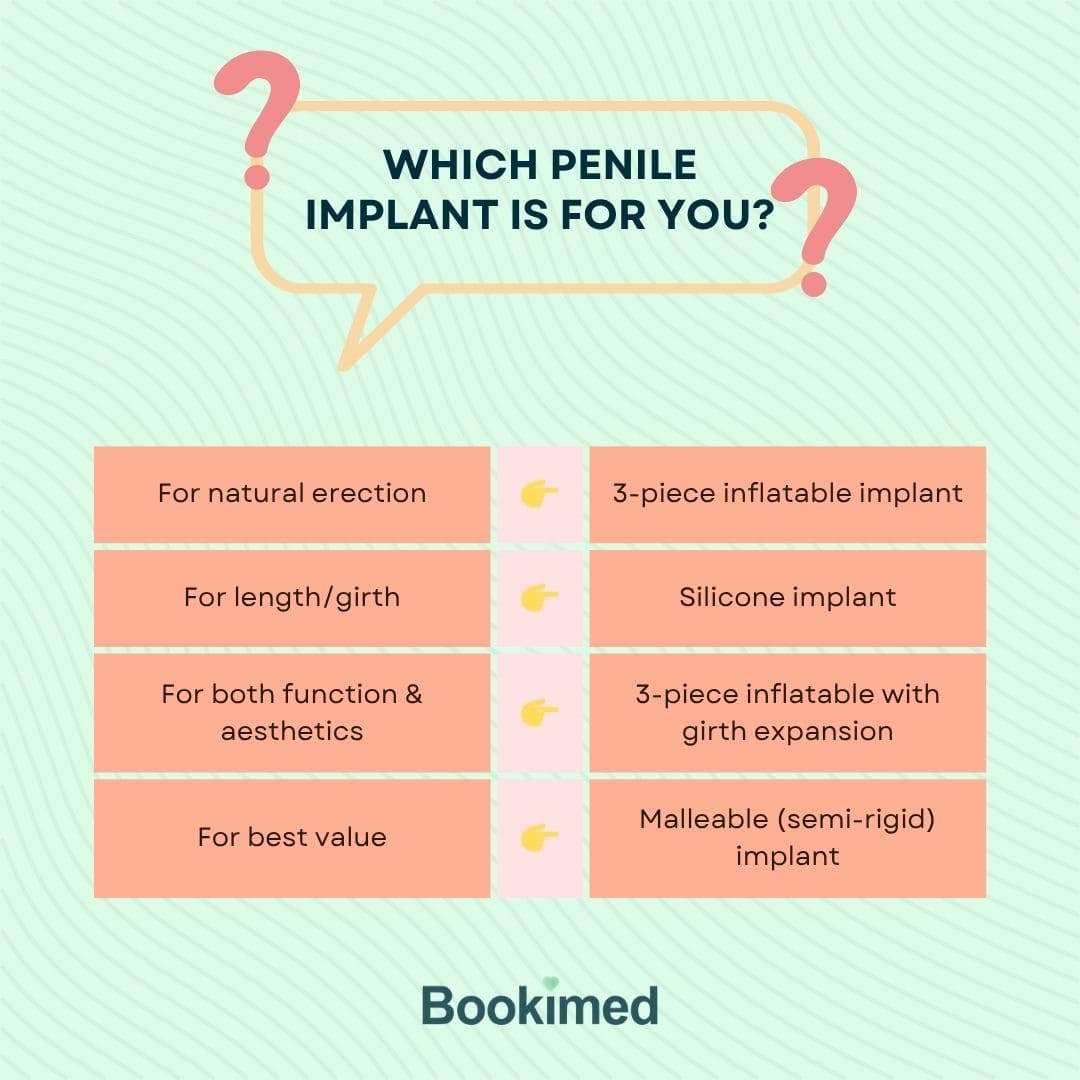
Penile implants fall into 3 main categories:
Inflatable penile implants
Inflatable implants are the reference standard for erectile dysfunction treatment. A pump moves fluid from a hidden reservoir into two cylinders inside the penis, creating an erection. They are available in two main configurations:
- Three-piece inflatable penile implants use separate cylinders implanted in the penis, a pump in the scrotum, and an abdominal reservoir for maximum natural feel and rigidity.
- Two-piece inflatable penile prostheses combine the pump and reservoir in the scrotum, offering simpler surgery but slightly less rigidity.
Key advantage: Provides full control and mimics a natural erection.
Satisfaction rate: over 90% for patients and partners, per SMSNA patient data.
Best for: Most men with ED seeking the most natural experience.
Malleable implants
Malleable penile implants consist of two semi-rigid rods inserted into the penis. They remain firm and can be positioned as needed for sexual activity.
Key advantages: Easy to use, less expensive, fewer mechanical failures.
Key limitation: Keeps the penis in a perpetually semi-erect state.
Satisfaction rate: 75%–88%.
Best for: Men with limited hand dexterity, multiple previous surgeries, or cost concerns.
Do inflatable or malleable implants increase size?
Yes, both types provide modest size increases:
- Inflatable penile prostheses increase length by about 0.2 inches (0.6 cm) and girth by 0.4 inches (1.7 cm). Specific implant models have length and girth expansion cylinders. They can expand girth by up to 0.8 inches (2 cm) and increase length by up to 25%.
- Malleable prostheses add around 0.3 inches (0.7 cm) in girth.
What an implant changes – and what it doesn’t
An implant restores mechanical rigidity – it does not change libido, skin sensation, or ejaculation. For most men, that is reassuring news: arousal and climax feel the way they did before surgery, and the device simply makes erections reliable again.
One nuance worth discussing at the consultation: the cylinders firm the shaft, not the glans. Some men notice the head of the penis staying softer during sex – sometimes called the floppy-glans effect. Surgeon technique and device choice help minimize it, so ask your surgeon how they select and position the implant model for your anatomy.
Implants also come in multiple length and girth sizes. The final size is chosen intraoperatively – the surgeon measures the erectile bodies during surgery and fits the cylinders to your anatomy. This is why the surgeon’s implant experience matters as much as the brand you pick. Durability is on your side too: long-term follow-up data show most devices still working 10 years after surgery, with a typical implant serving 10–15 years before replacement is considered.
Enlargement implants
Enlargement implants address size concerns rather than erectile function:
- Silicone implants use medical-grade silicone placed under the penile skin for a permanent 0.8–1.2 inch (2–3 cm) increase in penile length and girth.
- Dermal matrix implants use processed human tissue that integrates naturally for an authentic feel.
Key advantage: Permanent size enhancement.
Key limitation: Doesn't address erectile dysfunction.
Satisfaction rate: 96%.
Best for: Men with adequate erectile function seeking size enhancement.
Penile implant type comparison
| Type | Patient satisfaction rate | Natural feel | Complexity | Helps with ED? | Helps increase penile size? | Costs from Bookimed partners |
|---|---|---|---|---|---|---|
| Inflatable penile implant | Over 90% | Most natural | High | Yes | Yes, especially for models with length and girth expansion | $3,000–$8,000 |
| Malleable penile implant | 75–88% | Semi-rigid at all times | Low | Yes | Yes, but slightly | $3,000–$8,000 |
| Silicone/dermal matrix implants | 96% | Natural look and feel | Low | No | Yes | $3,500–$6,500 |
The verdict: Which type is the winner?
For erectile dysfunction: 3-piece inflatable implants.
For enlargement: Silicone or dermal matrix implants.
For both function and size: 3-piece inflatable penile prostheses with length and girth expansion.
Best Penile Implant Brands
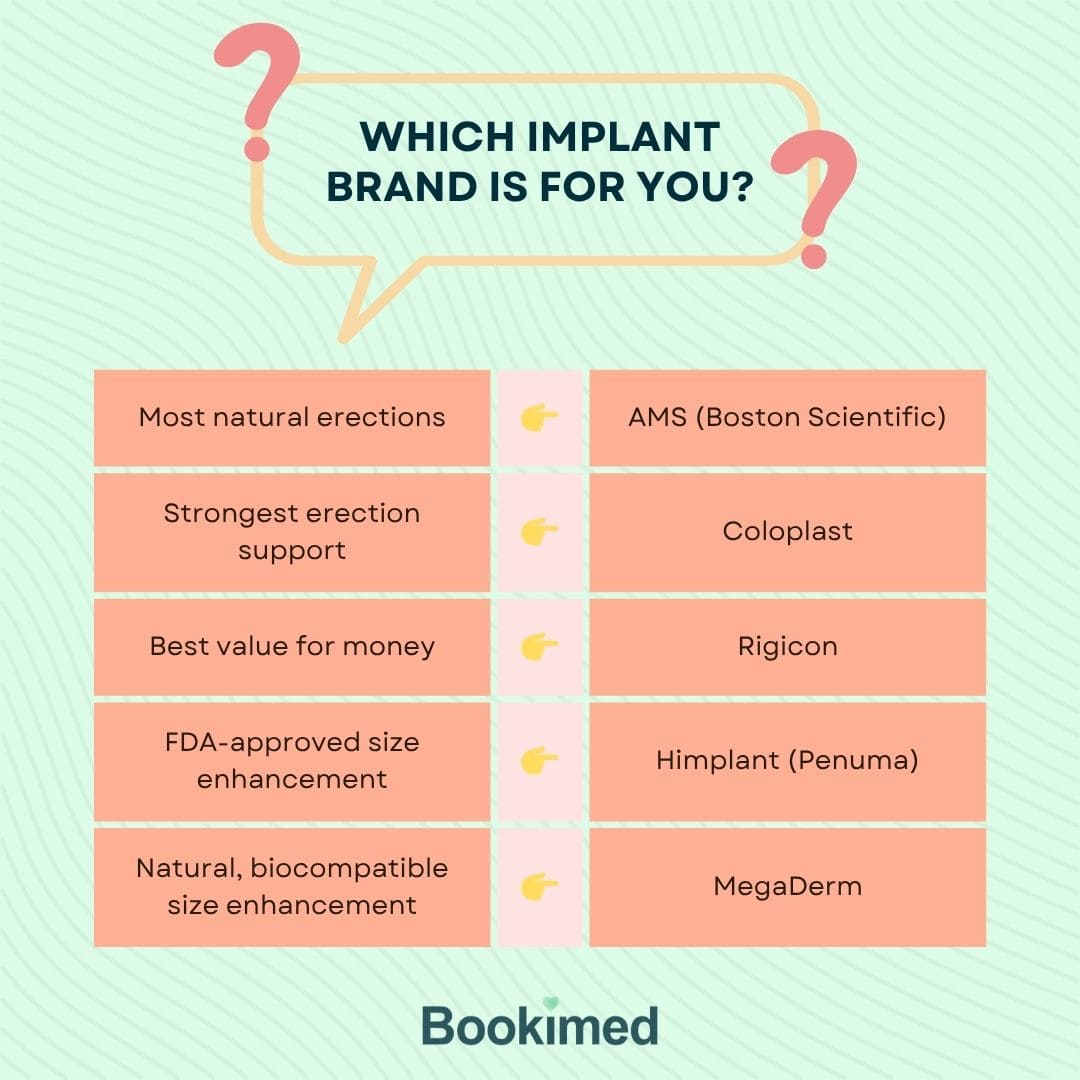
With implant types understood, the next critical decision is choosing the right brand. Here are the major players on the market, as well as emerging options:
1. AMS (American Medical Systems) by Boston Scientific – Physician favorite
The most physician-recommended implant brand with a natural feel and infection prevention.
Types offered:
- 3-piece inflatable (AMS 700)
- 2-piece inflatable (Ambicor)
- malleable (Spectra)
Why choose AMS?
- Built-in antibiotic coating prevents infection.
- Soft silicone material feels natural.
- The AMS 700 LGX model can increase both penile length and girth.
2. Coloplast – Rigid erections
Known for strength and durability, Coloplast implants are ideal for men needing firmer support.
Types offered:
- 3-piece inflatable (Coloplast Titan penile prostheses)
- malleable (Coloplast Genesis)
Why choose Coloplast?
- Coloplast Titan penile implants feature rigid cylinders that provide harder erections – great for men with severe ED or fibrosis.
- A hydrophilic coating makes penile implant surgery easier and reduces the risk of infection.
- The pump is easier to squeeze for men with arthritis.
3. Rigicon – Best value alternative
Emerging competitor offering comparable performance at lower costs.
Types offered:
- 3-piece inflatable;
- 2-piece inflatable;
- malleable.
Why choose Rigicon?
- Costs about 25–30% lower than the AMS or Coloplast brands.
- A reported 99.5% success rate in treating erectile dysfunction.
- The superior bending capacity of malleable options enables easier penile prosthesis implantation.
- Customizable designs, including sizes unavailable from competitors.
4. Peniflex – Affordable cosmetic implant
A soft silicone implant placed under the penile skin to add length and girth.
Why choose Peniflex?
- Adds permanent length and girth, like other silicone implants.
- Available at Bookimed partner clinics in Turkey and Mexico.
- Costs $3,500–$6,500, depending on the clinic and what’s included.
5. MegaDerm – Natural integration option
The only enlargement option that uses real human tissue, making it virtually undetectable from your natural anatomy.
Why choose MegaDerm?
- Uses AlloClean® technology, which removes all cell debris, antigens, and potential viruses while preserving natural collagen.
- Integrates completely with your body like a natural skin graft.
- Proven safe for medical transplantation and tissue reconstruction (also used for breast reconstruction, rhinoplasty, rotator cuff repair, and other medical causes).
Cosmetic-only implants are a newer category than ED prostheses. Confirm the device’s regulatory status in the country where you’ll be treated, and ask the surgeon about their experience with that specific implant.
Penile implant brand comparison
| Brand | Main purpose | Key strength | Cost |
|---|---|---|---|
| AMS | ED | Natural feel + infection prevention | Premium (around $20,000) |
| Coloplast | ED | Maximum rigidity | Premium (around $20,000) |
| Rigicon | ED | Cost-effectiveness + reliability | Affordable (around $6,000) |
| Peniflex | Enlargement | Available in Turkey and Mexico | Affordable ($3,500–$6,500) |
| MegaDerm | Enlargement | Uses natural tissue | Affordable (around $4,700) |
The verdict: Which brand is the winner?
For erectile dysfunction and enlargement: AMS 700 LGX model.
Cost-effective alternative: Rigicon.
For enlargement: Peniflex or MegaDerm.
Selection Guide: Which Factors to Consider When Choosing a Penile Implant?
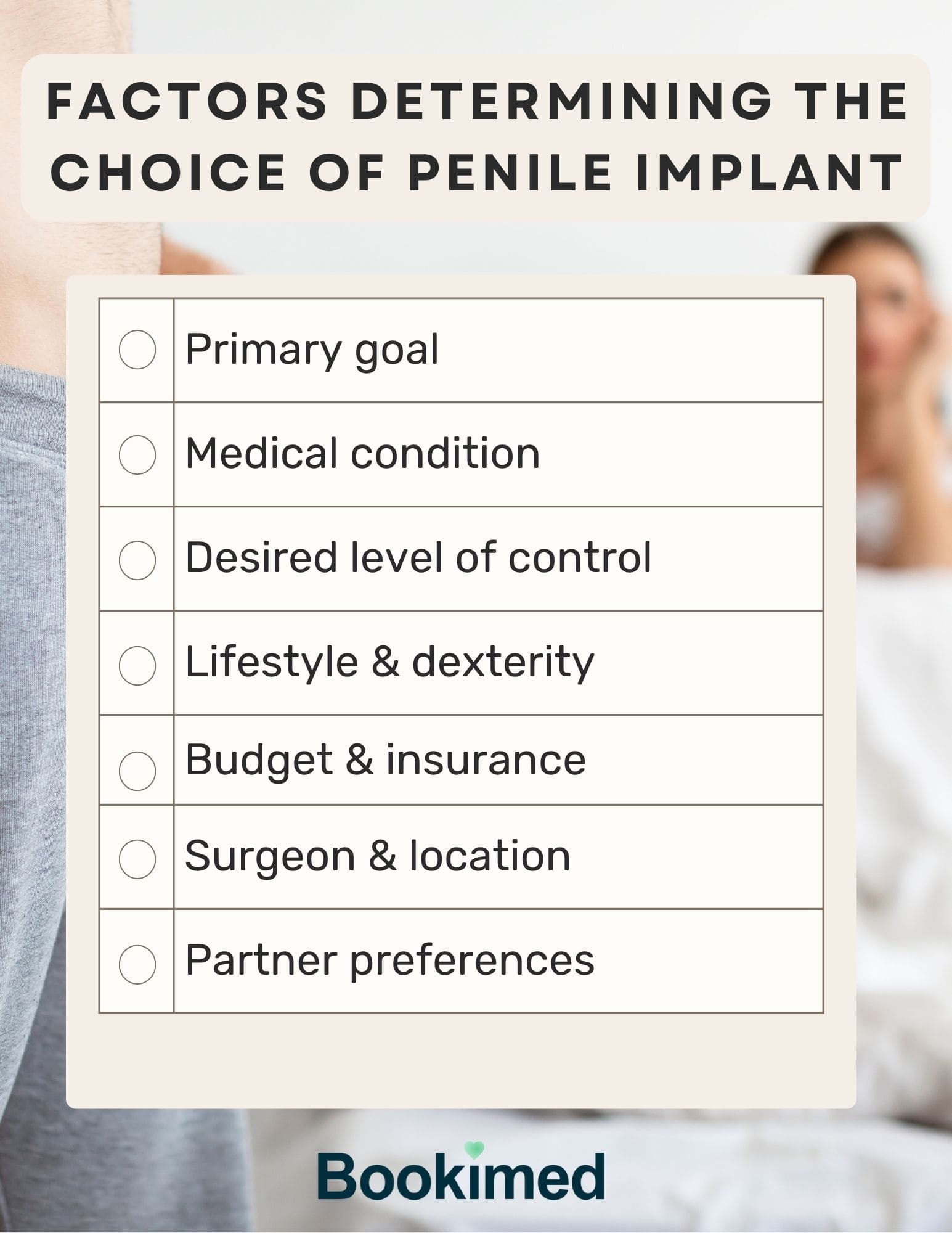
To select the right penile implant, patients must consider several personal and medical factors. Understanding these considerations will help you choose wisely:
1. Primary goal
Determine whether you want to address erectile dysfunction, size concerns, or both, as this fundamentally shapes your implant choice and brand selection.
2. Medical condition
- Severe or long-standing ED (especially in diabetic patients and after prostate surgery): 3-piece inflatable prostheses like AMS 700 or Coloplast Titan provide strong, natural-feeling erections.
- Scar tissue or Peyronie’s disease: The rigid cylinders of Coloplast Titan or malleable prostheses can better straighten or stretch the scarred tissue.
3. Desired level of control
- Want a natural look and the ability to inflate/deflate? → Go for a 3-piece inflatable penile prosthesis.
- Prefer a no-hassle, always-ready option? → Malleable implants are easier to use but stay semi-firm at all times.
4. Lifestyle & dexterity
- Active lifestyle? → Inflatable prostheses provide more discretion and comfort during daily movement.
- Limited hand strength or mobility? → Malleable prostheses may be easier to operate.
5. Budget & insurance
Insurance may cover implants for ED, while enlargement procedures require out-of-pocket payment. Consider both upfront costs and potential revision surgery expenses.
- AMS and Coloplast offer premium options.
- Rigicon and Megaderm provide a lower-cost alternative with similar results.
6. Surgeon & location
Choose a board-certified urologist experienced in implants, not just general surgeons. If cost is a concern, consider medical tourism – countries like Turkey, Mexico, and Thailand offer packages up to 80% cheaper from accredited clinics.
7. Surgical approach
Implants are placed through either a penoscrotal or an infrapubic approach, and that choice influences which cylinder and reservoir configurations are practical for your anatomy. Device model and surgical plan go together, so ask your surgeon which approach they prefer – the surgical section below compares both in detail.
8. Partner preferences
Open discussion about comfort and satisfaction with your partner is essential – they’re part of this journey too. Published research shows high partner satisfaction with inflatable prostheses (85.4%) due to their natural look and feel.
A quick note on the manufacturer landscape: the penile implant market is led by Boston Scientific (AMS), Coloplast, and the newer Rigicon. All three supply the same internationally approved devices worldwide. The implant fitted in Istanbul or Bangkok is the product used in US operating rooms – what changes is the cost of surgery, not the device.
Surgical Approaches and Recovery: What to Expect
How the implant goes in matters less than who puts it in – both standard approaches work well, and an experienced surgeon will recommend the one that suits your anatomy. Still, knowing the difference helps you ask better questions at the consultation.
Penoscrotal vs. infrapubic approach
- Penoscrotal approach. The implant is placed through a small incision in the scrotum. It gives the surgeon better visualization of the operating field, makes pump placement easier, and carries a lower risk to the dorsal nerves that supply sensation.
- Infrapubic approach. The incision sits just above the pubic bone. Its main advantages are reservoir placement under direct vision and a shorter operative time, though it is less suited to complex revision cases.
Neither approach is universally better. Ask your surgeon which one they use most often and why it fits your case – high volume with one approach usually beats occasional use of both.
Infection prevention: the no-touch technique
Some implant centers now use a no-touch sterile protocol, in which the device never contacts the patient’s skin before placement. Combined with antibiotic-coated implants, it is designed to keep skin bacteria away from the prosthesis. About 97–99% of first-time-implant patients stay free of infection. Clinics pairing coated devices with the no-touch technique report infection rates as low as 0.44%, according to Mayo Clinic urologists. When comparing clinics, ask whether the surgical team uses a no-touch protocol and antibiotic-coated devices.
Recovery and aftercare
Most of recovery is simple healing, and two small habits in the early weeks make a real difference:
- Pump positioning. Gently pull the scrotal pump downward several times a day in early recovery. This keeps the pump from migrating upward while the tissues heal, so it stays easy to reach and operate later.
- Penile positioning. Keep the penis positioned upward against the lower abdomen in snug underwear for the first two weeks. This supports healing and helps the implant settle in a position that gives a natural-looking result.
Your care team will tell you when to return to work, exercise, and sexual activity. Follow their timeline rather than a generic one, since it depends on the implant type and how you heal.
A note on priapism
After a prolonged episode of ischemic priapism (an erection that lasts too long), urology guidelines recommend early implant placement. During ischemic priapism, the trapped blood loses its oxygen supply. This can damage the erectile tissue and cause scarring.
Operating before scar tissue develops keeps the surgery simpler and preserves more length. If this is your situation, it is a reason to see an implant specialist promptly, not a reason to worry: outcomes are good when the timing is right.
Where to Get the Best Penile Implant
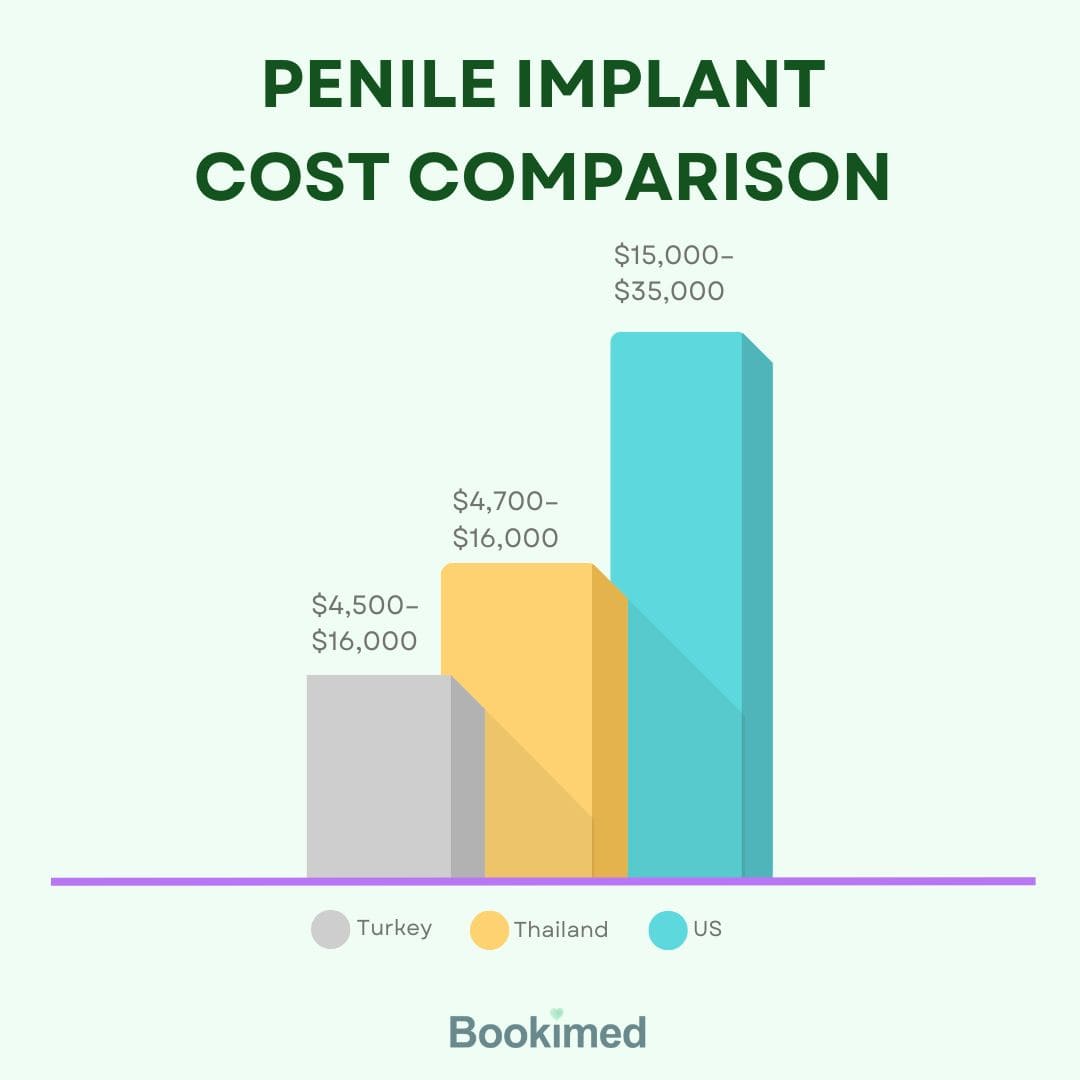
While the United States offers high-quality care, it also comes with some of the highest prices – penile implant surgery typically runs $20,000–$30,000. That’s why patients are now turning to Turkey, Thailand, and Mexico, where they receive the same internationally approved implants and professional care for 75–80% less.
Turkey: All-inclusive surgical care
Turkey has become the leading medical tourism destination, offering internationally recognized ED implant brands, plus popular enlargement options. Penile prosthesis implantation at Bookimed partner clinics costs $4,500–$7,500, depending on the type, clinic, and what’s included.
All-inclusive packages cover:
- inflatable, malleable, and silicone implant options;
- consultations;
- general anesthesia;
- post-op medications;
- VIP transfers;
- hotel accommodation;
- translator support.
Perfect destination for: those seeking ED treatment with size enhancement.
Thailand: Premium aesthetic packages
Thailand is known for its high medical standards and luxury recovery experiences. Penile implant surgery costs $3,000–$6,800, depending on implant type, clinic, and what’s included. Premium packages cover:
- consultation with a urologist and cosmetic surgeon;
- full pre-op screening (blood tests, EKG, X-rays);
- advanced options like MegaDerm;
- VIP nursing care;
- translation support;
- general anesthesia;
- post-op medication;
- 6-month follow-up care.
Perfect destination for: those seeking cosmetic enhancement with a focus on comfort and personalized care.
Mexico: Quality care across the border
Mexico works especially well for US patients. Tijuana and Mexicali are a short drive from the California border, so surgery and follow-up visits don’t require a long-haul flight. Cancun offers private, resort-style recovery for men who prefer to heal away from home. Penile implant surgery at Bookimed partner clinics costs $4,500–$8,000.
Perfect destination for: US patients who want to stay close to home – or combine surgery with a discreet, comfortable recovery.
Below, you can compare penile implant surgery costs across countries:
| Country | Penile implant surgery cost | Savings vs US |
|---|---|---|
| Turkey | $4,500–$7,500 | Up to 75% |
| Thailand | $3,000–$6,800 | Up to 80% |
| Mexico | $4,500–$8,000 | Up to 75% |
| United States | $20,000–$30,000 | Baseline |
These costs are based on data from Bookimed partner clinics. They can vary depending on the implant type, the patient’s case, and the clinic.
FAQ
What is the best age for a penile implant?
There’s no “perfect” age. Implants are usually recommended only after other ED treatments – pills, injections, or a vacuum device – have failed or are contraindicated. Most candidates are middle-aged and older men, and what matters most is overall health, not age.
How do women feel about penile implants?
Patient and partner satisfaction with penile implants is over 85%, according to published research. Implants usually feel natural during sex – partners can’t tell the difference from a natural erection. The firmness and duration stay consistent, which improves overall satisfaction compared to unreliable erections before surgery.
What are the risks of a penile implant?
As with any surgery, risks include:
- infection;
- mechanical failure;
- scarring;
- pain;
- reduced sensation.
These risks are uncommon: about 97–99% of first-time-implant patients stay free of infection. The no-touch surgical technique lowers infection rates further – to as little as 0.44%. Choosing an accredited clinic with an experienced surgeon and following post-operative care instructions keeps the other risks low.
What happens during the penile implant procedure?
The surgeon inserts the implant through a small incision (usually in the groin or lower abdomen) under general anesthesia. The procedure most often takes 45 to 90 minutes, and full recovery takes about 4–6 weeks, according to Mayo Clinic.
How long does a penile implant last?
Inflatable and malleable implants typically work for 10 to 15 years, sometimes longer with proper care. After this time, surgeons can replace the implant with a new one.
Silicone and dermal matrix implants are permanent. They don’t have moving parts, so they don’t “wear out” like other implants can.
Can I still ejaculate with a penile implant?
Yes. The implant doesn’t affect ejaculation or orgasm – it restores mechanical rigidity only, so arousal and climax feel the way they did before surgery.
Related reading
All medical content on this page is prepared by authors with specialized medical education and reviewed by certified physicians in the relevant field. Medical review by Ergin Er, Plastic surgeon.
Last updated: October, 2026.
- Statistics: Figures are based on Bookimed’s internal database October 2026, which includes analysis of 12,450 patient requests across accredited clinics in .
- Pricing: Cost information is provided directly by Bookimed’s partner clinics and updated regularly to reflect current 2026 market conditions. Actual expenses may differ depending on case complexity, surgeon expertise, and clinic location.
- Clinical Data: Treatment outcomes and patient satisfaction figures are collected from Bookimed’s verified clinic database and supported by data from peer-reviewed medical sources such as PubMed, The Lancet, JAMA, and NEJM (2023–2026).
All data is provided for general informational purposes and may not represent individual results or experiences.