


Contrary to the idea that non-binary people do not seek gender-affirming procedures, in a study of 67 non-binary patients, 69% had already had one or wanted one. Most gender-affirming surgery gives the body male or female features. Nullification surgery is the alternative: a smooth, neutral appearance that reflects a non-binary or agender identity.
The operation goes by several names: genital nullification, nullectomy, nulloplasty, and, in the community, nullo surgery. Each one means the same thing – removing the external genitals to leave a flat, neutral groin.
The sections below cover who qualifies, what each operation removes, how urination works afterward, and what it costs.
Key Takeaways
- What it is. Removal of the external genitals, leaving a flat, gender-neutral groin.
- Cost. From around $15,000 in the United States, or $8,000–$9,000 in Thailand, Turkey, and Mexico.
- It is permanent. Removed tissue cannot be restored.
- Sensation and urination stay. Buried nerve tissue can keep orgasm, and the urethra is preserved.
- Who qualifies. Adults who can give informed consent.
Table of Contents
- What is Gender Nullification Surgery?
- Who Can Have Nullification Surgery
- What Nullification Surgery Removes
- Risks of Nullification Surgery
- Nullification Surgery Results
- Recovery After Nullification Surgery
- Nullification Surgery Cost
- How to Get Gender-Affirming Care with Bookimed
- The Bottom Line
- Frequently Asked Questions
What is Gender Nullification Surgery?

Gender nullification surgery, also known as genital nullification, is a gender-affirming procedure that removes the external genitals to create a smooth appearance. Unlike traditional bottom surgery, which aligns the body with male or female characteristics, nullification focuses on neutrality – an option for people without a binary male or female gender identity.
Nullification and other types of non-binary surgery
Non-binary surgery is a broader term than nullification. It covers the procedures that help non-binary patients feel more comfortable in their bodies, in four groups:
- Top surgery. Chest masculinization, or a breast reduction that flattens the chest.
- Bottom surgery. Surgery on the genitals. It includes nullification, metoidioplasty, and vulvoplasty.
- Facial surgery. Softening or strengthening the features of the face.
- Body contouring. Reshaping the body for a more androgynous look.
Genital nullification is one type of non-binary bottom surgery, and it is not the only one. Some non-binary people want a more masculine or feminine result, while nullification suits those who prefer a fully gender-neutral appearance.
Who Can Have Nullification Surgery
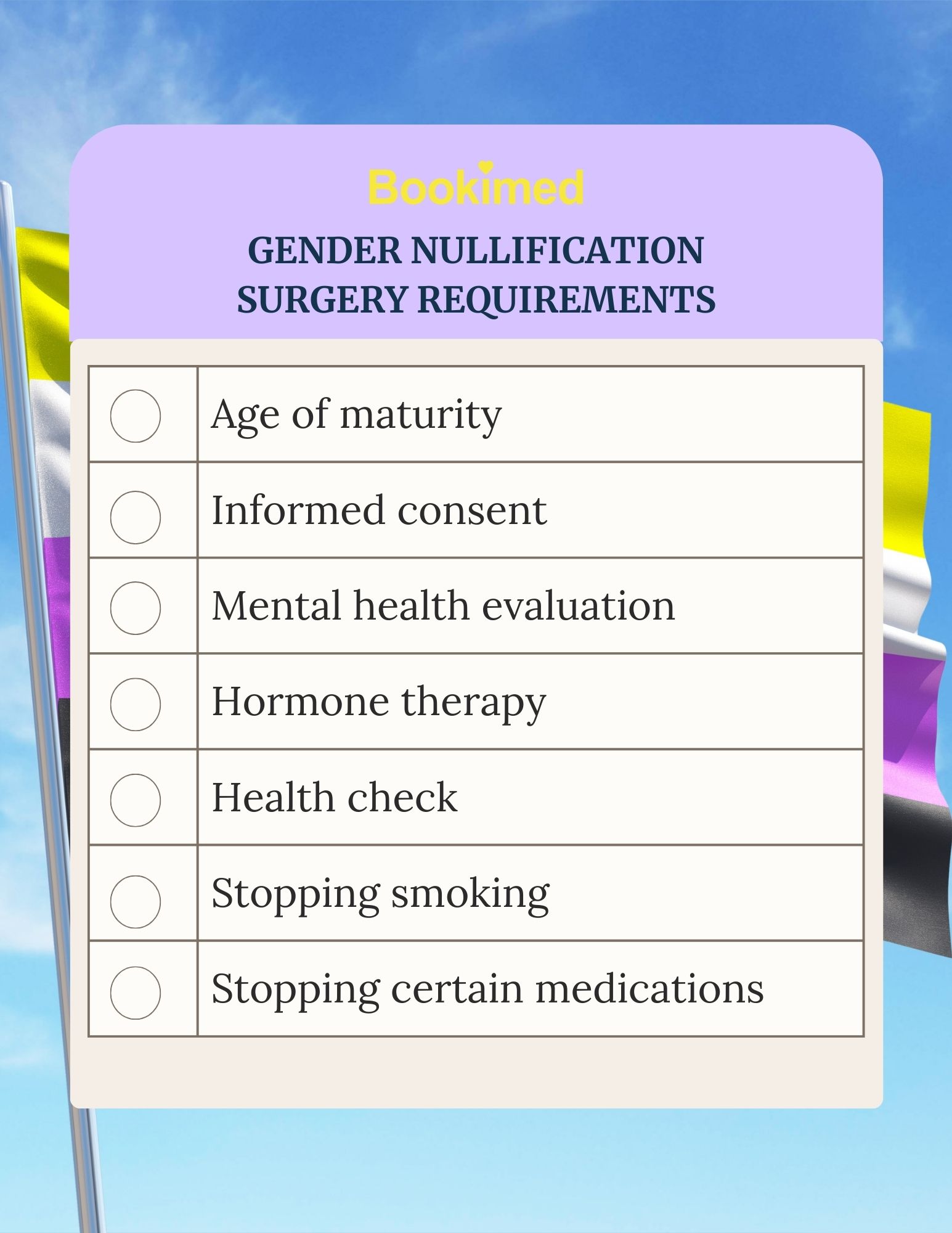
Adults who can understand and agree to a permanent operation can have nullification surgery. Surgeons follow the WPATH Standards of Care – the guidelines from the World Professional Association for Transgender Health – or an informed-consent model, where you and the surgeon go ahead once the risks and the result have been fully explained.
The exact requirements vary by clinic, but these come up most often:
- Age. Clinics generally set a minimum age of 18. There is no single fixed age; what matters is whether you can give informed consent.
- Informed consent. You confirm that you understand the permanent result, the risks, and what the operation can achieve.
- Mental health evaluation. A clinic may ask for an assessment from a mental health professional, sometimes one or two letters.
- Hormone therapy. Nullification does not always require it, unlike some other gender-affirming surgeries. A clinic may still ask for proof of it.
- General health check. A medical evaluation confirms that you are fit for surgery and anesthesia.
- Smoking and medications. Stop smoking before surgery, and ask your surgeon when to pause any blood thinners.
What Nullification Surgery Removes

Nullification is planned around each patient. It removes the external genitals and leaves a neutral appearance. The steps depend on whether you were assigned female at birth (AFAB) or assigned male at birth (AMAB).
Female Nullification Surgery (Female Nullo)
For patients assigned female at birth, the aim is to remove the female genitals while keeping comfort and function. The operation may include:
- Vaginectomy. Removal of the vaginal canal.
- Vulvectomy. Removal of part or all of the external genitals, the labia minora and the labia majora.
- Clitorectomy. Removal of the clitoris, chosen by patients who want an entirely smooth result.
- Hysterectomy. Removal of the uterus and ovaries, which stops the body from making its own sex hormones. It is included when the patient has not already had one.
Male Nullification Surgery (Male Nullo)
For patients assigned male at birth, the surgeon removes the external male genitals and sometimes moves the urethra. The goal is a smooth, unbroken line from the abdomen to the groin. A faint midline scar and a shortened urethra remain.
- Penectomy. Removal of the penis.
- Orchiectomy. Removal of the testicles.
- Scrotectomy. Removal of the scrotal skin.
- Urethral shortening. The urethra, the tube urine passes through, is repositioned so that you urinate while sitting.
Some of the internal erectile tissue always stays in place. Its deep roots anchor to the pubic bone, and one part wraps around the urethra. Removing them would risk heavy bleeding and damage to the urinary tract.
Two further options are available on request. The first is buried sensate tissue: a small piece of the most sensitive tissue is tucked under the skin just above the urethra, which keeps sexual sensation without changing the smooth outside. The second is an external shape without a canal, where some patients choose external labia, a clitoral hood, and a clitoris with no vaginal canal behind them – a no-depth vaginoplasty.
Every part of the plan is adjusted to the patient’s own gender identity and preferences.
Risks of Nullification Surgery
Nullification is surgery, so it carries the ordinary risks of any genital operation: bleeding, infection, slow wound healing, changes to the urine stream, and scarring. Serious problems are uncommon, and most settle with routine care.
Genital gender-affirming surgery has a good safety record overall. In a study of 407 patients who had feminizing genital surgery, more than half recovered with no complication of any kind, and the ones that did occur were mostly minor. Nullification is a different operation, so ask your surgeon what the risks are for the exact steps in your plan.
Nullification is not recommended for anyone who is unsure about a permanent result, and a surgeon may advise against it if a health problem makes surgery or anesthesia unsafe. Tell your surgeon about any bleeding disorder or ongoing medication so they can plan around it.
Nullification Surgery Results
The result depends on your anatomy and on the techniques you and the surgeon choose. Most patients can expect:
- A flat groin. The area is smooth, with a small opening for urine and little scarring.
- Sensation. Nerve tissue buried under the skin can still produce orgasm.
- Internal fullness during arousal. Deep erectile tissue stays in place, so some patients still feel it swell.
The result is permanent. The tissue that is removed cannot be restored, and no operation reverses it. Urination keeps working normally once you have healed, because the urethra stays in place.
Recovery After Nullification Surgery
You may go home the same day or stay one night, depending on the clinic and how much surgery you have. Healing takes several weeks, and swelling settles gradually, so the exact time varies from person to person.
Urination After Nullification Surgery
The urethra is preserved, so urination works normally once the area has healed. After urethral shortening, patients assigned male at birth urinate sitting down. Patients assigned female at birth may need the urethra repositioned after a vaginectomy, so that passing urine stays comfortable.
Here is what the first weeks usually look like:
| When | What to expect |
|---|---|
| First few days | Swelling, bruising, and mild pain, managed with medication. A Foley catheter, a thin tube that drains urine, stays in. |
| Week 1 | The first follow-up is usually the day after surgery, with more check-ups over the following weeks. Swelling begins to go down. |
| Weeks 2–4 | Moving around gets easier. Avoid strenuous activity and long periods of sitting. |
| 1–2 months | You can return to sexual activity once you have healed fully. |
Following your aftercare instructions closely lowers the chance of a problem:
- Hygiene. Keep the surgical area clean, and follow the washing instructions your surgeon gives you.
- Pressure. No tight clothing, cycling, or hard exercise until your surgeon says it is fine.
- Warning signs. Report unusual swelling, pain, or a fever to your clinic straight away.
- Scar care. Massage and the ointments your surgeon recommends help the scar heal.
Nullification Surgery Cost
Nullification is estimated to start around $15,000 in the United States. In Thailand, Turkey, and Mexico, the estimate is around $8,000 to $9,000, depending on whether the plan preserves sensation. No published price exists for this specific operation, so treat these figures as estimates rather than fixed quotes.
The final cost depends on the procedures chosen, the patient’s anatomy, the surgeon, and the location.
| Country | Estimated nullification cost |
|---|---|
| United States | From around $15,000 |
| Thailand, Turkey, or Mexico | Around $8,000 to $9,000 |
At these estimates, surgery abroad costs roughly 40% less than typical US prices.
Insurance Coverage for Nullification Surgery
Insurance coverage for nullification varies. Some insurers classify it as a gender-affirming surgery, while others do not cover it at all. Insurers that do cover it may ask for:
- mental health letters;
- a hormone therapy history;
- a diagnosis of gender dysphoria.
Check with your insurer early to understand your options. Some patients use medical loans, a payment plan, or treatment abroad, where the quoted price is lower. Related operations have their own price guides: transgender surgery and top surgery.
How to Get Gender-Affirming Care with Bookimed

Bookimed makes it easier to find surgeons who perform non-binary gender-affirming surgery. Here is how it works:
- Submit a request. Fill out a quick form on the Bookimed website and describe what you are looking for.
- Get free expert assistance. A medical coordinator helps you find the right clinic and surgeon for your goals and budget.
- Compare clinics and prices. You receive personalized cost breakdowns and treatment packages in different countries, so the quotes cover the same things.
- Consultation and planning. A free consultation with the surgeon covers expectations, the operation itself, and recovery.
- Travel and surgery arrangements. Bookimed assists with medical travel planning, including airport transfers and accommodation near the clinic.
Some patients compare nullification with an operation that builds male or female anatomy. The sex reassignment surgery guide covers preparation and recovery. Chest surgery is a separate decision, and the top surgery guide explains how it works.
The Bottom Line
Nullification suits people who want a body that shows no male or female features at all.
- What it removes. The external genitals, and in some cases the uterus and ovaries, which leaves a flat groin.
- It is permanent. There is no way to restore the removed tissue or reverse the result.
- Sensation can be kept. Buried nerve tissue keeps orgasm possible, and deep tissue still swells during arousal.
- Urination is preserved. The urethra stays in place, and after urethral shortening you urinate sitting down.
- Who qualifies. Clinics operate on adults who can give informed consent.
- Cost varies. The price depends on the procedures chosen, the surgeon, and the country, and the figures here are estimates.
Frequently Asked Questions
These answers cover urination, reversibility, insurance, and how nullification differs from other procedures.
How do you pee after nullification surgery?
You urinate through your own urethra, because surgeons keep it. Patients assigned male at birth have it shortened and repositioned, so they urinate sitting down. Patients assigned female at birth may need it repositioned after a vaginectomy.
A Foley catheter drains the bladder for the first few days and comes out before you go home or at the first follow-up. Spraying or a slower stream is common in the first weeks and settles as the swelling goes down. Ask at the consultation how long the catheter stays in, since that shapes when you can fly home.
Is genital nullification reversible?
No. Nullification permanently removes the external genitals, removed tissue cannot be put back, and no operation restores the original anatomy or builds male or female genitals in its place.
That is why surgeons spend so long on consent, and why some patients freeze sperm or eggs beforehand – the operation can end fertility. If you are unsure, say so at the consultation: buried sensate tissue preserves sexual sensation, and external labia without a vaginal canal keep some outer shape.
What is the difference between nullification and zero-depth vaginoplasty?
Nullification leaves a completely flat, smooth groin with no external genitals. Zero-depth vaginoplasty, also called no-depth vaginoplasty or vulvoplasty, builds external labia, a clitoral hood, and a clitoris, with no vaginal canal behind them.
The choice comes down to the appearance you want, and recovery for both is measured in weeks rather than months. Ask each surgeon which of the two they perform more often, and to show their own before-and-after photos.
Does insurance cover genital nullification?
It depends on the insurer. Some classify nullification as gender-affirming surgery and cover part of it, while others do not list it at all. Ask in writing before you plan anything, and ask which procedure codes they accept – nullification often combines several operations, and an insurer may approve an orchiectomy or a hysterectomy while refusing the rest.
If coverage is refused, three routes remain: a medical loan, a payment plan with the clinic, or treatment abroad, where the quoted price is lower. Compare what each quote includes, because one may cover the hospital stay, tests, and follow-up while another prices the operation on its own.
Is nullification surgery the same as non-binary surgery?
No. Non-binary surgery is the umbrella term for every procedure that helps a non-binary patient feel more comfortable in their body – chest surgery, facial surgery, body contouring, and genital surgery. Genital nullification is one option within it.
When you contact a clinic, name the exact operation rather than the umbrella term. Surgeons who advertise non-binary surgery do not all perform nullification, and asking early saves a wasted consultation.
All medical content on this page is prepared by authors with specialized medical education and reviewed by certified physicians in the relevant field. Medical review by Ergin Er, Plastic surgeon.
Last updated: October, 2026.
- Statistics: Figures are based on Bookimed’s internal database October 2026, which includes analysis of 12,450 patient requests across accredited clinics in .
- Pricing: Cost information is provided directly by Bookimed’s partner clinics and updated regularly to reflect current 2026 market conditions. Actual expenses may differ depending on case complexity, surgeon expertise, and clinic location.
- Clinical Data: Treatment outcomes and patient satisfaction figures are collected from Bookimed’s verified clinic database and supported by data from peer-reviewed medical sources such as PubMed, The Lancet, JAMA, and NEJM (2023–2026).
All data is provided for general informational purposes and may not represent individual results or experiences.