Cataract Surgery (One Eye) in Italy — Get 3 Top Clinic Matches with Costs


Medically reviewed by
Fahad Mawlood
How Much Does Cataract surgery (one eye) Cost in Italy?
Cataract surgery (one eye) in Italy typically costs from $2,000 to $3,600. The total price depends on the chosen lens type, surgical technique, and city. In the US, similar procedures cost around $5,300 on average. Patients can achieve savings of approximately 47%. Standard private packages usually include the intraocular lens, surgical fees, and basic post-operative follow-up.
- Lens selection: Premium multifocal or toric lenses significantly increase costs compared to standard monofocal options.
- Surgical technique: Laser-assisted surgery typically costs 20-30% more than traditional phacoemulsification methods.
- Diagnostic fees: Initial specialized eye consultations in Italy generally range between $350 and $450.
- Medical hubs: Primary destinations for private ophthalmic care include Milan, Rome, and Turin.
Bookimed Expert Insight: Italy offers exceptional value for patients seeking world-class ophthalmologists in academic centers. High-volume hospitals like San Donato in Milan perform thousands of procedures annually. For complex cases, San Raffaele Hospital provides access to top-tier specialists like Francesco Bandello. Choosing a mid-range clinic in Turin can save 15% compared to premium Milanese facilities. Most Italian private clinics provide hotel-quality accommodations for international patients.
| Italy | Turkey | Austria | |
|---|---|---|---|
| Cataract surgery (one eye) | ≈ $2,000 | from $800 | ≈ $2,300 |
Your Benefits and Guarantees with Bookimed
Transparent Prices & Flexible Installments
No hidden fees – just official clinic prices. Pay at the clinic for Cataract surgery (one eye) upon arrival and use a flexible installment plan if needed.
Verified Clinics & Doctors Only
Bookimed is committed to your safety. We only work with medical institutions that maintain high international standards in Cataract surgery (one eye) and have the necessary licenses to serve international patients worldwide.
Free 24/7 Assistance
Bookimed offers free expert assistance. A personal medical coordinator supports you before, during, and after your treatment, solving any issues. You're never alone on your Cataract surgery (one eye) journey.

Your personal Bookimed medical coordinator
- Supports you at every stage
- Helps choose the right clinic and doctor
- Ensures quick and convenient access to information
Discover the Best Cataract surgery (one eye) Clinics in Italy: 3 Verified Options and Prices








Cataract surgery (one eye) Overview in Italy
Day 1: Arrival
- Transfer from the airport is not provided by the clinic.
- Upon arrival at the clinic, you"ll be registered.
- A translator will be provided if needed.
Day 2: Pre-Operation
- You"ll consult with an ophthalmologist.
- Autorefractometry will be performed to measure eye refraction.
- You"ll have other necessary medical tests.
Day 3: Cataract Surgery
- You"ll be given local anesthesia.
- The operation lasts around 1-2 hours.
- The surgeon will replace your cloudy lens with a clear one.
Day 4: Post-Operation
- After surgery, you"ll be monitored for complications.
- Overnight hospitalization may be required, based on your condition.
Day 5: Discharge
- You"ll be discharged from the hospital.
- A follow-up appointment will be scheduled.
Week 1-2: Rehabilitation
- Avoid strenuous activities and heavy lifting.
- Wear sunglasses to protect your eye.
Week 3-4: Rehabilitation
- You can return to work and resume normal activities.
- Follow-up with your ophthalmologist.
Please note that each case is individual and the timeline may vary based on your personal condition and recovery speed.
- Bookimed deposit: $200 or €200.
- Clinic deposit: Pay a set percentage in advance.
Bookimed, a leading global medical tourism platform, is committed to helping clients looking for Cataract surgery (one eye) in Italy by offering expert assistance and trustworthy medical solutions for every situation. Smart automatic ranking system is used to compose transparent clinic listings, meticulously maintained by a data scientist using AI for accuracy. The platform guarantees authenticity by publishing reviews from real patients after their treatments. Bookimed offers comprehensive medical solutions, with updates from clinics to ensure trustworthiness. The content about Cataract surgery (one eye) in Italy, crafted by experienced medical authors and reviewed by specialists, adheres to Bookimed"s Editorial Guidelines, reflecting the platform"s commitment to delivering high-quality and clear health information. For more details or inquiries, feel free to contact us at marketing@bookimed.com or learn more about us and our mission About Bookimed .
Our Doctors
View all Doctors
Francesco Bandello
Leading expert in ophthalmology with prestigious awards and international leadership roles. Dr. Bandello specializes in retinal diseases and cataract surgery at San Raffaele.
- Principal investigator in clinical trials for retinal diseases
- Recipient of multiple awards including the Gabriel Coscas Medal
- President of several major European ophthalmology organizations
- Editor-in-Chief of the European Journal of Ophthalmology

Nicola Vione
Dr. Nicola Vione has performed thousands of procedures in functional and facial plastic surgery. He is a specialist in otorhinolaryngology at Santa Caterina da Siena clinic in Turin. Dr. Vione serves as a Professor of Functional and Aesthetic Surgery of the Nose.
- Serves on the scientific committee of the Micheli–Pellegrini Study Center.
- Uses preservation rhinoplasty techniques to protect nasal anatomy and speed recovery.
- Maintains membership in the Italian Association of Aesthetic and Functional Surgery of the Face.
- Treats complex conditions including deviated septums, nasal polyps, and sleep apnea.
Video Stories from Bookimed Patients
Reviews about Bookimed: Discover Patients' Insights
All reviewsShare this content
 Anna Leonova

Fast Facts about Cataract surgery (one eye)
Cataract surgery (one eye)
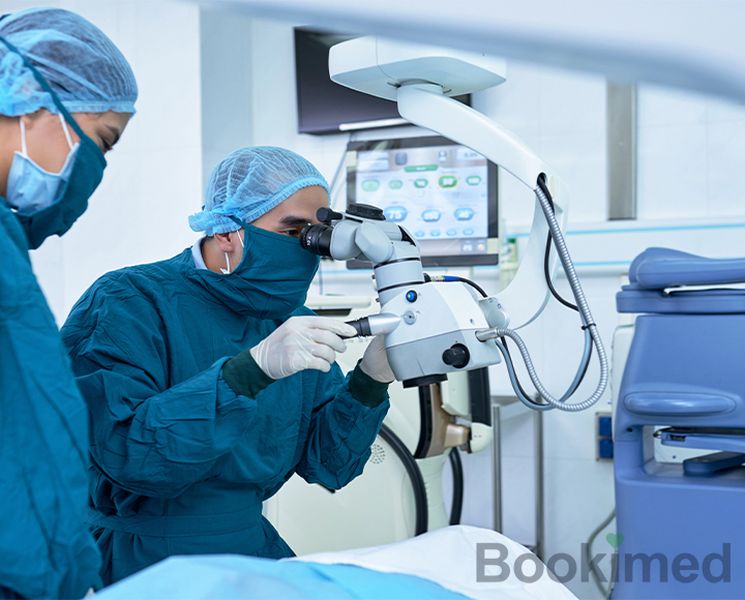
This ophthalmology procedure involves removing the cloudy lens from one eye and replacing it with a clear artificial intraocular lens to restore vision.
FAQ about Cataract surgery (one eye) in Italy
Is cataract surgery covered by the Italian public healthcare system?
Italy's National Health Service (SSN) covers cataract surgery for all legal residents. The procedure is performed at public hospitals or accredited private facilities like Ospedale San Carlo di Nancy. While essentially free, patients typically pay a small co-payment known as a ticket.
- Wait times: Public lists range from 6 months to over 2 years depending on region.
- Lens coverage: The public system only covers standard monofocal intraocular lenses for vision correction.
- Premium options: Multifocal or toric lenses require private payment starting around $2,000 per eye.
- Access requirement: Patients must obtain a referral from a general practitioner to enter public care.
Bookimed Expert Insight: Patients can bypass long public waitlists by choosing accredited private clinics that accept SSN referrals. Facilities like Ospedale San Carlo di Nancy provide public-funded care but often maintain shorter queues than large university hospitals. This bridge between public coverage and private efficiency is a common strategy for Italian residents.
Patient Consensus: Patients value the high surgical skill in public hospitals but notes that the process feels rushed. Many recommend requesting an urgency status from a specialist to speed up the surgical timeline.
How long is the wait for public-sector cataract surgery in Italy?
Public-sector cataract surgery in Italy typically requires a wait of 6 to 12 months. This timeline fluctuates significantly by province. Highly burdened regions may face delays exceeding 24 months, while efficient regional systems might schedule procedures within 4 months.
- Regional variation: Northern regions like Veneto average 12.5 months for non-urgent elective cases.
- Initial consultation: Patients often wait 4 to 12 weeks just for the first specialist exam.
- Priority codes: Urgent cases with severe vision loss can reduce waits to 1-3 months.
- Funding impact: Low public reimbursement rates of €900 per surgery often slow facility throughput.
Bookimed Expert Insight: Italian healthcare uses a tiered priority system (U, B, D, P). Most cataract cases fall under Planned (P), allowing up to 120 days. However, actual backlogs often double this timeframe. Patients with top-tier surgeons like Prof. Francesco Bandello in Milan often find faster access through private tracks, where surgeries cost between $2,000 and $3,600.
Patient Consensus: Patients recommend entering the public waitlist immediately upon diagnosis. Many track their status via hospital portals and consider private options if driving or work is severely affected.
How long does cataract surgery take?
Cataract surgery in Italy typically takes 10 to 20 minutes of active operating time. Patients should plan for a 2 to 4 hour hospital visit to complete pre-operative pupil dilation, local anesthesia administration, and initial post-surgical monitoring in specialized ophthalmic facilities.
- Surgical duration: Modern phacoemulsification generally requires only 10 to 20 minutes per eye.
- Pre-op preparation: Expect 60 to 90 minutes for medical check-in and essential pupil dilation.
- Laser-assisted speed: Advanced laser-assisted techniques can reduce active surgical time to 3 to 5 minutes.
- Post-op monitoring: Clinical observation typically lasts 15 to 60 minutes before patient discharge.
Bookimed Expert Insight: Italian centers like San Donato Hospital manage massive patient volumes, reaching 300,000 annually. This high frequency often leads to highly streamlined surgical workflows. While the procedure is fast, top surgeons like Prof. Dr. Francesco Bandello maintain success through extensive research and clinical trial experience.
Patient Consensus: Many patients find the post-operative pupil dilation more noticeable than the surgery itself. Expect blurred vision for 4 to 6 hours and always arrange a driver for the trip home.
recovery timeline after cataract surgery?
Recovery after cataract surgery typically follows a 4 to 8-week timeline for full healing. Most patients experience significant visual improvement within 24 to 48 hours. Italian specialists, such as Prof. Dr. Francesco Bandello at San Raffaele, ensure stability before finalizing new glass prescriptions by week 6.
- First 48 hours: Vision often appears blurry or hazy while the new intraocular lens adjusts.
- Immediate restrictions: Avoid bending at the waist or lifting over 15 lbs for 7 days.
- Functional recovery: Most patients return to light activities and driving within 2 to 3 days.
- Full stabilization: Eyes reach optimal clarity and complete physiological healing between weeks 4 and 6.
Bookimed Expert Insight: Italian ophthalmology centers often prioritize advanced diagnostic imaging before clearing patients for international travel. While vision feels usable by day 10, the most stable results for multifocal implants are seen after 4 weeks. Clinics like Santa Caterina da Siena utilize specific recovery protocols that focus on minimizing ocular pressure during the critical first week.
Patient Consensus: Patients often describe an initial gritty or scratchy sensation that fades as they strictly follow their eye drop schedule. Many report a sudden peak in visual clarity around day 14, though dry eye symptoms may require routine artificial tears during the first month.
Will I be awake during cataract surgery?
Yes, you will be awake during cataract surgery in Italy. Surgeons use local anesthesia, typically numbing eye drops or a small injection, to ensure the 10-to-15 minute procedure is painless. You stay conscious to follow instructions, which is safer than general anesthesia.
- Local anesthesia: Surgeons apply numbing drops or a targeted injection around the eye.
- Treatment duration: Most procedures in Italian clinics last only 10 to 15 minutes per eye.
- Surgical experience: You may see swirling colors or light patterns, but no sharp vision.
- Patient comfort: A speculum keeps your eye open, so you do not need to worry about blinking.
Bookimed Expert Insight: While US patients often expect IV sedation, Italian specialists like Prof. Dr. Francesco Bandello at San Raffaele prioritize topical anesthesia. This approach allows for immediate post-op mobility. If you have high anxiety, request mild sedation during your first consultation to ensure it is available.
Patient Consensus: Most people report the experience is calmer than a dental visit. They often feel more nervous driving to the clinic than they do during the actual surgery itself.
Can I shorten the wait by choosing private care?
Choosing private care for cataract surgery in Italy significantly reduces wait times from 18 months to just a few weeks or days. Private clinics provide faster access to specialists, flexible scheduling, and consistent doctors, which is essential for patients needing rapid vision restoration beyond the public health system availability.
- Wait time reduction: Private care cuts wait times from 18 months down to several days.
- Specialist access: Patients can select specific consultants like Dr. Francesco Bandello at San Raffaele.
- Scheduling flexibility: Private facilities offer convenient appointment times tailored to the patient's personal schedule.
- Consistent providers: You receive care from the same surgeon during both surgery and follow-up.
Bookimed Expert Insight: Italian private healthcare offers a unique bridge between high-end research and clinical speed. Clinics like San Carlo di Nancy in Rome provide advanced screening, while San Donato serves 300,000 patients annually. Choosing a clinic within the GVM Care & Research network ensures standardized surgical protocols across different Italian cities.
Patient Consensus: Patients emphasize verifying that post-operative follow-up visits are included in the private quote. Many recommend getting at least 2 quotes to compare surgeon credentials and total package costs.
What should I expect in the first few days after cataract surgery?
Patients typically experience rapid vision improvement within 24 to 48 hours following cataract surgery. You may feel mild grittiness or light sensitivity as the incision heals. Use prescribed drops and wear a protective shield while sleeping to prevent accidental contact during the initial recovery phase.
- Vision changes: Expect temporary cloudiness or halos that resolve within 2 days.
- Physical sensations: Gritty or scratchy feelings often peak on day 1 and subside.
- Drop schedule: Apply antibiotic and steroid drops every 1–2 hours during day 1.
- Activity limits: Avoid bending below the waist or lifting over 15 lbs for 7 days.
Bookimed Expert Insight: While basic surgery costs $2,000, choosing multifocal lenses increases the price to $3,400. Italian hospitals like San Donato combine high-volume academic research with patient care. This ensures surgeons stay current on the latest pressure-management protocols for complex cases.
Patient Consensus: Recent patients report that day 1 feels like having sand in the eye. They recommend keeping dark sunglasses ready because screen time and overhead lights feel uncomfortably bright initially.