What types of veneers are available in Turkish clinics?
Depending on the material, dental veneers in Turkey are of the following types:
| Porcelain veneers |
Composite veneers |
Emax veneers (lumineers) |
| Durable veneers up to 0.6 mm thick, created from solid ceramics, do not require forceful enamel removal and entirely hide tooth imperfections. |
Made of light-cured filling material, require significant tooth sharpening and have a shorter lifespan in contrast with other types. |
The most excellent ceramic layer (0.2–0.3 mm) correct imperfections and do not require additional preparation of teeth. |
How much do veneers in Turkey cost?
Composite veneers in Turkey cost on average $450, ranging from $300 to $600 per tooth according to Bookimed data. Differences in cost may depend on several factors:
- the reputation of the clinic
- doctor's fee
- type of veneers
- materials used
- the laboratory service.
International Comparison:
- UK: $800–$1,600 per tooth ($12,500–$21,100 full set)
- US: $900–$2,000 per tooth ($10,000–$30,000 full set)
- Savings: 60–80% compared to UK/US prices
Most Turkish clinics provide their patients with veneer packages that usually include accommodation, transfers, language assistance, and some other additional services.
What factors do affect the veneer cost in Turkey?
There are a number of indicators that can significantly affect the price of this dental treatment in the country. Among them are:
- clinic's location
- material used
- doctor's experience
- the number of teeth involved
- any other treatment (if necessary).
How long do you need to stay in Turkey after the procedure?
Patients typically stay in Turkey for 5–7 days for veneer procedures (6–7 nights recommended in Istanbul according to 2024 treatment protocols). However, the exact time depends on the type of dental veneers, their number, and time for veneer manufacturing in the laboratory, with the total process including laboratory fabrication taking 2–3 weeks.
Why do international patients choose Turkey for veneers installation?
- Turkey is one of the leading countries for dental treatments. Because of the great demand and international internships, Turkish dentists have vast experience and perform veneer placement qualitatively. Leading specialists include Dr. Susana Akdash (cosmetic dentist) and Dr. Gencer Huniler (orthodontist) at WestDent Clinic.
- 424 clinics across Turkey offer composite veneer procedures, with top-rated facilities including Soraca Med (4.9/5), WestDent Clinic (4.8/5), and YEG Clinic (4.6/5). 49 JCI-accredited health institutions (53% in Istanbul) confirm high-quality services.
- Dental veneers in this destination are characterized by their affordability. The cost of veneer placement in the country is up to 70% lower than in American medical centers. Furthermore, the treatment quality is at the same level.
- Treatment in Turkey allows combining medical care with a vacation. The country is globally recognized due to its resorts and mild climate.
Turkey's reputation for excellence is reflected in patient experiences. A patient from Belgium who received treatment shared: "Everything was perfect, all my wishes were fulfilled. The staff is super, the doctor is competent."
What are the benefits of veneers in Turkey?
- Low costs — Turkish clinics offer one of the cheapest veneer placement due to the general price policy in the country and the level of local citizens income. Moreover, dental clinics compete with each other, so it forces them to reduce prices for newcomers. Thus, the veneer cost is 2–4 times lower than in the USA, Canada, Australia, and some European countries.
- Latest equipment — Leading dental facilities such as Hisar Hospital Intercontinental (4.6/5, Istanbul) and Soraca Med (4.9/5, Antalya) continuously upgrade their equipment to provide faster procedures and better results.
- All-inclusive packages — when you choose this destination to have dental veneers, you pay for the procedure but additionally receive such services as transfer, accommodation, language assistance, etc.
A patient from Austria who received treatment at VSC Dental Clinic shared: "I had zirconia crowns placed on my upper and lower teeth. Very satisfied. Friendly staff, experienced and attentive doctors, interpreter services available, hotel and transfer included."
What are dental veneers?
Veneers are thin ceramic plates covering only the front part of the teeth in contrast with crows that cover the entire tooth. The tooth veneers are the most suitable option in case the enamel of your front teeth has small chips, cracks, spots, and you want to transform the smile.
The ceramic layer completely closes the smile's imperfections and helps to adjust the teeth shape. Dental veneers look almost like natural teeth. It is a way to get a beautiful smile without whitening procedures and braces.
|
Lifespan
|
Porcelain veneers: 10–15 years, composite veneers: 5–7 years
|
|
Creation of veneers in a dental lab
|
1–3 weeks
|
|
Original tooth enamel removal for veneers installation
|
<1 mm (typically 0.3–0.5mm for traditional veneers)
|
|
Duration of the placement
|
30–40 minutes per tooth
|
|
Number of veneers usually installed
|
8–10 (the front teeth that are visible when smile)
|
How do dentists install veneers?
The teeth veneer placement process is divided into 4 steps:
- Teeth preparation — a painless process when dentists remove the tiny upper surface of the tooth to fix a veneer. Traditional veneers require 0.3–0.5mm of enamel removal, while ultra-thin no-prep veneers need only minimal surface preparation.
- Modeling — specialists pick up impression or make 3D modeling (a special scanner for precise image-making and identifying of the most barely noticeable features of the tooth surface) to design future veneers. Digital impressions ensure precise fit and optimal bonding strength.
- Manufacturing — the principle and material of veneer producing are similar for all dental clinics. However, the components may differ and affect the final result. In modern dental laboratories, experts provide teeth plates using a microscope to achieve a more accurate result.
- Installation — a quite fast and completely painless process. The installation takes 30–40 minutes per tooth and, therefore, prolongs the total visit time that depends on the veneer number you need to put.
Who is the right candidate for veneers placement?
Veneer installation is a cosmetic procedure and solves some smile defects. So people may choose veneers as the best option if they have:
- Enamel damage — chips and cracks on the front teeth look unaesthetic, so dental veneers cover up these shortcomings
- Tooth discoloration — with the help of veneers dentists return teeth whiteness, especially for teeth with a removed nerve that usually looks darker than others.
- Light crowding and curvature of the teeth — veneers take away large interdental spaces.
- Little teeth size — if the teeth do not look organic, then specialists adjust their length, width, and shape with dental veneers.
- Dental enamel erosion — veneers are the only way to keep your teeth in excellent condition and not hide them entirely under the crowns in case of enamel erosion.
What materials do experts use to manufacture veneers?
Dental veneers are installed in the smile area (8–10 front teeth), so it is crucial that the micro-prosthesis completely imitates the structure and color of the enamel. According to the material, veneers are:
- Composite — made of light-cured filling material, require significant tooth sharpening and have a shorter lifespan in contrast with other types.
- Ceramic (porcelain) — durable veneers up to 0.6 mm thick, created from solid ceramics, do not require forceful enamel removal and entirely hide tooth imperfections.
- Ultra-thin porcelain — the most excellent ceramic layer (0.2–0.3 mm) correct imperfections and do not require additional preparation of teeth.
A prospective clinical study found that no-prep veneers achieved 100% survival rates over 9 years compared to conventional methods, demonstrating superior long-term outcomes.
What result can you achieve with veneers?
With dental veneers, it is possible to get a perfect smile. They hide small teeth defects (rough tooth surfaces or tooth stains) and solve serious and visible smile shortcomings (chipped and cracked teeth, tooth darkening and discoloration, interdental spaces, teeth with irregular shape or position in a row).
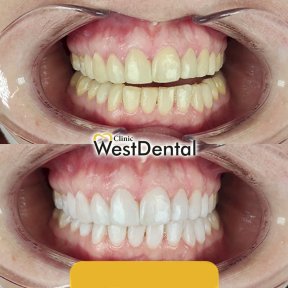
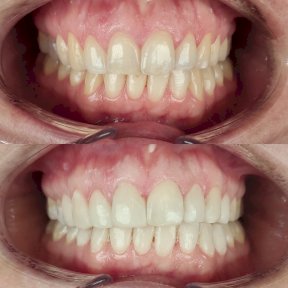
View before/after photos, which clearly show how the smile changes with the help of veneer restoration.
According to clinical studies on veneer survival rates, dental veneers demonstrate over 90% survival rates for more than 10 years, with ultrathin ceramic veneers showing 97.9% success rates at 4-year follow-up. The service life cycle of ceramic veneers takes 10–15 years.
To stretch veneer services longevity out, a person must follow the dentist's recommendations, avoid injuries, limit spicy and solid foods. However, dental veneers do not require excessive effort to maintain their original appearance for many years.
Ceramic surfaces do not darken over time, do not change color and shape; the only thing that can happen is a structural breakdown with intense mechanical stress. Therefore, people who are fond of traumatic sports, veneers are not recommended. Otherwise, surfaces are quite comfortable to use, do not cause pain and discomfort when worn; the patient does not feel an artificial material in the mouth.
Recovery Timeline and What to Expect
The veneer recovery process follows a predictable timeline:
- First 48 Hours: Initial discomfort and sensitivity should fade as you adjust to your new veneers. Stick to soft foods and avoid extreme temperatures.
- First 1–2 Weeks: Temperature sensitivity is normal during this adjustment period. Most patients experience a 2-week adaptation period with possible minor sensitivity to hot and cold.
- 2–4 Weeks: Speech adaptation may take 2–4 weeks, with minor lisping that gradually improves with practice.
- 4–8 Weeks: Complete oral adaptation as your tongue fully adjusts to the veneers.
Patients can typically return to normal activities immediately, though the full adjustment period spans approximately 2 weeks for most individuals.
Potential Risks and Complications
While dental veneers are generally safe, patients should be aware of potential complications:
Common Side Effects:
- Tooth sensitivity: Over 80% of patients experience no postoperative sensitivity
- Temporary discomfort: Usually resolves within 48 hours
- Speech adjustment: Minor lisping may occur for 2–4 weeks
Rare Complications:
- Pulpitis: Approximately 98% of patients do not experience this complication
- Veneer fracture or chipping: Primary failure mechanism in rare cases
- Debonding: Secondary cause of veneer failure
- Gum irritation: Can occur with improperly fitted veneers
Important Considerations:
- Veneers are irreversible due to enamel removal
- Regular dental checkups essential for monitoring
- Avoid hard foods and using teeth as tools
- Proper oral hygiene crucial for longevity
Always consult with qualified dental professionals to discuss individual risks and suitability for veneer treatment.
What is the veneer pre-installation period?
Aesthetic dentistry requires complete sanitation of the oral cavity. So before installing veneers, you should undergo a dental examination and, if necessary, treat the detected caries and perform a professional cleaning. After this, the dentist can begin to perform the required manipulations for veneer manufacturing and installation.
How to care for veneers?
Inadequate care of smile veneers leads to cracking or chipping. Dental care recommendations are quite simple to follow.
- Maintain oral hygiene as dental veneers, like natural teeth, require daily brushing with a suitable toothpaste and brush. It is also worth using dental floss but not toothpicks. Personal hygiene habits eliminate the risk of caries under veneers.
- Use an irrigator (also known as dental water jet, dental water toothpick, water flosser) — a home dental care device that removes plaque and food debris between teeth and below the gum line with a stream of high-pressure pulsating water.
- Check with a specialist how installed veneers respond to various foods, whether they can stain, change color, damage. Depending on the doctor's recommendations, it is worthwhile to exclude or minimize some foods or use mouthwash immediately after eating.
- Dental veneers are susceptible to damage due to heavy loads. It would be best if you did not chew any hard candies or nuts.
- Visit your dentist twice a year and undergo professional oral hygiene.
What should I do if the veneer breaks or moves over?
You have installed veneers a long time ago, but there is a nuisance — a chip or crack appeared on the ceramic plate, or it entirely moves over the tooth. There is nothing to worry about in these situations.
Contact your dentist. A specialist will remove the broken veneer, make and install a new one. And if the surface just has moved away because of the lousy cement and tooth connection and is not damaged, then the doctor will attach it back.
What should you know about Turkey before the trip?
|
Currency
|
lira (you also can pay for services in dollars and euros)
|
|
Best period for the trip
|
May–October
|
|
Language
|
Turkish (most of medical staff speaks English fluently)
|
|
Visa
|
is not required for a trip of at least 30 days per visit
|
|
Time difference with Europe
|
3 hours
|
|
Time difference with the USA
|
8 hours
|
|
Capital
|
Ankara
|
|
Medical tourism center
|
Istanbul
|
|
Popular resorts
|
Alanya, Antalya, Kemer, Marmaris
|
What is the level of medicine in Turkey?
Healthcare is the key development sector of the Turkish government. The Turkish authorities are convinced that care for the citizens' health should be an absolute priority of state policy and spend about 77 billion liras for healthcare annually.
As a result, 28,000 medical facilities provide excellent medical care in the country. About 50 centers have certificate of JCI (Joint Commission International), the international improver of healthcare quality and safety across the globe.
The index of certificates obtained is the largest. To compare, Israel has 20 JCI-accredited facilities, and Germany — only 10 clinics of this type.
Why is Turkey trendy for medical tourism?
Turkey is also a well-known country globally due to high-skilled doctors that undergo internships in American and European institutions. Patients from Saudi Arabia, Qatar, Kuwait, the UAE, Jordan, and Lebanon prefer treatment in this destination to other places.
Highly developed medical centers and first-rate therapeutic services at affordable prices attract people from all over the world. According to Turkey's official health tourism statistics, the country hosted 2 million health tourists in 2024, generating $10 billion in revenue. So the country is among Top 10 destinations with the most developed medical tourism sector.
Turkey is a top destination for medical tourists because of low-costs. You may save up to 50% on services compared to European countries or the USA due to the average local citizens' income and general price policy within the country.
A patient from Ethiopia who received treatment at Dental Bosphorus shared: "The support from Bookimed was more than I expected. Every time at every step my assistant was there for me to find the solution." (Bookimed verified review)
What hotel services are provided here?
In Turkey, hotels of different price ranges and service levels are presented. The level of Turkish hotels is comparable to hotels in Tunisia, Morocco or Egypt.
Most tourists choose 4 and 5 star hotels with all-inclusive meals. Such hotels have everything for a comfortable stay: varied food, a large well-groomed territory, animation for children and adults. Some hotels have their own water park, which guests can use for free.
Budget travelers can afford to book an economical 3-star hotel with half board or no meals at all.
When is the best time to travel to Turkey?
The main advantage of Turkish resorts is the long beach season. On the Mediterranean coast, it starts in April and lasts until November. In the resorts of the Aegean Sea — from May to October.
The most comfortable time for swimming is from mid-June to the end of October. A large influx of tourists is in July–August, when the air temperature is +38°C, and the water warms up to +27°C.
Do I need a visa?
Today the Republic of Turkey has visa-free agreements with 89 states. Some foreigners are exempted from obtaining entry visas, others are required to receive an electronic visa (e-Visa), and still others must apply for a visa at Turkish missions abroad.
What documents are required to apply for a visa to Turkey for treatment?
Visas for travel to Turkey require a number of documents. The necessary papers can be submitted 90 days before the planned departure. Lists of documents includes:
- ID card
- confirmation of online registration and filling out the questionnaire
- certificate of income and availability of funds ($50 per day per person)
- insurance policy for a stay in Turkey (original and copy)
- 2 photos (5x6)
- visa receipt
- booking of flight and hotel
- medical opinion about the need for treatment.