

A Korean plastic surgery tour package costs from about $2,000 for a tummy tuck to $12,500 for a facelift, roughly 35–75% less than in the United States. South Korea has over 2,800 plastic surgeons, the fifth-largest total of any country. The package bundles consultations, the operation, aftercare, accommodation, transfers, and translation. Prices below cover eyelid surgery, rhinoplasty, facelifts, breast augmentation, and a tummy tuck, each against a United States price. They come with what a package covers, how to check your surgeon, and how long to stay.
Key Takeaways
- Eyelid surgery. $2,200–$3,500 for upper lids and $4,700–$7,300 for upper and lower, against $3,500–$7,500 in the US.
- Rhinoplasty. $5,900–$6,600, against $10,000–$22,000 in the US.
- Facelift. $8,000–$12,500, against $12,800–$23,000 in the US.
- Breast augmentation. $6,800–$11,500, against $6,500–$12,000 in the US.
- Tummy tuck. $2,000–$10,800, against $9,000–$15,000 in the US.
Table of Contents
- What's Included in a Korean Plastic Surgery Tour Package?
- Korean Plastic Surgery Package Cost Breakdown
- Why Choose a Korean Plastic Surgery Tour Package?
- How to Check Your Korean Surgeon's Training
- Traveling to Korea for Plastic Surgery: Important Considerations and Tips
- Recovery in South Korea and Flying Home
- The bottom line
- Frequently Asked Questions
What's Included in a Korean Plastic Surgery Tour Package?
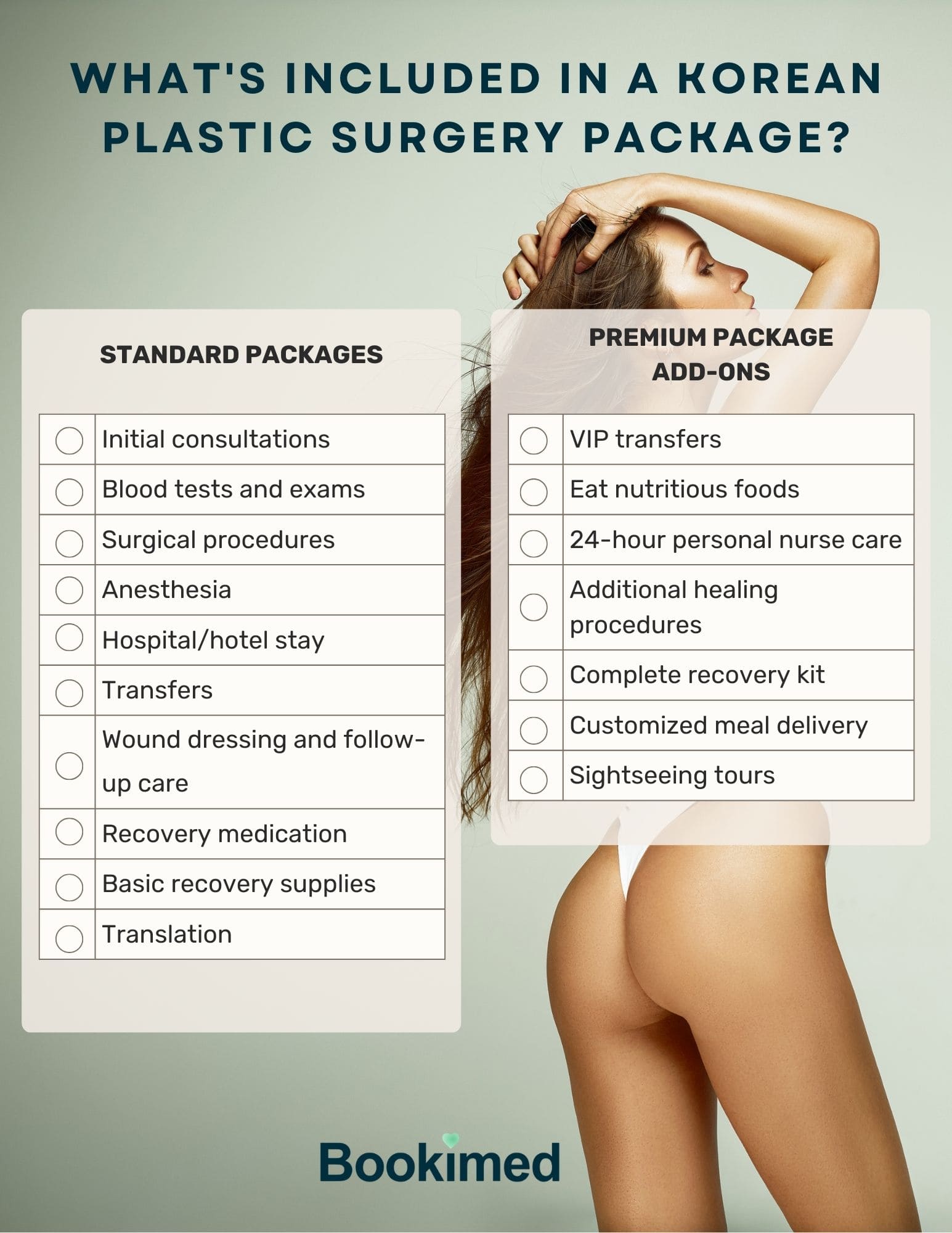
A Korean plastic surgery tour package covers your treatment from the first consultation to the final check-up. For the wider view of plastic surgery in Korea, the full guide covers procedures and clinics. Each package bundles services that are hard to arrange alone:
- Personalized consultations with surgeons, including online consultation after returning home
- Blood tests and necessary pre-op examinations
- Plastic surgery procedures
- Hotel or apartment accommodation
- Regular airport transfers and clinic transportation
- Post-operative care and follow-up appointments
- Wound dressing and medication
- Translation services
Clinics may also add extra amenities and services:
- VIP transfers in private vehicles
- 24-hour personal nurse care
- Additional procedures like oxygen therapy sessions and vitamin infusions to speed recovery
- Recovery comfort kits (neck pillows, ice packs, and specialized cosmetics)
- Customized meal plans
- Sightseeing tours
A package does not cover your flights. The cost section below prices the extras a clinic charges separately.
DID YOU KNOW?
In South Korea, cosmetic surgery is an ordinary, openly discussed choice. The share of Koreans who have had a procedure rose from 2% in 1994 to 7% in 2015, and a 2020 Gallup Korea poll put it at about one in three women aged 19–39. Double eyelid surgery and rhinoplasty are common graduation gifts.
Korean Plastic Surgery Package Cost Breakdown

A Korean plastic surgery tour package starts at about $2,000 for a tummy tuck. A facelift is the highest price on the page, at up to $12,500. Every Korea price below comes with the United States price for the same operation.
| Procedure | Korea | United States |
|---|---|---|
| Upper eyelid surgery | $2,200–$3,500 | $3,500–$7,500 |
| Eyelid surgery, upper and lower | $4,700–$7,300 | $3,500–$7,500 |
| Rhinoplasty | $5,900–$6,600 | $10,000–$22,000 |
| Tip rhinoplasty | $3,600–$5,600 | $10,000–$22,000 |
| Facelift | $8,000–$12,500 | $12,800–$23,000 |
| Mini facelift | $5,400–$8,500 | $8,500–$16,000 |
| Breast augmentation | $6,800–$11,500 | $6,500–$12,000 |
| Tummy tuck | $2,000–$10,800 | $9,000–$15,000 |
The nose is where the gap is widest. Rhinoplasty costs roughly 40–70% less than in the United States. For tip rhinoplasty the saving is roughly 60–75%. Lifting comes next: a full and a mini facelift each cost roughly 35–45% less. Upper eyelid surgery costs roughly 35–55% less.
Full eyelid surgery and breast augmentation cost about the same in Korea as in the United States. Eyelid surgery makes up about 31% of cosmetic surgical procedures in South Korea. Eyelid surgery is in steady local demand, and its Korean price stays close to the US one.
A package may charge separately for transfers, extra nights with nursing care and meals, and add-on recovery therapies. The clinic prices these when you confirm your package.
Korean eyelid plastic surgery packages

Eyelid surgery removes or repositions loose skin around the eye. Upper eyelid work adds a defined crease and lifts sagging skin. Lower eyelid work reduces puffiness and under-eye bags.
Double eyelid surgery is the most requested version in Korea. It adds a crease to the upper lid to make the eyes look larger.
Korean rhinoplasty packages
Rhinoplasty reshapes the nose. Tip work refines only the tip. A fuller nose job can also lower a bump and reset the nasal bones through osteotomy.
Korean surgeons may build up the bridge with a silicone implant instead of the patient's own cartilage.
Korean facial contouring packages

A facelift tightens loose skin and the deeper tissue for a firmer jaw and cheeks. A mini facelift treats the lower face through smaller cuts, so recovery is shorter.
Facelift packages often bundle a second treatment with the surgery: buccal fat removal to slim the cheeks, or a course of skin-hydration injections to improve skin texture while you heal. Ask the clinic which of these your quote already covers.
Body contouring packages in South Korea
Breast augmentation reshapes and adds volume with implants. A tummy tuck removes loose lower-belly skin and tightens the muscle wall.
The lower figure is for a partial tummy tuck, and the higher one for a full procedure.
Why Choose a Korean Plastic Surgery Tour Package?

A tour package turns an operation abroad into one arrangement, with less to organize and fewer surprises:
- One booking. Your hotel, airport transfers, and an interpreter are arranged for you, so you land ready for the clinic.
- A price agreed upfront. The cost is set before you travel, so aftercare and add-ons are not a surprise on the day.
- Priority scheduling. Package patients from abroad are booked ahead of the walk-in queue, so consultations and surgery come sooner.
- Accredited partners. Bookimed partner clinics include hospitals accredited by the Korea Institute for Healthcare Accreditation (KOIHA). Their surgeons include members of the American Society of Plastic Surgeons.
- Clinics set up for foreign patients. Korea treated 2.01 million foreign patients in 2025, 233,000 of them in plastic surgery departments. Seoul took 87% of that total, so its clinics run interpreters, foreign-patient desks and English paperwork as routine.
- Recovery care in the price. Dressing changes, swelling care and the follow-up visits are part of the package, not appointments you arrange and pay for one by one.
How to Check Your Korean Surgeon's Training
A plastic surgery specialist in Korea finishes medical school and a hospital internship. They then complete a four-year full-time residency in plastic and reconstructive surgery, followed by a national board examination.
You can confirm the same standard at your clinic by asking these questions:
- Which surgeon will perform my operation?
- Did that surgeon complete a plastic surgery residency and earn board certification?
- How many of this operation does the surgeon perform?
- Will the surgeon stay in the room for the whole operation?
- Can my operation be recorded, and what do I sign to request it?
Your Bookimed coordinator can put these questions to the clinic and pass on the answers.
The prices in the table are what Bookimed partner clinics charge, and those clinics already meet this standard. Bookimed ranks them by its published Ranking Policy.

SAERO Plastic Surgery is a Gangnam-based clinic with over 24 years of experience. It focuses exclusively on plastic surgery for adults from five continents. The clinic is led by a single specialist overseeing every procedure.
- Offers rhinoplasty, blepharoplasty, face lifts, and abdominoplasty.
- Fat grafting is available for natural-looking volume restoration.
- Consults are offered in person and online, with full language support.
- Treats around 700 patients each year from Europe, Asia, the USA, and Australia.
Latest review
Traveling to Korea for Plastic Surgery: Important Considerations and Tips
A flight from the United States to Seoul takes about 14 hours, so plan enough time to rest before surgery.
| Topic | Details |
|---|---|
| Visa requirements | Visitors from the US, EU, Canada, and Australia get visa-free entry for up to 90 days. Check whether you need a Korea Electronic Travel Authorization (K-ETA) before you travel. |
| Flights | Flights from major US cities to Seoul take about 14 hours. Round-trip economy fares are usually about $600–$1,500, depending on season, route, and how far ahead you book. |
| Weather | The best seasons for a comfortable recovery are spring (April – May) and fall (September – October). Korea's summer is hot and humid, with a rainy season from late June into July: heat worsens swelling, sweat sits under dressings, and UV light on a fresh scar causes lasting darkening. Winter is cold and dry. |
| Length of stay | Plan for at least 10–14 days to cover consultation, surgery, initial recovery, and check-ups. |
| Recovery timeline | Most swelling and bruising improve within 7–10 days. Full recovery and final results can take 3–6 months, depending on the procedure. |
| Currency | The currency is the South Korean won. Credit cards are widely accepted, but keep cash for small shops and taxis. ATMs are easy to find, though some charge foreign cards extra. |
| Payment | Clinics accept credit cards, such as Visa and Mastercard, and cash in South Korean won. |
| Insurance | Regular travel insurance does not cover cosmetic surgery. You may budget for a short-term medical travel or complication policy. |
| Transportation | Packages include airport pick-up and clinic transfers. Otherwise, taxis are inexpensive and easy to find, and a ride-hailing app makes them simple to book. |
What to pack for your plastic surgery trip to South Korea
Pack for the first days after surgery, when you cannot pull clothing over your head or wet the surgical area:
- Loose, comfortable clothing (button-up or zip-up tops)
- Slip-on shoes
- Basic skincare products (gentle cleanser, moisturizer, and sunscreen)
- Any prescribed or personal medications
- Small travel pillow
- Lightweight recovery mask or scarf (to cover swelling if you want)
- Power adapter (South Korea uses 220V, Type C and F plugs)
- Copies of important documents (passport, flight tickets, insurance, medical records, and clinic confirmation)
Cultural tips to know before you go
Daily life in Korea follows a few habits worth knowing before your trip:
- Bow slightly when greeting people – it is a sign of respect.
- Tipping is not expected in Korea, even for taxis and restaurants.
- Keep your voice calm and polite, especially in medical settings.
- Hand over money, cards, and documents with both hands when possible.
- Public spaces are clean and well organized.
- Stand on the right side of escalators in Seoul.
- Learning a few basic phrases is appreciated, even if you mostly rely on English.
For the wider picture of medical tourism to South Korea, that guide covers hospitals and planning a visit. Bookimed arranges the clinic, consultation, and transfers, and explains what each package covers.
- Dr. Yong Woo Kim achieved the top score in the resident board exam by the Korean Society of Plastic and Reconstructive Surgeons.
- Returning Plastic Surgery is led by Dr. Yong Woo Kim, a former director at BK Plastic Surgery.
- Included Services: 3D CT scan, coffee zone, cosmetic kit, CT scan, parking.
- Stay Info: Accommodation and transfer are not included.
Recovery in South Korea and Flying Home
In a package, your first recovery days are spent at or near the clinic. Staff change your dressings, manage swelling, and give you a check-up before you fly.
After a nose operation, keep weight off the bridge for four to eight weeks once the splint is removed. Wear contact lenses, or tape your glasses to your forehead.
Cabin air is dry, and pressure changes make swelling worse. A healing nose is uncomfortable on a long flight. Book your return for after the worst swelling has passed.
A Korean package may add extra recovery care:
- Oxygen sessions. Time in a pressurized oxygen room to support healing.
- Light therapy. Gentle light to calm swelling and redness.
- Drainage massage. A slow massage that moves fluid away from the treated area.
Clinics may serve pumpkin soup after surgery, a Korean recovery custom.
Safety and side effects
Swelling, bruising, and short-term numbness are the normal part of healing after cosmetic surgery. They settle over the first few weeks.
What lowers the risk is something you can check. A board-certified plastic surgery specialist performs the operation. A dedicated anesthesiologist watches you under general anesthesia. Ask who monitors your anesthesia, and what the clinic's revision policy covers.
A pre-operative check can push the date back. Tell the clinic about every medicine you take, any bleeding or clotting problem, and whether you smoke. Blood tests and a health check come first. Surgery is not recommended until anything they find is treated.
Keep the check-up before you leave, and fly home only once the swelling allows a comfortable trip.
The bottom line
- Savings are largest on the nose and on lifting, roughly 35–75% below US prices.
- The package price covers your consultations, surgery, aftercare, hotel, transfers, and translation, but not flights or extra recovery nights.
- Plan around two weeks, most of it recovery: dressing changes, swelling care, and a check-up before you fly.
- Ask the clinic who will operate and whether that surgeon holds plastic surgery board certification.
Frequently Asked Questions
The answers below give the price, the package contents, and the timing.
How much is plastic surgery in Korea?
Plastic surgery in Korea starts at about $2,000 for a tummy tuck. The most you would pay is about $12,500, for a facelift. The price depends most on which procedure you have.
Rhinoplasty costs about $5,900–$6,600, and tip rhinoplasty about $3,600–$5,600. A full eyelid surgery, upper and lower, costs about $4,700–$7,300. Upper eyelid surgery alone costs about $2,200–$3,500. A mini facelift costs about $5,400–$8,500.
Breast augmentation costs about $6,800–$11,500. The widest range is the tummy tuck. A partial one costs about $2,000 and a full one about $10,800.
A tour package includes most of the trip in that price. It covers consultations, the operation, aftercare, hotel, transfers, and translation. Flights and extra nights are charged separately. The clinic confirms the final figure at your consultation.
What does a Korean plastic surgery tour package include?
A Korean plastic surgery tour package includes your consultations, the operation, aftercare, accommodation, airport transfers, and translation. One booking arranges the medical care and the trip around it.
A typical package covers:
- Consultations before and after surgery, including an online follow-up once you are home.
- Blood tests and other pre-operative checks.
- The operation and your hospital or clinic stay.
- Hotel accommodation and transfers between the airport and the clinic.
- Dressings, medication, and a check-up before you fly.
- An interpreter for your appointments.
Flights, extra recovery nights, private transfers, and add-on recovery therapies are usually charged separately. Your Bookimed coordinator can ask the clinic for a written list of what your package covers before you pay. The exact inclusions appear in your quote, so check it against this list.
Is plastic surgery in Korea cheaper than in the United States?
Korea is cheaper for the nose and for lifting procedures, and about level for full eyelid surgery and breast augmentation.
Rhinoplasty costs roughly 40–70% less than in the United States. For tip rhinoplasty the gap is roughly 60–75%. A full or mini facelift comes in roughly 35–45% under US prices. Upper eyelid surgery is about 35–55% lower. A tummy tuck starts at about $2,000 against $9,000 in the United States.
Full eyelid surgery and breast augmentation cost about the same in Korea as in the United States. Both are in steady local demand, and their Korean prices stay near US levels.
The exact gap depends on the clinic and on what your case needs. Your quote gives the final figure, and the clinic confirms it at your consultation.
How long do you need to stay in Korea after plastic surgery?
Plan for about 10 to 14 days in Korea. That covers your consultation, the surgery, early recovery, and the check-ups before you fly. A more complex operation can need a few extra days.
The first days are spent close to the clinic. Staff change your dressings, watch the swelling, and see you for follow-up visits.
Swelling and bruising ease within the first week or two. Final results can take a few months, depending on the procedure. Ask your surgeon when you can travel and when you can return to work.
A nose operation needs a longer wait before a long flight. Book your return once the worst swelling has passed, so the trip is comfortable. Plan a few spare days in case a follow-up appointment moves.
How do you check that a Korean surgeon is qualified?
Ask the clinic directly, and confirm the surgeon holds board certification in plastic surgery. A specialist in Korea trains for years before earning it.
They finish medical school, a hospital internship, and a four-year residency in plastic and reconstructive surgery. A national board examination comes at the end.
Ask the clinic:
- Which surgeon will perform your operation.
- Whether that surgeon completed a plastic surgery residency and holds board certification.
- How many of your operation the surgeon performs.
- Whether the surgeon stays in the room for the whole operation.
- Whether the operation can be recorded, and what you sign to request it.
The credential that matters is plastic surgery board certification. The clinic can show you the certificate itself, so ask to see it at your consultation.
When can you fly home after surgery in Korea?
Patients fly home once the first swelling settles and the surgeon clears them. That is near the end of a 10–14 day stay. The right date depends on your operation. Ask the surgeon for a specific clearance date at your last check-up.
Cabin air is dry and the pressure changes make swelling worse. A healing nose or face can feel uncomfortable on a long flight.
After a nose operation, wait until the worst swelling has passed before a long-haul trip. Keep the check-up before departure, so the surgeon confirms you are ready to travel.
Move gently on the flight and drink water to stay comfortable. If anything feels wrong before you leave, tell the clinic and ask whether to delay the flight.
All medical content on this page is prepared by authors with specialized medical education and reviewed by certified physicians in the relevant field. Medical review by Ergin Er, Plastic surgeon.
Last updated: September, 2026.
- Statistics: Figures are based on Bookimed’s internal database September 2026, which includes analysis of 12,450 patient requests across 1 accredited clinics in Republic of Korea.
- Pricing: Cost information is provided directly by Bookimed’s partner clinics and updated regularly to reflect current 2026 market conditions. Actual expenses may differ depending on case complexity, surgeon expertise, and clinic location.
- Clinical Data: Treatment outcomes and patient satisfaction figures are collected from Bookimed’s verified clinic database and supported by data from peer-reviewed medical sources such as PubMed, The Lancet, JAMA, and NEJM (2023–2026).
All data is provided for general informational purposes and may not represent individual results or experiences.