To homepage
820К+ patients have got assistance since 2014
50 countries
1,500 clinics
6K+ reviews
3K+ qualified doctors

How Much Does Breast augmentation Cost in Germany?

The average price of Breast augmentation in Germany is $6,500, the minimum price is $4,500, and the maximum price is $8,500.
GermanyTurkeyThe USA
Breast augmentationfrom $4,500from $3,775from $6,500
Breast Augmentation with Tear Drop Implants from $6,500from $5,091from $8,500
Breast Augmentation with Silicone Implantsfrom $6,000from $3,500from $8,000
Breast Augmentation with Saline Implantsfrom $5,500from $2,800from $7,500
Breast Augmentation with Gummy Bear Implantsfrom $8,500from $3,500from $11,000
Data verified by Bookimed as of June 2026, based on patient requests and official quotes from 365 clinics worldwide. Median costs are based on real invoices (2025–2026) and updated monthly. Actual prices may vary.

Your Benefits and Guarantees with Bookimed

Transparent Prices & Flexible Installments

No hidden fees – just official clinic prices. Pay at the clinic for Breast augmentation upon arrival and use a flexible installment plan if needed.

Verified Clinics & Doctors Only

Bookimed is committed to your safety. We only work with medical institutions that maintain high international standards in Breast augmentation and have the necessary licenses to serve international patients worldwide.

Free 24/7 Assistance

Bookimed offers free expert assistance. A personal medical coordinator supports you before, during, and after your treatment, solving any issues. You're never alone on your Breast augmentation journey.

Why we?

Your personal Bookimed medical coordinator

  • Supports you at every stage
  • Helps choose the right clinic and doctor
  • Ensures quick and convenient access to information

Breast augmentation Packages in Germany — June 2026

Procedure type
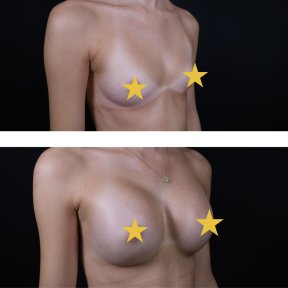
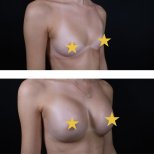
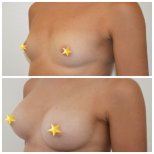
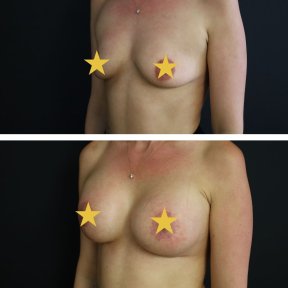
Before and after breast augmentation results at Esthétique du Nord, enhanced breast volume
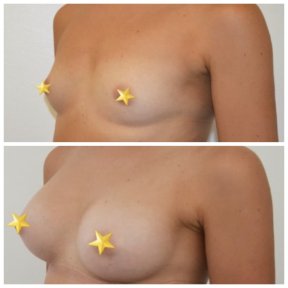
Before and after breast augmentation at Esthétique du Nord, visible volume increase result
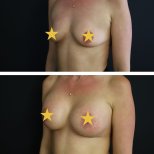
Before and after breast augmentation results at Esthétique du Nord – enhanced breast volume
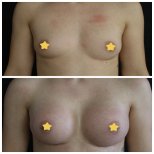
Before and after breast augmentation results at Esthétique du Nord, enhanced breast volume
20 years of experience

Basic Breast Augmentation
  • Technique: Basic breast augmentation without the use of implants.
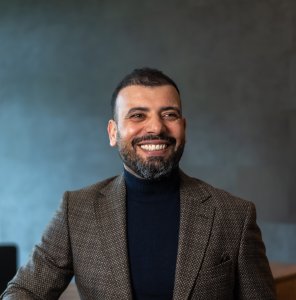
  • Walid Eljabu is triple board-certified in plastic aesthetic surgery, hand surgery, and trauma surgery, ensuring advanced anatomical expertise.
  • Esthétique du Nord is led by Dr. Eljabu, who trained at leading institutes in Sweden and Turkey for aesthetic procedures.
  • Included Services: Consultation with a plastic surgeon.
  • Stay Info: 1 day stay in the hospital room; hotel accommodation is not included in the price.
You’ve viewed 1 of 8 packages

Discover the Best Breast augmentation Clinics in Germany: 8 Verified Options and Prices

The Bookimed clinic ranking is based on data science algorithms, providing a trusted, transparent, and objective comparison. It takes into account patient demand, review scores (both positive and negative), the frequency of updates to treatment options and prices, response speed, and clinic certifications.

Breast augmentation in Germany: Your Travel Plan

Day 1: Arrival in Germany
  • Upon landing in Germany, you should ensure you have all necessary documents, including your passport, medical records, and appointment confirmation.
  • Check into your accommodation and rest after your journey. This will help you prepare for upcoming medical procedures.
  • Familiarize yourself with the local area and transport options to the clinic.
  • Stay hydrated and avoid alcohol or heavy meals. This will help maintain optimal health before your preoperative examination.
Day 2: Preoperative Consultation and Examination
  • You need to visit the clinic for your scheduled preoperative consultation. This includes a mammological examination using ultrasound and possibly MRI/CT to check for conditions like tumor recurrence.
  • Discuss with your surgeon the specific techniques that may be used, such as implant placement or combined techniques using your own tissues for a natural breast shape.
  • Ask any questions you may have about the procedure, recovery, and follow-up care.
  • Receive a detailed preoperative plan and instructions on how to prepare for the surgery, including any dietary restrictions or medications to avoid.
Day 3-6: Preparation for Surgery
  • Follow any specific instructions provided by your surgeon, such as stopping certain medications or adjusting your diet.
  • Engage in light activities and avoid strenuous exercise. This will keep your body in optimal condition for surgery.
  • Arrange transportation to and from the clinic for the day of your surgery.
  • Prepare your post-surgery recovery area in your accommodation. Include any necessary supplies like special underwear (bustier) provided by the clinic.
  • Stay in contact with the clinic if you have any questions or concerns during this preparation period.
Day 7: Surgery Day
  • Arrive at the clinic on time for your scheduled breast augmentation surgery.
  • The procedure may involve a left breast augmentation and a right breast lift, depending on the preoperative plan.
  • Undergo anesthesia and the surgical procedure, which typically takes a few hours.
  • After the surgery, you will be monitored in a hospital setting for 2-3 days to ensure a safe recovery.
  • Follow all postoperative care instructions provided by the medical team.
Day 8-9: Postoperative Hospital Stay
  • During your hospital stay, receive early postoperative rehabilitation and care to promote healing.
  • Rest and allow your body to recover, following any mobility or activity guidelines provided by your healthcare team.
  • Discuss your recovery progress with your surgeon and address any concerns you may have.
  • Plan your discharge and ensure you have all necessary medications and care instructions for your return to your accommodation.
Day 10: Discharge and Recovery
  • Return to your accommodation and continue your recovery following the clinic's guidelines.
  • Wear the special underwear (bustier) provided to support your breasts as they heal.
  • Engage in light activities and avoid lifting heavy objects or engaging in strenuous exercise.
  • Keep the surgical area clean and dry. Monitor for any signs of infection or complications.
  • Stay in contact with the clinic and schedule any necessary follow-up appointments before your departure.
Day 11-12: Follow-up and Departure Preparation
  • Attend any scheduled follow-up appointments to assess your recovery progress.
  • Discuss long-term care and any additional follow-up visits needed after returning home.
  • Ensure you have all medical records and documentation of your procedure for future reference.
  • Prepare for your return home. Ensure you have all personal belongings and travel arrangements in place.
  • Contact the clinic if you have any final questions or require assistance before departure.
Day 13: Departure from Germany
  • Check out of your accommodation and travel to the airport for your return flight home.
  • Continue to follow postoperative care instructions during your travel to ensure a smooth recovery.
  • Plan for follow-up visits as per the schedule provided by your surgeon

Bookimed, a leading global medical tourism platform, is committed to helping clients looking for Breast augmentation in Germany by offering expert assistance and trustworthy medical solutions for every situation. Smart automatic ranking system is used to compose transparent clinic listings, meticulously maintained by a data scientist using AI for accuracy. The platform guarantees authenticity by publishing reviews from real patients after their treatments. Bookimed offers comprehensive medical solutions, with updates from clinics to ensure trustworthiness. The content about Breast augmentation in Germany, crafted by experienced medical authors and reviewed by specialists, adheres to Bookimed"s Editorial Guidelines, reflecting the platform"s commitment to delivering high-quality and clear health information. For more details or inquiries, feel free to contact us at marketing@bookimed.com or learn more about us and our mission here.

Our Doctors

View all Doctors
verified

Manuela Seifert

26 years of experience

Dr. Manuela Seifert leads the Breast Cancer Center at Solingen Clinic, specializing in breast-sparing surgeries and aesthetic reconstruction.

  • Over 26 years of experience of experience in gynecology and breast health
  • Expert in breast-sparing techniques for better aesthetic outcomes
  • Provides comprehensive care from diagnosis to postoperative support
  • Head of the Breast Cancer Center at Solingen Clinic
verified

Walid Eljabu

20 years of experience

Board-certified in Plastic & Aesthetic, Hand, and Trauma Surgery – Dr. Eljabu brings rare anatomical expertise to breast augmentation at Esthétique du Nord.

  • Specialized training in Sweden and Turkey for aesthetic refinement
  • Member of both the Rhinoplasty Society of Europe and American Society of Plastic Surgeons
  • CEO and Head Surgeon at Esthétique du Nord Hamburg
  • Uses advanced surgical knowledge for natural-looking results
verified

Mahdi Rezai

34 years of experience

Dr. Mahdi Rezai has treated over 21,000 breast cancer patients and is a leading breast specialist in Germany.

  • Head of Breast Center at Luisenkrankenhaus, University Hospital in Dusseldorf since 1996
  • Specializes in minimally-invasive and breast-preserving treatments
  • Founder of the West German Study Group Breast Cancer
  • Recipient of the Order of Merit of the Federal Republic of Germany
  • Member of multiple prestigious international breast cancer organizations

Video Stories from Bookimed Patients

Vika
In a few hours, I went from being self-conscious to loving my new look.
Procedure: Breast augmentation
Alona
A beautiful, natural shape and symmetry. Exactly what I wanted!
Procedure: Breast augmentation
Clinic: Dr. MED
Alina
I went from an A to a B cup, and I’m thrilled with the results!
Procedure: Breast augmentation

Breast augmentation: Before & after photos

View all

Related Articles

View more

Share this content

Updated: 05/27/2022
Authored by
Anna Leonova
Anna Leonova
Head of Content Marketing Team
A certified medical writer with 10+ years of experience, developed Bookimed’s trusted content, backed by a Master’s in Philology and medical expert interviews worldwide.
Fahad Mawlood
Medical Editor & Data Scientist
General practitioner. Winner of 4 scientific awards. Served in Western Asia. Former Team Leader of a medical team supporting Arabic-speaking patients. Now responsible for data processing and medical content accuracy.
Fahad Mawlood Linkedin
This page may feature information relating to various medical conditions, treatments, and healthcare services available in different countries. Please be advised that the content is provided for informational purposes only and should not be construed as medical advice or guidance. Please consult with your doctor or a qualified medical professional before starting or changing medical treatment.

Our Breast augmentation Techniques: What Suits You Best?

When considering Breast augmentation, it’s important to understand the different techniques and which is best suited for you. Here’s a concise comparison of popular options:

Breast Augmentation with Fat Transfer

This breast enhancement method involves transferring fat from other body areas to the breasts to increase volume.

Pros: Uses your body's fat, reducing the risk of rejection. Offers more natural results compared to pectoral implants. Avoids foreign materials like silicone or saline implants.
Cons: Typically achieves a smaller increase in size compared to tear drop implants. Requires enough donor fat from other body areas.
Effectiveness: Success rate of 60-80% for fat survival in the transferred area.
Duration: 3-5 hours
Recovery: 2-4 weeks
Best for: Women seeking modest breast enlargement and body contouring. Suitable when natural results are desired.
Prices: Cost of Breast Augmentation with Fat Transfer in Germany from $8,000

FAQ about Breast augmentation in Germany

These FAQs come from real patients seeking medical assistance through Bookimed. Answers are given by experienced medical coordinators and trusted clinic representatives.

What incision and placement methods are most common in Germany?

German plastic surgeons primarily use inframammary incisions and dual-plane implant placement to ensure natural results. The inframammary approach offers precise surgical access, while dual-plane placement combines submuscular and subglandular techniques to optimize tissue coverage and minimize visible implant edges.

  • Inframammary incision: Most common method involving a 3–4 cm cut within the natural underbust crease.
  • Dual-plane placement: Preferred standard for natural teardrop silhouettes, placing the implant partially under the muscle.
  • Subfascial placement: Growing trend offering faster recovery by positioning implants directly under the muscle fascia.
  • Transaxillary approach: Niche armpit incision used at specialized centers to keep the breast tissue scar-free.

Bookimed Expert Insight: German clinics like Esthétique du Nord in Hamburg often utilize B-Lite lightweight implants paired with microsurgical techniques. This combination is a strategic choice for patients seeking long-term stability, as lighter implants reduce tissue sag over time compared to traditional silicone options.

Patient Consensus: Patients frequently report that the inframammary scar becomes nearly invisible within the breast fold. Most emphasize that consultations focus heavily on achieving a conservative, natural shape rather than dramatic volume.

Will German health insurance cover breast augmentation?

German health insurance generally excludes breast augmentation unless you document a physical medical necessity. Public and private insurers categorize purely cosmetic procedures as elective. You may secure coverage for reconstruction after cancer, severe congenital deformities like tubular breasts, or documented gender-affirming care transitions.

  • Reconstructive surgery: Full coverage is standard following mastectomy or trauma-related breast loss.
  • Congenital deformities: Insurers may approve cases involving Poland syndrome or severe breast asymmetry.
  • Gender-affirming care: Coverage requires completing hormone therapy and psychotherapy per insurance guidelines.
  • Psychological exclusion: German law typically denies coverage for psychological distress without physical malfunction.

Bookimed Expert Insight: Documentation wording is the deciding factor for German insurers. Using terms like reconstruction or correction of deformity rather than cosmetic enhancement significantly improves approval odds. Clinics like Esthétique du Nord in Hamburg provide detailed consultations that help clarify if your specific case meets these strict physical criteria.

Patient Consensus: Many patients find that obtaining pre-authorization is the only way to avoid full out-of-pocket costs. Most successful cases rely on a surgeon's official medical report detailing a physical anomaly rather than emotional suffering.

What is the typical recovery timeline after surgery?

Recovery after breast augmentation in Germany typically includes a 1 day hospital stay for monitoring. Most patients return to light work within 7 to 14 days, while physical activities and heavy lifting are restricted for 6 weeks to ensure proper tissue healing and implant positioning.

  • Initial phase: Expect tightness and chest soreness during the first 3 to 7 days post-surgery.
  • Hospital stay: German clinics like Esthétique du Nord provide 1 day of clinical observation.
  • Physical restrictions: Avoid lifting over 10 pounds or reaching overhead for at least 3 weeks.
  • Final results: Tissues fully settle and implants reach their final position after 3 to 6 months.

Bookimed Expert Insight: While basic packages focus on the surgery, premium options in Germany often include a 3 to 7 day 5-star hotel stay. This is strategic because local surgeons, like triple board-certified Dr. Walid Eljabu, prefer patients to remain nearby during the critical first week for immediate follow-up if needed.

Patient Consensus: Patients find the first week most challenging due to limited arm mobility and sleep discomfort. Many emphasize that while you may look recovered early on, the mental patience required for internal healing is often underestimated.

How can I verify a surgeon’s qualifications in Germany?

Verifying a surgeon in Germany requires checking regional medical chambers called Landesärztekammer. Since Germany lacks a central national registry, you must use state-specific Arzt-Suche directories to confirm an active license (Approbation) and Facharzt specialist designation in plastic and aesthetic surgery.

  • Regional registration: Every surgeon must register with the Landesärztekammer of their specific federal state.
  • Specialist titles: Confirm the title Facharzt für Plastische und Ästhetische Chirurgie for specialized training.
  • Insurance directories: Use Kassenärztliche Vereinigung (KV) portals to verify surgeons billing the public system.
  • Hospital reports: Access Qualitätsberichte via Deutsches Krankenhausverzeichnis to review department volumes and complication rates.

Bookimed Expert Insight: German surgeons often hold multiple certifications across different countries. For instance, Dr. Walid Eljabu at Esthétique du Nord is triple board-certified in plastic, hand, and trauma surgery with credentials from the Royal College of Surgeons of Edinburgh. Checking for international memberships like ISAPS or ASPS alongside German registration provides an extra layer of quality assurance.

Patient Consensus: Patients emphasize looking for a board-certified plastic surgeon rather than a cosmetic doctor. They recommend asking for specific annual caseload numbers and confirming the surgeon personally handles any potential follow-up care.

Can I still breastfeed or undergo breast-cancer screenings after the procedure?

You can safely undergo breast cancer screenings and breastfeed after augmentation in Germany. Surgeons prioritize submuscular placement and inframammary incisions to keep milk ducts and nerves intact. Modern German facilities use specialized displacement mammography and high-precision ultrasound to ensure implants do not compromise diagnostic accuracy.

  • Screening accuracy: Technologists use displacement views to push implants back, maximizing visible natural tissue.
  • Advanced imaging: Clinics like Medical Center Solingen utilize 3D mammography for superior diagnostic precision.
  • Breastfeeding safety: Inframammary incisions under the breast crease typically leave the milk delivery network untouched.
  • Implant placement: Submuscular positioning minimizes interference with glandular tissue compared to placement above the muscle.

Bookimed Expert Insight: While many focus on silicone versus saline, the incision site is actually the critical factor for future nursing. Data suggests that choosing a surgeon like Dr. Walid Eljabu at Esthétique du Nord, who specializes in advanced microsurgical techniques, reduces the risk of nerve damage that can impact milk let-down.

Patient Consensus: Individuals emphasize that while breastfeeding usually succeeds, you must alert mammogram technicians about implants beforehand. Some patients also recommend regular self-exams, noting that any new lumps or changes require immediate clinical evaluation.

What types of breast implants are permitted and considered safe in Germany?

Germany permits cohesive silicone gel and sterile saline implants as the only primary materials for breast augmentation. These devices are strictly regulated as CE Class III medical items under the European Medical Device Regulation. The Federal Institute for Drugs and Medical Devices monitors all permitted variants for safety.

  • Silicone gel implants: Use highly cross-linked, cohesive gel often called gummy bear implants for stability.
  • Saline solution implants: Feature a silicone shell filled with saltwater that the body absorbs if leakage occurs.
  • Surface safety standards: Smooth and nanotextured surfaces are permitted while macro-textured implants are restricted or banned.
  • Mandatory registry tracking: Every procedure must be legally recorded in the National Implant Registry for patient safety.

Bookimed Expert Insight: German clinics like Esthétique du Nord in Hamburg often prioritize premium B-lite implants, which are up to 30% lighter than traditional silicone. This focus on advanced technology aligns with German surgeons’ preference for long-term tissue health and reduced strain on breast ligaments.

Patient Consensus: Patients prioritize cohesive silicone gel for its natural feel and often ask for specific documentation like the official European Implant Passport. There is a strong preference for smooth surfaces to minimize long-term inflammation risks.

Do breast implants need to be replaced after 10 years?

Breast implants do not require automatic replacement after 10 years. While not lifetime devices, the decade mark is a monitoring milestone rather than an expiration date. Modern silicone and saline shells often remain structurally sound for 15 to 20 years without medical intervention or complications.

  • Replacement triggers: Surgery is only necessary for ruptures, capsular contracture, or desired cosmetic changes.
  • Rupture detection: Saline leaks cause visible deflation, while silicone requires ultrasound or MRI monitoring.
  • Shell durability: Modern implants typically retain over 90% of their original tensile strength after 10 years.
  • Monitoring protocol: Surgeons recommend imaging every 2 to 3 years starting at year 5.

Bookimed Expert Insight: German clinics like Esthétique du Nord often utilize lightweight B-lite implants, which reduce long-term tissue sagging compared to standard silicone. Choosing advanced materials or non-implant fat transfer, which averages $8,000 in Germany, can eliminate the need for future implant-related revision surgeries entirely.

Patient Consensus: Many patients regret believing the 10-year myth and wish they knew implants often last much longer. They emphasize choosing surgeons who provide clear, long-term follow-up plans to monitor for silent ruptures.

Where are the incisions typically made and how visible are the scars?

Breast augmentation incisions in Germany are typically placed in the inframammary fold or around the areolar edge to minimize visibility. Surgeons like Dr. Walid Eljabu use advanced techniques to ensure scars settle into natural skin creases, typically fading into thin, faint lines within 6 to 12 months after surgery.

  • Inframammary incision: Placed under the breast fold, hiding scars within the natural lower crease.
  • Periareolar incision: Made around the nipple edge, blending with the natural pigmentation transition.
  • Scar maturation: Initial redness fades over months, eventually becoming difficult to detect.
  • German standards: Clinics in Hamburg and Nuremberg utilize meticulous suturing for optimal healing.

Bookimed Expert Insight: While many focus on scar location, the choice of implant often dictates the incision length. Packages at Esthétique du Nord featuring B-Lite lightweight implants are popular because these implants can sometimes be inserted through slightly smaller, more refined incisions than traditional silicone, potentially reducing the final scar footprint.

Patient Consensus: Patients emphasize that the inframammary approach is the most discreet option for most body types. While scars appear red initially, they consistently report that the lines become nearly invisible once they reach the one-year mark.
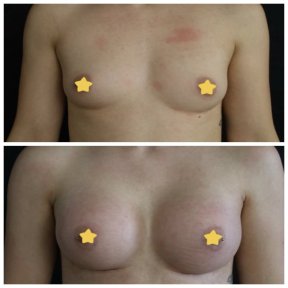
Should the implant be placed over or under the chest muscle?

Choosing implant placement depends on your anatomy and desired look. Under the muscle placement provides natural results and reduces visible rippling for thin patients. Over the muscle placement offers a faster recovery and is ideal for women with sufficient natural tissue or active lifestyles.

  • Submuscular placement: Provides superior long-term support and masks implant edges in petite patients.
  • Subglandular placement: Sitting entirely above the muscle, this technique prevents distortion during heavy chest exercise.
  • Recovery time: Over the muscle placement leaves chest muscles intact, ensuring a faster return to work.
  • Advanced options: German clinics specialized in breast health also offer natural fat transfer and B-lite implants.

Bookimed Expert Insight: German surgeons like Walid Eljabu at Esthétique du Nord carry rare triple board certifications. This anatomical expertise is crucial when navigating complex dual-plane placements. We see many patients choosing Germany specifically for this high level of surgical precision and microsurgical background.

What is the typical recovery timeline after breast-augmentation surgery in Germany?

Recovery from breast augmentation in Germany typically requires 6 to 8 weeks for structural healing, with final aesthetic settling taking 12 months. Patients usually resume desk work within 5 to 7 days, though German surgeons strictly prohibit driving for 14 days and heavy lifting for 6 weeks.

  • Hospital stay: Most clinics require 1 night for observation following general anesthesia.
  • Activity restrictions: Heavy lifting over 3 kg and arm elevation are restricted for 4 weeks.
  • Support garments: A compression bra and Stuttgart belt are mandatory 24/7 for 6 weeks.
  • Final results: Breasts undergo drop and fluff maturation over 3 to 12 months.

Bookimed Expert Insight: German clinics like Esthétique du Nord often prioritize premium B-Lite implants, which are 30% lighter than standard silicone. This weight reduction can positively impact long-term recovery by reducing strain on breast tissue and potentially slowing natural sagging over time.

Patient Consensus: Many find the first 3 to 7 days surprisingly difficult for basic tasks like bathing or dressing. They recommend planning for help at home as limited arm mobility is standard during the first week.

Do breast implants need to be replaced every 10 years?

Modern breast implants do not require automatic replacement every 10 years. While the FDA labels them as non-lifetime devices, high-quality silicone and saline implants frequently last 20 years or longer. Revision is only necessary if medical complications arise or you desire an aesthetic change in size or shape.

  • Annual monitoring: Yearly physical exams by a surgeon help detect early signs of shell wear.
  • Imaging protocols: FDA guidelines recommend an initial ultrasound or MRI after 5 to 6 years.
  • Silent ruptures: Recurring screenings every 2 to 3 years identify leaks in cohesive silicone gels.
  • Replacement triggers: Immediate surgery is indicated for capsular contracture, implant rupture, or visible deflation.

Bookimed Expert Insight: German clinics like Esthétique du Nord often utilize B-Lite lightweight implants to reduce long-term tissue strain. Our data shows that high-volume centers led by triple board-certified surgeons like Dr. Walid Eljabu focus on advanced microsurgical techniques. This precision helps minimize early scar tissue formation, which is a primary reason for premature implant replacement.

Patient Consensus: Many patients report their implants remaining intact and comfortable well beyond the 10-year mark. The prevailing sentiment highlights that monitoring through regular imaging is more vital than a fixed surgical deadline.

Get a free consultation

Select the best way to contact you