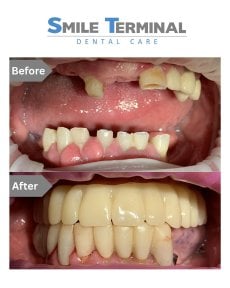
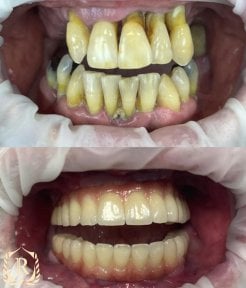
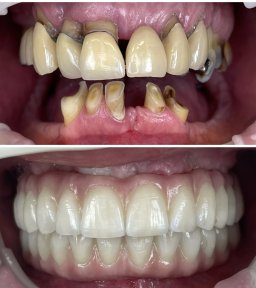
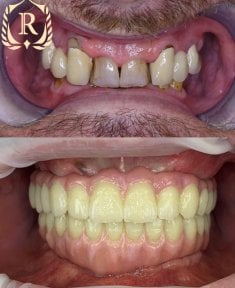
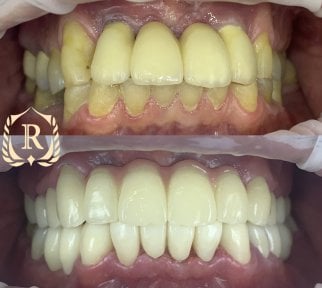
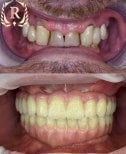
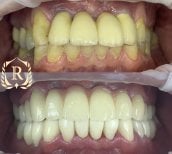
A full arch of fixed teeth supported by four dental implants can restore your smile and chewing ability, but in countries like the UK or the US, the price often puts it out of reach. The same treatment, however, can cost far less in Hungary. On Bookimed, full-arch dental implants in Budapest start at about $2,900, compared with more than $20,000 in the UK and around $25,000 in the US.
That's savings of up to 85%. The gap is real. But naturally it raises questions. Why is it more affordable? Is the quality the same? What does the price include? Here's a straight answer to each.
All-on-4 vs All-on-6: which option is right for you?
It may seem that the more implants, the better. The evidence says it isn't that simple.
Four implants vs six: long-term success
Peer-reviewed studies find no meaningful difference in how well four- and six-implant designs last. What matters most is not the number of implants or the bridge itself, but which jaw you're treating.
Implant success rates run around 94% in the upper jaw. The lower jaw does better, at 97% to 99%. The reason is simple: the lower jaw usually has denser bone, making it a more stable foundation for implants. In lower-jaw cases, about 95% of implants lasted 10 years, with strong results reported after follow-ups of up to 18 years.
So your surgeon may recommend a different number of implants for the upper and lower jaw. Both options come priced on Bookimed. Dentop Clinic lists All-on-4 from $6,000 and All-on-6 from $7,900.
Protecting your jawbone long-term
Bone loss is the main factor to consider with four implants. Studies report that All-on-6 designs may experience slightly less bone loss over time. Six implants spread bite force across more anchor points, though both designs survive equally well. Ask your surgeon to justify the plan from a 3D scan of your jaw.
Bite design matters too. The back teeth extend slightly beyond the implants, a section known as the cantilever. Experienced surgeons aim to keep this section short: about 6 to 9 mm in the lower jaw. A cantilever beyond 12 mm can increase mechanical issues, like screw loosening, by roughly 20%. Reputable clinics describe All-on-4 as a well-supported option, with results depending on individual factors.
How reliable is Hungarian dentistry? What independent cross-border data shows
Testimonials can show individual experiences. Independent data provides a broader picture.
Independent cross-border outcome data
The strongest safety signal is the clinic's outcome data gathered by outsiders. A Techniker Krankenkasse survey of German patients treated in Hungary tracked what happened after members flew home:
- About 72% needed no corrective aftercare.
- Roughly 22% had a follow-up planned in advance.
- About 95% of patients did not run into an unexpected issue needing treatment.
The same survey saw clinic equipment and organization rated good or very good about 98% of the time. Complications are uncommon, and when they do arise, most are routine to correct.
Why Budapest leads dental tourism
Hungary is one of Europe's largest destinations for UK dental patients, and Budapest sits about a 2.5-hour flight from the UK. Close enough to return if a check-up is needed. Researchers have studied Hungary's dental tourists for years, which is part of why the destination is so well documented.
Bookimed adds another layer of confidence. You're matched only to verified Hungarian clinics. Compare real ratings and patient numbers before you commit. Evergreen Dental, for one, holds a 4.9 rating across 20+ patient reviews. In our experience coordinating 270+ dental requests across Hungary, one pattern stands out: starting with a vetted shortlist makes the decision process more reliable.
How to choose a trusted Hungarian dental clinic, and who regulates them
Price is only one factor when choosing a clinic. Professional credentials and careful treatment planning matter just as much. Cleveland Clinic stresses that proper diagnostic planning and specialist assessment, not price alone, should drive implant care.
Who regulates Hungarian dentists
Every practicing dentist in Hungary must belong to the Hungarian Medical Chamber (MOK). Membership is mandatory to work, so your surgeon should hold it. State public-health authorities inspect clinics for sterilization, infection control, and radiation safety. National bodies also publish central clinical guidelines. Training is rigorous too: dentists complete a five-year EU-compliant degree, while oral surgeons undergo several additional years of residency for complex implant work.
The Code of Practice at Leading Clinics
Leading clinics follow a shared code. They have teams of specialist dentists with postgraduate diplomas, as well as in-house 3D CBCT planning, high annual implant volumes, and liability insurance enforceable across Europe. Bookimed's verified clinics demonstrate these standards in practice. BMC Dental Klinik is ISO-certified and ranks first among nearly 500 clinics by Global Clinic Rating. Implant4Life by Smilefactory holds a Nobel Biocare All-on-4 Clinic of Excellence award and plans every case on CBCT.
How to verify a clinic yourself
Before you book All-on-4 dental implants in Budapest, run a short check:
- Confirm the surgeon's Chamber membership and university.
- Ask which implant brand and 3D planning (CBCT) they use.
- Check that liability insurance covers you as an overseas patient.
Bookimed lists 45+ verified Hungarian clinics, so you start from a vetted shortlist. For example, Dr. Adam Bodnara is a Semmelweis alumnus who treated 1,300 patients in 2019. Meanwhile, Dr. Sofiane Menzou has worked with over 1,500 patients in a single year. Both are Chamber members with credentials shown on their profiles. From what we see across our verified Hungarian shortlist, these credentials help patients compare clinics based on experience and qualifications.
Are you a candidate? The health checks and 3D scan that must come first
A few health checks can determine whether All-on-4 is suitable for you.
Who needs extra screening before All-on-4
A few health conditions need attention before surgery. Conditions to stabilize first:
- uncontrolled diabetes (unstable blood sugar);
- high blood pressure;
- an underactive thyroid;
- osteoporosis;
- heavy teeth-grinding (bruxism);
- active smoking.
None is an automatic no. Each just needs a plan. In a review of failed implants, high blood pressure was the most common underlying condition.
Why a 3D CBCT is non-negotiable
A 3D CBCT scan should come before any firm price. It maps your bone thickness, density, and nerve position so implants sit safely. Never accept a fixed quote or "guarantee" based on a flat 2D X-ray alone.
All-on-4's angled back implants often avoid bone grafting when bone loss is moderate. Severe loss can still need a graft or sinus lift first. That may add a visit worth confirming from your scan. Bookimed's Hungarian clinics list this capability. Medicover MDental Clinic reports 15,200+ implants placed at a 98.6% success rate.
Realistic success rates
Implant success rates are typically around 95% to 98%.
Two gum issues are worth knowing. Reversible inflammation around an implant, called mucositis, is common but treatable at a cleaning visit. The deeper, bone-affecting form, peri-implantitis, is less common. Catching the reversible kind early can help protect the surrounding gum and bone.
Managing underlying health conditions can significantly improve implant outcomes. Patients with well-controlled conditions have better results, while unmanaged conditions may increase the risk of peri-implant problems. That's exactly why pre-screening matters. Surgeons like Dr. Kornelia Juhasz have placed over 1,000 implants each and plan from a full 3D assessment.
The real All-on-4 cost: what the package includes
Advertised prices are often starting prices. On Bookimed, Hungarian All-on-4 dental implant offers span roughly $2,900 – $13,600. The low end usually covers surgery plus a temporary bridge, not the finished result.
| Usually included | Confirm before you book |
|---|
| Implants and abutments | The final zirconia bridge |
| Consultation and 3D scan | Extra diagnostics or extractions |
| A temporary bridge | Accommodation and airport transfers |
What packages usually include
Rosental Dental's All-on-4 package at around $8,100 is one of the fuller bundles. It covers the maxillofacial and dentist consultation, panoramic X-ray, 3D scan, and implants. It also covers a temporary prosthesis, apartments, and airport transfer. Other packages include fewer extras. Smile Terminal Dental Care's All-on-4 is priced at around $9,800, with accommodation not included in the package. It does, however, include the permanent zirconia bridge.
Costs to confirm before you book
Cleveland Clinic describes implant work as a staged process. The biggest single variable is the final prosthesis. Base packages may deliver a temporary acrylic (PMMA) bridge. Upgrading to a definitive zirconia bridge, fitted on your second visit, is a separate charge. The provisional acrylic bridge is designed for the early healing stage. A final bridge made with stronger materials, such as titanium or metal-ceramic, is fitted later for long-term durability.
Small line items add up too. At some clinics, a single crown starts around $290 and a single implant near $1,000. Compare full treatment packages, not just starting prices. You can weigh All-on-4 in Poland the same way.
Refunds, tax and Brexit: what UK and Irish patients can actually claim
Before you count on a refund, know the rules. They differ sharply by where you live.
UK residents: what you can (and cannot) claim
If you live in the UK, plan to self-fund. After Brexit, the EU cross-border reimbursement route closed for UK residents. The NHS won't refund dental treatment received abroad. The NHS S2 planned-treatment route funds only pre-approved state healthcare. It's essentially never granted for private dental tourism. Private work in Budapest is a personal, non-deductible expense under UK tax rules. Any refund for pre-planned treatment stays inside those narrow state-care conditions.
Irish residents: 20% MED 2 relief
Ireland has a different approach. Residents can claim 20% tax relief on non-routine dental treatment abroad. That includes implants, crowns, and bone grafts. The practical step? Ask your Hungarian clinic to complete and sign the Revenue MED 2 form for your claim.
| Country | State funding | Tax relief | What to do |
|---|
| United Kingdom | None for private dental abroad | Non-deductible | Budget to self-fund |
| Ireland | None | 20% via MED 2 | Have the clinic sign your MED 2 |
Any dispute is handled under Hungarian law through the dental chamber or EU contact point, not UK consumer law. So specialist medical-travel insurance is worth considering. For many patients, the cost is a major factor in the decision. Hungary starts at $2,900. The UK runs $20,000 to $35,000. The US runs $25,000 to $35,000. You can also compare All-on-4 in Turkey.
After you fly home: aftercare, the "domestic refusal" trap and your implant passport
The surgery date isn't the finish line. What you arrange for the months and years after matters more.
Here's the short recovery arc most patients follow:
- Days 1–3: rest, soft-food diet and ice packs, with a temporary bridge already in place.
- Days 7–14: sutures come out if they're not self-dissolving. Most people feel fit to fly by then.
- Weeks 2–12: osseointegration, so keep to soft foods and avoid heavy chewing on the new arch.
Implants have strong long-term results when they are properly maintained. Regular check-ups and good oral hygiene help catch early signs of inflammation and protect the health of your implants over time. Some UK and US dentists decline to service implants placed abroad, often because they lack the specific brand's tools. Line up a local dentist willing to maintain your implants before you travel. The American Dental Association recommends having a dental home to support continuity of care.
The Implant Passport to request
Your key record for future care is an implant passport. Before leaving Budapest, collect a document that lists the exact implant manufacturer, model, and serial or lot numbers. Any dentist at home can then order the correct parts.
Brand choice makes this easier. Widely documented systems like Straumann or Nobel Biocare are far simpler for a local dentist to source components for. Less common brands may be harder to maintain if replacement components are not widely available. Adding an extra layer of protection, Budapest Dental Solutions backs its work with a written guarantee covering implants and All-on-4.
Your home maintenance schedule
Day-to-day care keeps the bridge lasting. Clean under the fixed bridge daily; a water flosser helps. Use non-abrasive products. Keep professional implant cleanings on schedule. Post-surgery hygiene steps help support healthy healing while everything settles. Establishing that routine, and a dentist to maintain it, helps ensure continuity of care after treatment abroad.