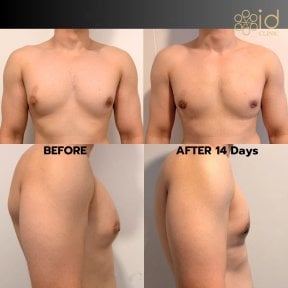
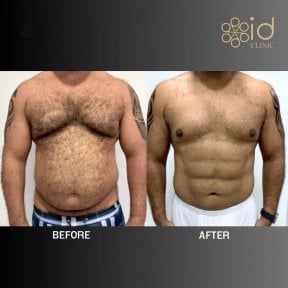
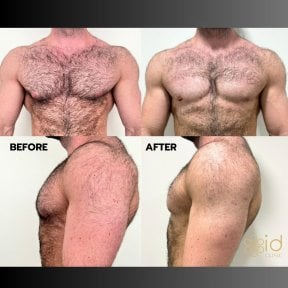
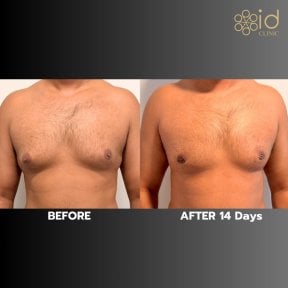
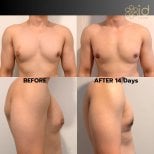
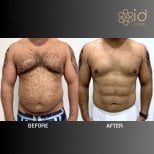
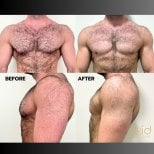
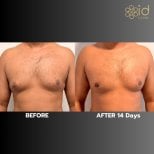
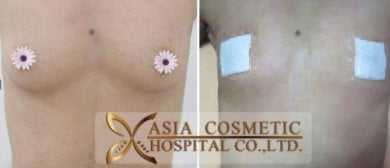
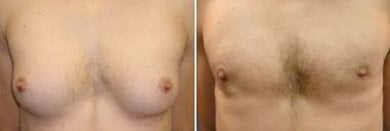
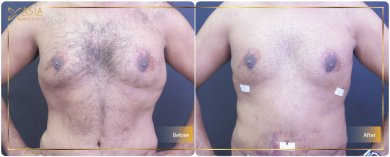
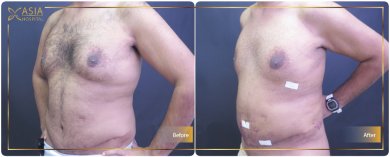
Up to 65% of men develop some degree of gynecomastia in their lifetime, according to Medical News Today. Yet most live with it for years before acting. The hardest part is rarely the surgery itself. It's knowing which procedure you actually need and who is a safe candidate. It's understanding what recovery really looks like far from home. Standard gynecomastia surgery in Thailand starts at around $2,200, against $4,500 – $8,500 in the United States. Every figure here comes from Bookimed data across 15+ Thai partner clinics.
Why Liposuction Alone Often Falls Short – Choosing the Right Technique
Two men with the same puffy chest can need two completely different operations. The difference comes down to which type of tissue is causing it. Get this wrong, and the chest looks fine at first, then changes again. That distinction changes the surgery.
Pseudogynecomastia vs true gynecomastia
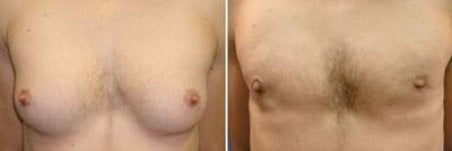
Pseudogynecomastia is an enlarged chest caused by excess fatty tissue. It spreads softly and diffusely, and it responds well to liposuction on its own. True gynecomastia is different. Dense, firm glandular tissue grows directly behind the nipple. Mayo Clinic describes this as real glandular growth rather than fat. A scalpel is needed to remove it. Liposuction physically cannot.
A quick self-check helps. Firm, rubbery tissue under the nipple that doesn't shift or shrink with weight loss is the defining sign. That points to true gynecomastia. Soft, even fullness across the whole chest points instead to fatty tissue. Standard surgical guidelines require direct excision for glandular tissue, not suction.
How Thai surgeons combine techniques
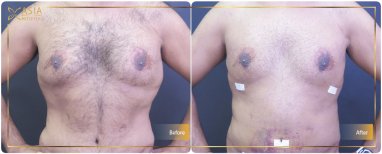
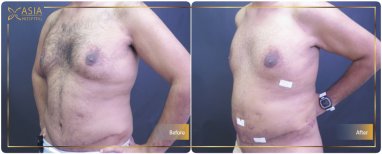
When glandular tissue is left behind, hormones can re-stimulate it and the fullness returns. That's a leading driver of repeat surgery. This is why advanced clinics rarely rely on one method. The fix is to treat both tissue types in one operation. VASER or power-assisted liposuction gently breaks up and removes the fatty layer across the chest. Periareolar gland excision then removes the firm gland. The incision tucks along the lower edge of the areola, where the scar fades well.
A recent cohort study of combined liposuction and gland excision reported a mean satisfaction of 4.8 out of 5. Nearly 9 in 10 patients rated their result as very good. Among Bookimed partners, ID Clinic Bangkok (rated 4.4/5) is tagged for combined fat and glandular removal. Asia Cosmetic Hospital handles complex and revision cases. Combined VASER procedures run about $3,200 – $4,800. Standard surgery runs $2,200 – $3,400. Patients who've had a previous operation can review revision surgery in Thailand separately.
Who Is a Good Candidate for Gynecomastia Surgery in Thailand?
A careful clinic won't simply book you in. Before approving surgery, a thorough surgeon checks why the tissue grew in the first place. In some cases the chest will settle on its own, and in rare cases the cause needs treating first.
Medical screening requirements
A hormone panel comes first. Blood tests for thyroid, testosterone, estradiol, prolactin, and LH help rule out hormonal causes. Examples include an overactive thyroid or low testosterone. Surgical guidelines call for hormone and liver tests before approval. Imaging matters too. A firm lump on one side only should trigger an ultrasound or mammogram before any cosmetic step. This rules out rarer causes.
This screening is one reason accreditation matters. Asia Cosmetic Hospital is JCI-accredited and ISO certified, with a principal surgeon who is an active ISAPS member. Wansiri Hospital (rated 4.7/5) runs 9 departments with operating rooms built to Clean Room air-filtration standards. All Bookimed-listed partner clinics in Thailand hold Royal College of Surgeons Thailand credentials, verified at the time of listing.
When to wait before surgery
Sometimes the right medical advice is patience. Certain causes resolve on their own, and operating too early risks the problem coming back.
- Drug-related cases: anabolic steroids, marijuana, and some heart or mood medications can trigger gynecomastia. Guidelines ask patients to stop the trigger for 6 to 12 months, then reassess.
- Younger patients: Mayo Clinic notes that adolescent gynecomastia often clears within 6 months to 2 years. Waiting is usually advised.
- Psychological readiness: men who expect surgery to fix broader self-image concerns should speak with a mental health professional first. A standard consultation also screens for Body Dysmorphic Disorder (BDD), as ISAPS guidelines advise.
- Cooling-off period: a UK parliamentary review recommends at least two weeks between consultation and surgery. That gives you time to decide without pressure.
Your Thailand Recovery Timeline: What to Actually Expect
The chest contour matters, but recovery is what most patients worry about. That's doubly true when a long flight home is part of the plan. Knowing the timeline in advance removes most of that anxiety.
Day of surgery
Most procedures take 1 to 3 hours under general anesthesia. Fasting begins 6 to 8 hours before your scheduled start time. Plan to stay at the clinic for 4 to 6 hours in total, recovery included. Then your coordinator transfers you to your accommodation. Where possible, arrange for someone to travel back with you.
Fit-to-fly windows by procedure type
Flying too soon raises the risk of deep vein thrombosis. That's a blood clot that can form in the legs during long periods of sitting still. Cabin pressure changes and dehydration add to the risk. Written fit-to-fly clearance from your surgeon is mandatory, not a formality. Get it in writing.
| Procedure type | Minimum stay before flying |
|---|
| Liposuction only (minor) | 8 – 10 days |
| Combined liposuction with gland excision | 12 – 14 days |
Compression vest protocol
For the first four weeks, the vest is worn 24 hours a day and removed only to shower. It limits fluid build-up and helps the skin retract to your new chest shape. From weeks 4 to 8, you wear it during the day only, as the swelling settles.
Months 1 to 6: what to expect
Around weeks 6 to 8, patients may feel firm internal scar tissue under the skin. This is a normal part of healing, not a sign that something went wrong. It usually softens with gentle massage. Fluid collections such as a seroma most often appear 7 to 10 days after surgery. That's exactly why the supervised stay in Thailand matters. Final results emerge over 3 to 6 months as swelling fully subsides.
Worth knowing: a 5-star Bookimed reviewer from the UK summed up the experience well. As he put it, "the most difficult part has been the sleeping position limits." Coordination is rated 4.8/5 across Thai partner clinics. Patients at ID Clinic Bangkok report staff staying in contact through follow-up check-ups. That includes surgeons like Dr Phatcharasak Kraisornphongsakul (4.9/5). Patients comparing destinations can also consider gynecomastia surgery in Turkey.
What Are the Complication Rates for Gynecomastia Surgery in Thailand, and How Do You Stay Safe After Flying Home?
Honest numbers help more than a "0% complications" promise. The data on gynecomastia surgery is genuinely reassuring. Knowing it lets you plan calmly rather than worry.
What the data actually shows
A national multi-center database of nearly 1,800 patients found that over 98% of adults recovered successfully within 30 days. The same national database study reports revision rates ranging from 0.6% to 25%. That wide span mostly reflects how small touch-ups are counted alongside full reoperations. The most common early issue is a fluid or blood collection under the skin, a seroma or hematoma. That's why surgeons watch you closely in those first days.
Protecting yourself before you fly home
The real planning gap for overseas patients is aftercare. Research shows only about a quarter of medical-travel patients ever see their original surgeon again once home. When problems do crop up, the most common ones treated at home are infections and wound separation. A short checklist closes that gap:
- Request your full operative notes, translated into English, before you leave the clinic.
- Get your medication list and dosages written in English.
- Confirm how to reach the clinic remotely after you fly home.
This is where end-to-end support earns its keep. In our experience across Thai partner clinics, the revision cases we see most often trace back to one cause. The gland was missed in a liposuction-only procedure. Bookimed coordinators stay reachable after the trip. They can help arrange remote follow-up with your operating clinic, which is what the 4.8/5 coordination rating reflects.
For complex or revision cases, Asia Cosmetic Hospital carries JCI accreditation, an external safety credential rather than a marketing line. Thai pricing still lands up to around 60% below the US, with the surgeon and clinic already vetted for you.