

South Korea welcomes about 1.17 million international patients a year – and dental treatment is one of the key reasons. It ranks #2 for dental care quality among high-income countries, ahead of the US and the UK.
A single dental implant costs $650–$900 (about ₩880,000–₩1,220,000) at dental clinics in South Korea. That is up to 75% less than in the United States, where the same implant costs from $2,700.
The clinics in this guide use digital scans and their own dental labs, which can shorten your stay for crowns and veneers. Below are the clinics, the treatments they offer, what each treatment costs against US prices, and how to plan the trip.
Korean Dental Clinics at a Glance
Each clinic below treats foreign patients and has its own profile in the clinics section:
- S-Plant Dental Hospital (Seoul) – ★★★★☆ (4.2)
- Seoul Today Dental Clinic (Goyang, near Incheon Airport) – ★★★★★ (4.9)
- Yonsei JW Dental Clinic (Seoul) – ★★★★★ (4.9)
- Sinchon Dain Dental Hospital (Seoul) – ★★★★★ (4.9)
- 365 Seoul OneTop Dental Clinic (Seoul) – ★★★★★ (4.9)
- DARUN Dental Clinic (Seoul) – ★★★★★ (5.0)
- Guardians Dental Clinic (Myeongdong, Seoul) – ★★★★★ (4.7)
Table of Contents
- Why Choose a Dental Clinic in Korea?
- Top Korean Dental Clinics for International Patients
- Before and After Photos from Dental Clinics in Korea
- Types of Dental Treatment Offered by Clinics in South Korea
- How Much Does Dental Work Cost in South Korea?
- How to Choose a Korean Dental Clinic
- Planning a Dental Trip to Korea
- How to Organize Your Dental Treatment in Korea with Bookimed
- The Bottom Line
- Frequently Asked Questions
Why Choose a Dental Clinic in Korea?
Korea's population has the second-best dental health of ten high-income countries in an international oral health comparison, with the United States in third place. This ranking reflects better oral health outcomes, easier access to care, and lower costs compared to the US, UK, Canada, and Australia.
For a patient who travels from abroad, Korean dental care also offers the following:
- Specialist dentists. Korea's Ministry of Health and Welfare issues a dental specialist license in fields such as prosthodontics (crowns, bridges, and dentures), orthodontics, and gum treatment. Korean dentists have 10 to 20 years of experience and have trained internationally, including at top institutions like Johns Hopkins University. They are active members of professional societies such as the Korean Association of Orthodontists, the Korean Academy of Prosthodontics, and the Korean Society of Esthetic Dentistry.
- Accredited clinics. Korean clinics can be accredited by the Korea Institute for Healthcare Accreditation (KOIHA), the national body that audits safety and quality of care.
- Digital technology. Clinics use 3D scanners, CAD/CAM (computer-aided design and milling), and digital smile design, a computer preview of your new smile. Crowns in zirconia or ceramic can then be made on site within days, so you need fewer visits.
- Support for foreign patients. Clinics that treat international patients offer English-speaking dentists, online consultations before you travel, and airport pickup.
- Locations. The clinics in this guide are in Seoul and in Goyang, a city near Incheon International Airport.
The national system licenses the dentist and accredits the clinic, and on-site labs let you plan treatment around a short stay.
Top Korean Dental Clinics for International Patients
Bookimed ranks its partner clinics under its Ranking Policy. The order depends on the number of patients who chose each clinic and how quickly it sends treatment plans. Patient reviews and up-to-date prices and profiles also count.
1. S-Plant Dental Hospital – Seoul
S-Plant Dental Hospital focuses on implants and has placed over 23,000 of them since 2008.
- Its dentists graduated from Seoul National University.
- The clinic co-developed Anatomage Guide, 3D software that builds a model of your jaw to plan the position of each implant. The clinic reports a 99.6% implant success rate with this method.
- An on-site lab makes ceramic crowns and veneers, and a 3D-CT scanner is used to plan treatment.
Guided placement of this kind puts implants closer to the planned position than placement by hand, according to a review of 10 clinical trials.
2. Seoul Today Dental Clinic – Goyang
Seoul Today Dental Clinic is in Goyang, 30–40 minutes from Incheon International Airport.
- The clinic offers same-day tooth extractions, as well as prosthetics (replacement teeth such as crowns and dentures) and implants.
- Its multilingual team includes dentists who graduated from US universities and from Seoul National University Dental School.
- An on-site dental lab makes crowns and other replacement teeth.
3. Yonsei JW Dental Clinic – Seoul
Yonsei JW Dental Clinic is an official provider of the Straumann dental implant system.
- The clinic treats adults and children under one roof.
- Its patients come from Europe, Asia, North America, and Australia.
4. Sinchon Dain Dental Hospital – Seoul
Sinchon Dain Dental Hospital is approved by the Seoul Metropolitan Government and is a member of the Seoul Medical Tourism Alliance.
- 9 doctors work across 6 departments.
- The hospital provides dental care for children as well as cosmetic dentistry.
- The hospital has an on-site dental lab for crowns and other replacement teeth.
5. 365 Seoul OneTop Dental Clinic – Seoul
365 Seoul OneTop Dental Clinic is a private clinic in Seoul with KOIHA accreditation.
- The Ministry of Health and Welfare has approved the clinic to provide advanced regenerative medicine (treatments that use living cells to repair tissue).
- Its 9 doctors treat adults and children.
- The clinic offers full-arch implants with the Osstem implant system.
6. DARUN Dental Clinic – Seoul
DARUN Dental Clinic is led by US board-certified prosthodontists – dentists who specialize in crowns, bridges, veneers, and dentures.
- The clinic holds KOIHA accreditation.
- Its dentists are members of the Academy of Osseointegration and the American College of Prosthodontists.
- The clinic's own technique for crowns and veneers keeps as much natural tooth as possible, with the aim of making the work last longer.
- Same-day adjustments are possible, which reduces the number of visits.
7. Guardians Dental Clinic – Seoul
Guardians Dental Clinic in Myeongdong, Seoul, holds accreditation from the Korean Accreditation Program for Hospitals Serving Foreign Patients (KAHF).
- The clinic offers gum treatment, prosthodontics, and orthodontics (teeth straightening).
- Its specialists hold a dental specialist license from the Ministry of Health and Welfare.
- An on-site digital lab and a dedicated sterilization center are part of the clinic.
For veneers or a full smile makeover, S-Plant Dental Hospital, DARUN Dental Clinic, and Guardians Dental Clinic list this work among their treatments.
Before and After Photos from Dental Clinics in Korea
These photos show veneer, whitening, gum treatment, and dental cleaning results at clinics in this guide.
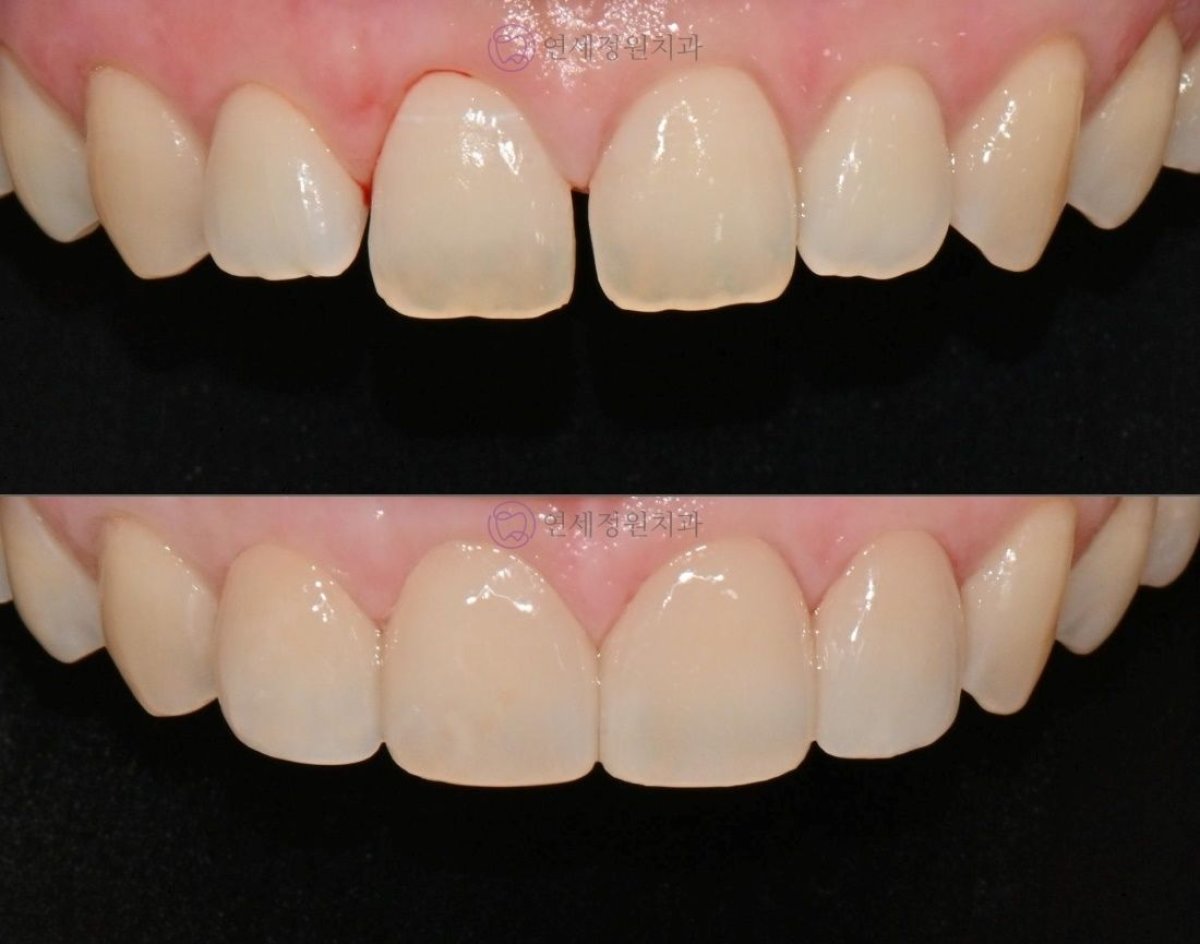
No-prep veneers (fitted without shaving the tooth) at Yonsei JW Dental Clinic

Porcelain veneers at Sinchon Dain Dental Hospital
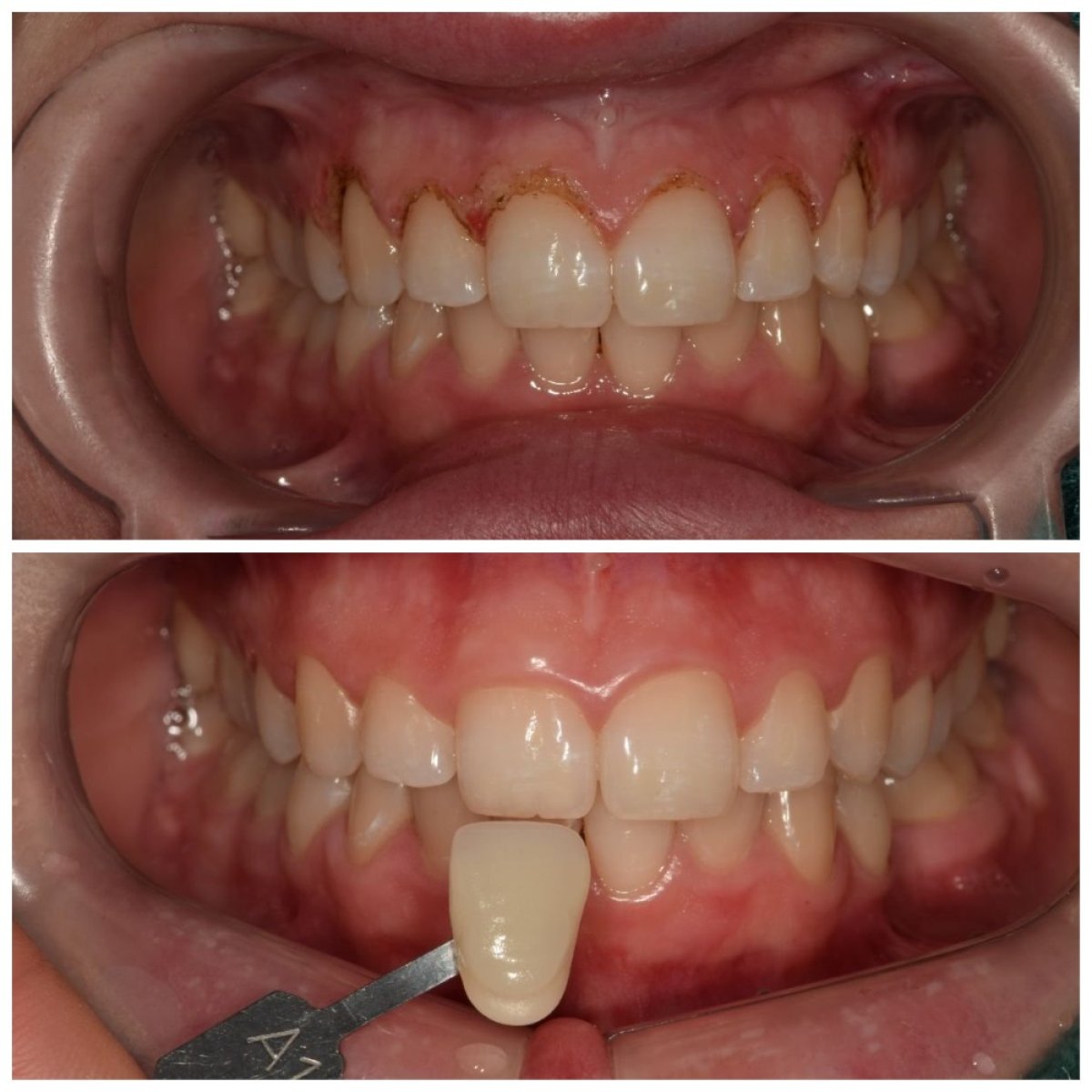
Gum treatment results
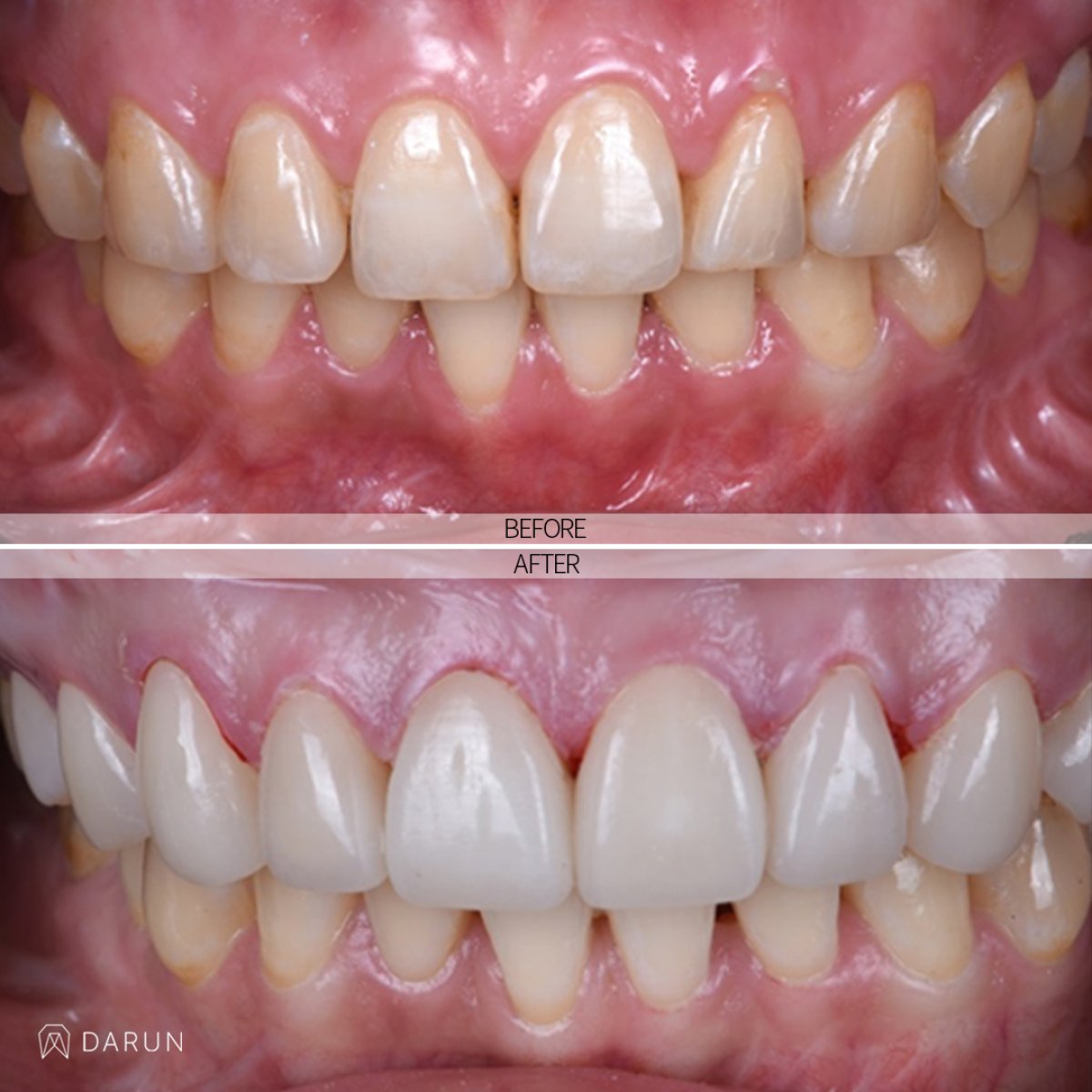
Teeth whitening results at DARUN Dental Clinic

Dental cleaning results
Types of Dental Treatment Offered by Clinics in South Korea
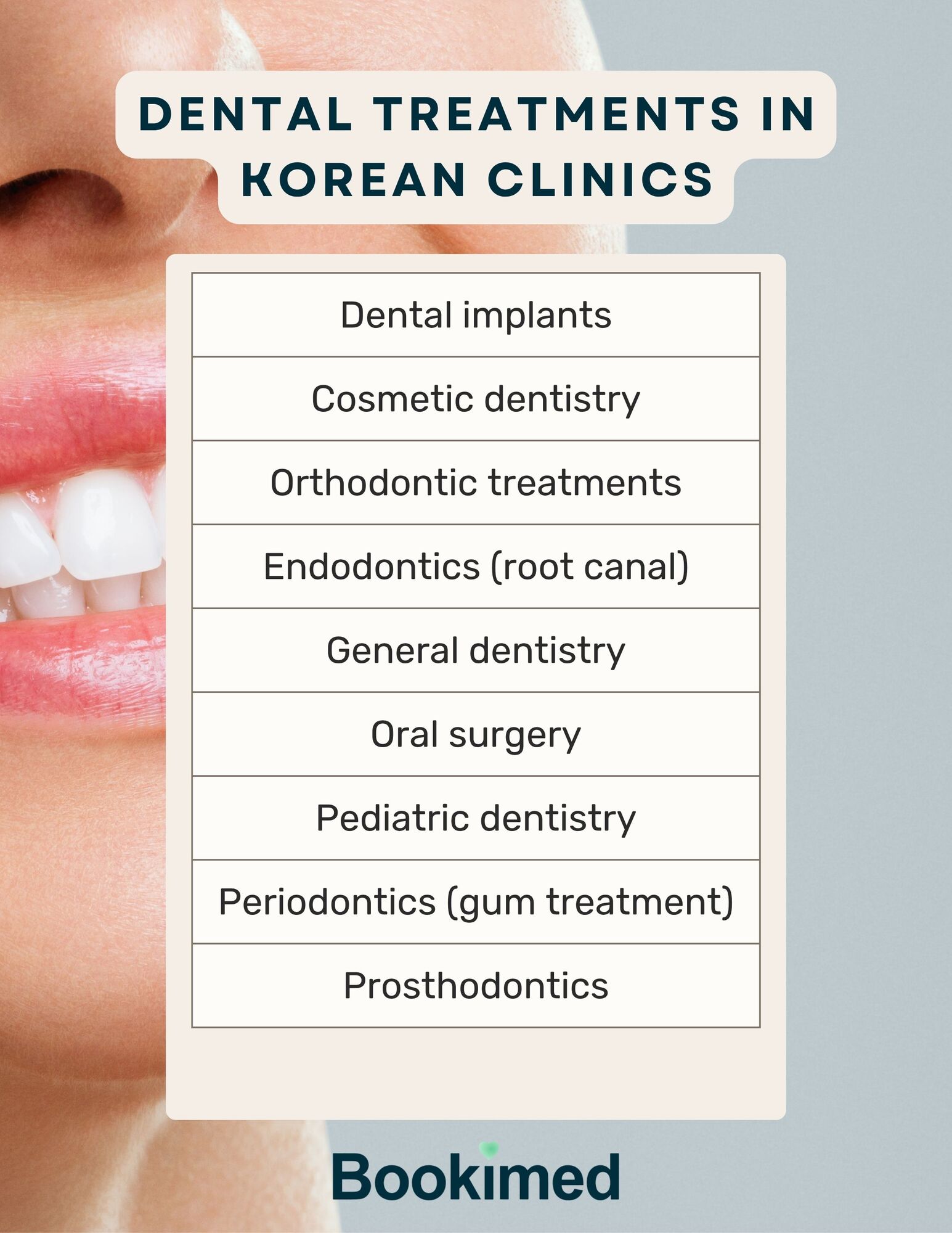
Korean dental clinics offer care from checkups and fillings to implants and smile makeovers.
Dental implants
Dental implants are permanent replacements for missing teeth: a titanium or zirconia post is fixed in the jaw and holds a new tooth. Korean clinics offer the full range of implant treatments:
- single implants;
- All-on-4 and All-on-6 full-arch implants, where a whole row of teeth is fixed on four or six implants;
- bone grafting and sinus lifts (adding bone to the upper jaw) when the jaw has lost bone.
Surgeons plan the position of each implant with 3D-CT scans and planning software.
Cosmetic dentistry
Cosmetic dentistry changes the color, shape, and alignment of your teeth. Options at Korean clinics include:
- porcelain veneers (thin shells bonded to the front of the teeth);
- dental crowns;
- teeth whitening with laser or LED light;
- smile makeovers.
A smile makeover is a planned combination of veneers, crowns, whitening, or gum shaping, designed around your face and smile line.
Orthodontic treatments
Orthodontic treatment straightens teeth and corrects the bite. Options include:
- clear aligners, such as Invisalign;
- metal braces;
- lingual braces, fixed behind the teeth so they stay hidden from view.
Orthodontists design aligners and braces from 3D digital scans, which lets them plan how each tooth moves and track the progress.
Root canal treatment
Root canal treatment removes infected tissue from inside a tooth, so you can keep it. Korean clinics use dental microscopes, digital X-rays, and a rubber dam. A microscope lets the dentist see the narrow canals inside the root. A rubber dam (a thin sheet around the tooth) keeps it dry and clean during treatment.
General dentistry and preventive care
General and preventive care keeps teeth healthy between larger treatments. Services include:
- routine checkups with intraoral cameras (small cameras that show the inside of your mouth) and digital X-rays;
- dental cleanings and exams;
- fluoride treatments and sealants (protective coatings on the back teeth) to prevent cavities;
- dental fillings, either composite or ceramic.
A checkup and cleaning each take a single visit, so you can add them to any dental trip.
Oral surgery
Oral surgery treats the teeth, gums, and jawbone. Common procedures include:
- tooth extraction;
- gum reshaping;
- apicoectomy (removing the tip of a tooth root).
Ask the clinic to list each surgical step in your treatment plan and how each one changes the dates of your trip.
Pediatric dentistry
Pediatric dentists treat children with gentle care and techniques that help a child stay calm. Services include:
- preventive cleanings;
- fluoride application;
- cavity treatment.
Among the clinics above, Seoul Today Dental Clinic, Yonsei JW Dental Clinic, and 365 Seoul OneTop Dental Clinic treat children as well as adults.
Gum treatment
Gum treatment manages gingivitis (gum inflammation) and periodontitis (gum disease that affects the bone around the teeth). Options include:
- deep cleaning below the gum line, called scaling and root planing;
- laser therapy;
- regenerative procedures that help lost gum tissue grow back.
Dentists treat gum disease first, before placing implants, crowns, or veneers.
Crowns, bridges, and dentures
This branch of dentistry, called prosthodontics, restores missing or damaged teeth. Treatments include:
- dentures, partial or full;
- dental bridges;
- crowns fitted on top of implants.
Dental technicians make these restorations with CAD/CAM milling and CEREC, a system that designs and mills a crown in the clinic in one visit.
How Much Does Dental Work Cost in South Korea?
A dental crown starts at $500 in Korea. That is up to 50% less than in the United States, where crowns start at $1,100. The gap is widest for root canal treatment, which costs from $250 in Korea, up to 85% less than the US price.
The table compares Korean and US prices for common treatments. Each saving compares the lowest Korean price with the lowest US price for the same treatment.
| Dental treatment | Cost in South Korea | Cost in the US | Savings vs the US |
|---|---|---|---|
| Porcelain veneers (per tooth) | from $750 (about ₩1,020,000) | from $900 | up to 15% |
| Single dental implant | $650–$900 (about ₩880,000–₩1,220,000) | from $2,700 | up to 75% |
| Full-arch implants (All-on-4) | from $7,400 (about ₩10,030,000) | from $12,000 | up to 35% |
| Dental crown | from $500 (about ₩680,000) | from $1,100 | up to 50% |
| Root canal treatment | from $250 (about ₩340,000) | from $1,700 | up to 85% |
| Braces | from $2,200 (about ₩2,980,000) | from $5,000 | up to 55% |
| Teeth whitening | from $300 (about ₩410,000) | from $450 | up to 30% |
| Dental bridge | $1,400–$3,100 (about ₩1,900,000–₩4,200,000) | from $3,300 | up to 55% |
| Smile makeover | $7,200–$14,500 (about ₩9,760,000–₩19,650,000) | $15,000–$30,000 | up to 50% |
Savings differ by treatment. A veneer costs close to the US price, while root canal treatment, single implants, bridges, and braces cost less than half the US price. Treating several teeth in one trip spreads the cost of the flight across more work.
Get a free quote
How to Choose a Korean Dental Clinic
To choose a Korean dental clinic, check its accreditation, your dentist's specialist license, and how the treatment fits the length of your stay. You can ask about each point below during an online consultation, before you pay for flights:
- Treatment focus. Choose a clinic that regularly performs your treatment, since Korean clinics differ in focus: one may center on implants, another on veneers or orthodontics. If the clinic performs it only now and then, compare it with a clinic that focuses on it.
- Specialist license. Ask whether your dentist holds a specialist license from the Ministry of Health and Welfare for your treatment. Prosthodontists handle crowns and bridges, and orthodontists handle braces. If the answer is no, ask which specialist plans your case.
- Accreditation. Ask whether the clinic holds KOIHA accreditation, the national check of patient safety and quality, or KAHF status, which assesses care for foreign patients.
- Implant brand. Ask which implant brand the clinic uses, so a dentist in your country can service the implant later. Straumann and Osstem are two of the systems used at the clinics in this guide.
- In-house lab and CT scanner. A clinic with its own lab and CT scanner can scan, plan, and make crowns on site. This can cut the number of days you spend in Korea.
- Before-and-after cases. Ask to see the clinic's before-and-after photos for the exact treatment you want. If it has none for that treatment, ask how often it performs it.
- Support for foreign patients. Look for English-speaking staff and a coordinator for international patients at the clinic.
- Airport access. Clinics near Incheon or Gimpo Airport may offer airport pickup, which saves time on a short trip.
A clinic that answers each point in writing gives you a plan you can compare line by line with other quotes.
Planning a Dental Trip to Korea
How long you stay in Korea depends on the treatment. Crowns, veneers, and root canal treatment can be finished in one trip, while implants are placed in two stages several months apart.
How many visits each treatment requires
Veneers and crowns made in a clinic's own lab can be ready within days, so one trip of several days may be enough. An implant takes longer, because the jawbone has to fuse with the implant post before the final tooth goes on.
Cleveland Clinic notes that this healing takes three to nine months, depending on how quickly your body heals. Plan one trip to place the implant and a second trip for the final crown. You can also ask the clinic whether it can fit a temporary tooth, so you do not travel home with a gap.
If you need a bone graft or a sinus lift before the implant, ask at the online consultation how this changes the timing. The clinic can then tell you the dates of both trips before you buy flights.
Side effects after implant surgery and aftercare
In a review of 10 clinical trials, more than 98% of implants were still in place a year after the new tooth was fitted. This result held with or without a surgical guide.
Mild discomfort and swelling are normal after implant surgery, and over-the-counter pain relievers ease them. You can expect to feel like yourself within a week or so, according to Cleveland Clinic.
Call your dentist if you notice any of these changes around an implant, because they can be signs of infection or a loose implant:
- a loose or wobbly implant;
- bleeding or swollen gums;
- fever;
- pus around the implant;
- swollen lymph nodes in your neck, along with one of the changes above.
Before surgery, tell the dentist about gum disease, diabetes, a bone disorder, or smoking. Each one can make it harder for the implant to anchor in the jaw and increase the risk of complications. The dentist can then treat the gums first or adjust the plan to keep that risk low.
Records to take home
Your dentist at home can check and maintain the work only if they know exactly what was done. Before you leave Korea, ask the clinic for:
- your X-rays and CT scan;
- a written summary of the treatment;
- the implant brand and size, in writing.
The CT scan shows the bone around each implant and its position. A local dentist can compare it with new scans and spot changes early. The X-rays show the state of the other teeth after treatment. The written summary lists every tooth that was treated, the materials used for crowns and veneers, and any bone graft or sinus lift.
Implant systems each use their own screws and connecting parts, so a dentist uses the implant brand and size to order matching parts for later care. Without this information, a simple repair, such as replacing a loose screw or a broken crown, can become slow and costly.
Ask for the records in English and as digital files, and keep copies on your phone and in email. You can then send them to any dentist for a repair or an adjustment. You can also share them with the Korean clinic if you have a question after you return.
How foreign patients are protected in Korea
Korea has national systems that check clinics serving foreign patients and help settle disagreements. The Korean Accreditation Program for Hospitals Serving Foreign Patients (KAHF) is backed by the Ministry of Health and Welfare. It assesses clinics on their care for international patients. A clinic that passes can display the KAHF logo, so look for it at the clinic.
The Korea Medical Dispute Mediation and Arbitration Agency (K-medi) is the state agency that offers mediation between patients and clinics. Its English-language service accepts applications from foreign patients.
How to Organize Your Dental Treatment in Korea with Bookimed
Bookimed's service is free for patients, who pay only the clinic's price with no markup. A medical coordinator helps you organize treatment in Korea in these steps:
- Fill in a short request form and describe the treatment you need.
- Send your X-rays or photos, so the clinics can prepare a treatment plan and a quote before you buy flights.
- Your coordinator helps you choose a clinic and arranges online consultations with dentists in Korea.
- Compare the treatment plans and quotes, and choose the clinic that fits your case.
- The coordinator arranges your appointment, helps with travel details, and stays in touch 24/7 during your treatment.
If your medical documents require translation, the coordinator can arrange a translation into the language the clinic requires.

- Technique: Invisalign
- Jeongwon Youn is an Invisalign provider and adjunct professor at Yonsei University specializing in orthodontics.
- Yonsei JW Dental Clinic serves around 5,000 patients annually from Europe, Asia, the USA, and more.
- Included Services: 3D dental scan, consultation with a dentist
- Stay Info: Accommodation is not included in the price; no hotel stay required for this procedure.
- Technique: Full arch implant – Osstem BA
- Kwon Jae-won is a certified specialist in implant dentistry by the Ministry of Health and Welfare.
- 365SeoulOneTop365 Dental Clinic provides Osstem implant clinical training and advanced implant systems for precise outcomes.
- Included Services: 3D dental scan, language assistance, consultation with a dentist.
- Stay Info: Accommodation is not included; no hotel stay required for this procedure.
The Bottom Line
The savings and the length of a dental trip to Korea depend on the treatment:
- Root canal treatment and single implants show the widest price gap against the United States.
- The clinics in this guide include implant centers and clinics led by prosthodontists.
- An implant takes two trips, while crowns and veneers can be finished in one.
- KOIHA and KAHF are the two national checks to ask about when you choose a clinic.
An online consultation with one of these clinics gives you a treatment plan and a quote for your own case.
Frequently Asked Questions
These answers deal with cost, language, length of stay, and finding a clinic in Korea.
Is it worth flying to Korea for dental work?
A dental trip to Korea saves the most on implants, root canal treatment, and work on several teeth at once.
A single dental implant costs $650–$900 in Korea. That is up to 75% less than in the United States, where an implant costs from $2,700. Root canal treatment costs from $250 in Korea, up to 85% less than the US price from $1,700.
A single porcelain veneer costs from $750 in Korea, close to the US price from $900. The flight is easier to justify when several teeth are treated in one trip. Implants require two trips several months apart, because the jawbone has to heal around the implant first.
Are there English-speaking dentists in Seoul?
Yes, Bookimed's partner clinics in Seoul and nearby Goyang have English-speaking dentists.
For example, Seoul Today Dental Clinic has dentists who graduated from US universities, and DARUN Dental Clinic is led by US board-certified prosthodontists.
Before you travel, a coordinator can arrange an online consultation with the dentist, so you hear how your treatment is explained in English. At the consultation, ask who will speak with you on treatment days and whether your written treatment plan comes in English.
How much does a smile makeover cost in Korea?
A smile makeover costs $7,200–$14,500 in Korea, based on Bookimed data.
That is up to 50% less than in the United States, where a smile makeover costs $15,000–$30,000. The final price depends on how many teeth are treated and which treatments are combined.
A smile makeover combines treatments such as porcelain veneers, crowns, teeth whitening, and gum shaping. Porcelain veneers cost from $750 per tooth in Korea, so each extra veneer adds at least $750 to the total. Ask each clinic for a plan that lists every tooth and treatment, so you can compare quotes line by line.
How long do I need to stay in Korea for dental treatment?
Crowns and veneers can be finished in one trip of several days, while dental implants require two trips several months apart.
Clinics with an on-site lab design and make crowns and veneers within days, so you do not wait for an outside lab. Root canal treatment and fillings can also fit into a short stay. Ask the clinic whether it has its own lab before you buy flights.
An implant post has to fuse with the jawbone before the final tooth goes on. According to Cleveland Clinic, this healing takes three to nine months. Plan one trip to place the implant and a second trip for the crown.
How do I recognize a dental clinic in Korea?
Look for the Korean word 치과, which means dental clinic and appears on dental clinic signboards across Korea.
A clinic may be on an upper floor of a building with shops or offices. Check the floor directory next to the elevator as well as the front of the building. The word is part of the clinic's Korean name, and larger dental hospitals with several departments use it too.
Before your first visit, ask the clinic for its address in both Korean and English, along with the floor number. Show the Korean address to a taxi driver, and use it to match the name on the building to the clinic you booked. Clinics that treat foreign patients may also show their name in English on the sign.
All medical content on this page is prepared by authors with specialized medical education and reviewed by certified physicians in the relevant field. Medical review by Fahad Mawlood, Medical Editor & Data Scientist.
Last updated: October, 2026.
- Statistics: Figures are based on Bookimed’s internal database October 2026, which includes analysis of 12,450 patient requests across accredited clinics in .
- Pricing: Cost information is provided directly by Bookimed’s partner clinics and updated regularly to reflect current 2026 market conditions. Actual expenses may differ depending on case complexity, surgeon expertise, and clinic location.
- Clinical Data: Treatment outcomes and patient satisfaction figures are collected from Bookimed’s verified clinic database and supported by data from peer-reviewed medical sources such as PubMed, The Lancet, JAMA, and NEJM (2023–2026).
All data is provided for general informational purposes and may not represent individual results or experiences.