


Cancer immunotherapy can cost $15,000 to $45,000 for a full course in the United States. Abroad, the same treatment starts near $2,200 in Turkey, a saving of up to 85%. Those hospitals hold Joint Commission International (JCI) accreditation. In the UK, private care runs higher still. Bookimed helps patients compare verified clinics, doctors, and transparent prices across countries. Prices vary widely by country. The reasons behind the gap, and where costs are heading, both matter when you choose where to treat.
Key Takeaways: Immunotherapy Costs
Cost savings:
Immunotherapy abroad is up to 85% cheaper than in the U.S. and U.K.
Turkey: $2,200 – $5,400.
Thailand: $20,000 – $40,000.
Germany: from $3,400.
Israel: $2,400 – $4,900.
Mexico: $8,000 – $16,000.
What you get abroad:
Affordable all-inclusive packages (hotel, transfers, coordinator).
JCI-accredited hospitals with extended care.
Table of Contents:
- How Much Does Immunotherapy Cost?
- What Is Immunotherapy For Cancer?
- Why Does the Cost Vary So Much?
- Chemotherapy vs Immunotherapy Cost
- When Will It Get Cheaper? Biosimilars by 2028
- Immunotherapy Side Effects and Risks
- How to Lower the Cost: Treatment Abroad
- Begin Your Journey with Bookimed
- The Bottom Line
- FAQ: Immunotherapy Cost
How Much Does Immunotherapy Cost?
Immunotherapy uses the body's own immune system to fight cancer, and it is one of the most expensive options. What you pay depends on the drug, the number of cycles, your insurance, and where you are treated.
In the United States, checkpoint-inhibitor immunotherapy often costs more than $100,000 per patient, according to NIH-published research. A single dose of Keytruda lists at nearly $25,000 every six weeks. CAR-T cell therapy is higher still, reaching $450,000 or more for one infusion.
These are drug list prices, not a one-off fee. A planned treatment course is usually quoted lower, as the country table below shows. Immunotherapy is billed per cycle, with drugs given every two to three weeks over several months. Ask for a per-cycle price and the expected number of cycles. A shorter course can cost far less than an open-ended plan.
Two things lower that real cost: insurance coverage and treatment abroad.
Insurance and Medicare Coverage
In the United States, most health plans cover FDA-approved immunotherapy. This includes Medicare and Medicaid. Even so, you can still owe a share of the bill.
Under Medicare Part B, patients typically pay about 20% coinsurance after the deductible. On a six-figure course, that share adds up. Check your plan's out-of-pocket maximum before treatment starts.
Manufacturer patient-assistance programs can offset those costs. Cancer Research UK and the National Cancer Institute list programs that help with drug costs or clinical-trial access.
Keytruda (Pembrolizumab) Cost
Keytruda (pembrolizumab) is the most-searched immunotherapy drug, so its price is worth a close look. The manufacturer lists one dose at nearly $25,000 every six weeks. Most patients do not pay that full list price.
Your real cost depends on weight-based dosing, the number of cycles, and insurance. Abroad, the same drug is far cheaper. In Turkey, a course including Keytruda starts around $2,200.
Results and Value: Is It Worth It?
The price buys results that older treatments could not match. For many advanced cancers, immunotherapy now delivers long-term survival.
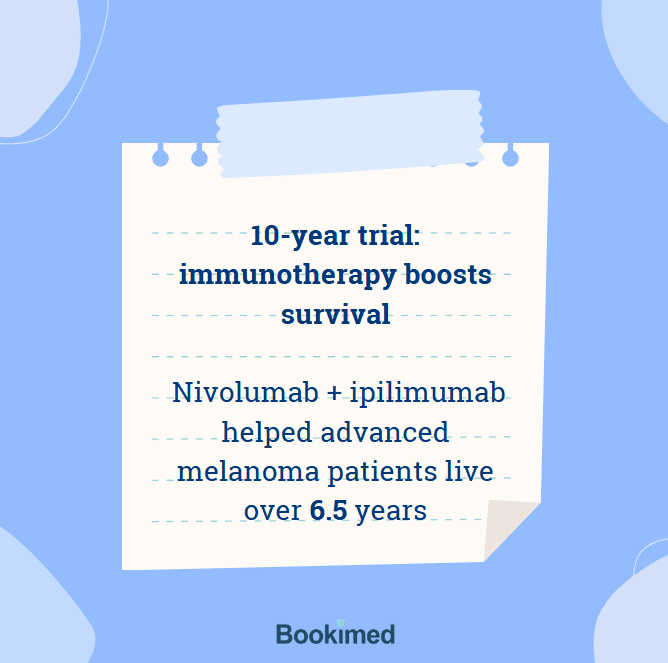
A 10-year trial across 21 countries followed 945 patients with advanced melanoma. Combining nivolumab and ipilimumab kept many alive well beyond six years. For non-small cell lung cancer, five-year survival nearly doubled from 6.8% to 10.7% since 2015. That came from a study of over 190,000 patients.
Results still vary by cancer type, stage, and patient. Immunotherapy is not right for everyone. But for many, it turns a once-fatal diagnosis into a manageable condition. That value can justify the cost.
What Is Immunotherapy For Cancer?

Immunotherapy is a medical treatment that helps the body's immune system recognize and fight cancer. Unlike chemotherapy or radiation, it does not attack cancer cells directly. Instead, it teaches the immune system how to find and destroy them.
To explain it simply, imagine the body as a kingdom. The immune system is its army, always on guard against threats like viruses, bacteria, and other intruders. But cancer is a clever enemy, wearing disguises and blending in with healthy cells. The army doesn't always see it as a threat.
Immunotherapy gives the immune system new tools, training, or instructions. With them, it can finally recognize the disguised cancer cells and target them precisely.
There are several main types
| Type | Description |
|---|---|
| Checkpoint inhibitors | Medications that remove the brakes from immune cells, allowing them to attack cancer more effectively. |
| CAR-T cell therapy | Doctors take a patient's immune cells, genetically reprogram them to target cancer, and return them to the body. |
| Cancer vaccines | Teach the immune system to recognize and attack cancer cells. |
| Cancer treatment vaccines | These vaccines aim to treat existing cancer by stimulating the immune system to attack cancer cells. |
| Monoclonal antibodies | Lab-created proteins that stick to cancer cells and flag them for attack. |
Often, these treatments are used in combination with other therapies, known as treatment combinations, to enhance their effectiveness.
Conditions treated by immunotherapy
Immunotherapy is especially effective for advanced, hard-to-treat cancers or those that haven't responded to traditional treatments.
| Cancer Type | Common Immunotherapy |
|---|---|
| Non-small cell lung cancer | PD-1/PD-L1 inhibitors |
| Small cell lung cancer | Immunotherapy combined with chemotherapy |
| Triple-negative breast cancer | Atezolizumab plus chemotherapy |
| Melanoma | Checkpoint inhibitors |
| Blood cancers (e.g., lymphoma) | CAR-T cell therapy |
| Bladder, liver, prostate | Experimental or newly approved therapies |
The field is still moving fast. In 2024 the FDA approved the first tumor-infiltrating lymphocyte (TIL) therapy, lifileucel (Amtagvi). It also approved the first TCR-engineered T-cell therapy for a solid tumor. Meanwhile, researchers are advancing "off-the-shelf" CAR-T to shorten the weeks-long cell-manufacturing wait.
For patients, these advances matter. They widen the range of cancers immunotherapy can treat, and speed access to personalized options.
Why Does the Cost Vary So Much?

The cost of immunotherapy can differ by tens or even hundreds of thousands of dollars. It depends heavily on where treatment is received. Here are the main factors that explain the price gap.
Local healthcare pricing
In countries with public healthcare, like Spain or Israel, governments negotiate drug prices and offer subsidies. That brings the cost far below U.S. rates. In contrast, U.S. patients often face full market prices.
Patented drugs and biosimilars
A large share of the price sits in the drug itself. Patented biologic medicines drive costs upward in high-income countries like the U.S. Markets that already use biosimilars pay significantly less. Biosimilars are lower-cost versions of original biological drugs. This patent dynamic is also why prices are expected to fall later this decade.
Hospital and service fees
The immunotherapy cost per treatment also includes consultations, scans, and infusions. In the U.S., hospital fees can triple the total cost compared to clinics in Turkey or Mexico. Organizations like the World Health Organization (WHO) note significant disparities in treatment costs across regions.
Access to support programs
Governments, charities, or manufacturers sometimes offer assistance. For example, Cancer Research UK and the National Cancer Institute (NCI) publish resources on assistance programs. These may help reduce immunotherapy costs or help patients join clinical trials.
Chemotherapy vs Immunotherapy Cost
When patients weigh treatment options, cost is often part of the conversation alongside effectiveness. Chemotherapy tends to cost less per cycle than immunotherapy. Many chemotherapy regimens rely on long-established generic drugs that are cheap to produce. Immunotherapy depends on patented biologic medicines, such as checkpoint inhibitors and monoclonal antibodies. Those carry a much higher price.

A simple per-cycle comparison rarely tells the whole story. Total cost depends on the cancer type and how long the regimen runs. It also depends on whether immunotherapy is given alone or combined with chemotherapy. Some patients receive a short course with durable results. Others need extended treatment that adds up over time.
Patented-drug pricing also differs between countries, as European health-economics research documents. That shifts the balance depending on where care is delivered. The right choice is a clinical decision made with your oncologist. Cost is one factor among several, not the deciding one.
The gap is widest on the drug itself. At Bookimed-network hospitals abroad, the immunotherapy component is far cheaper, which narrows the cost distance from chemotherapy.
Even so, the two are often used together rather than as an either-or choice. The sequence your oncologist recommends should drive the plan. The price difference is something to plan around, not the reason to choose one over the other.
When Will It Get Cheaper? Biosimilars by 2028
Immunotherapy is expensive today, but the price is set to come down. Understanding why helps you plan when and where to treat.
One reason immunotherapy stays expensive is that the biggest drugs are still protected by patents. Without competition, manufacturers set the price. That picture is about to change.
Patents on the two best-known checkpoint inhibitors, pembrolizumab (Keytruda) and nivolumab (Opdivo), are set to expire from around 2028. Their expiry opens the door to biosimilars, which are highly similar, lower-cost versions of biologic drugs.
The pipeline is already moving. Drugmakers including Samsung Bioepis, Amgen, and Celltrion are running Phase 3 biosimilar trials on these targets. They are positioning their products to launch as the patents lapse. When biosimilars reach the market, they typically force prices down. Across other biologic categories, that competition has historically lowered prices.
For patients planning long-horizon treatment, timing matters. If your care can be staged over the coming years, biosimilars may bring meaningful savings. Ask clinics whether a biosimilar option is available or expected for your specific drug. Then factor that into your budget and treatment planning.
Immunotherapy Side Effects and Risks
Immunotherapy works by switching the immune system on against cancer, and that same mechanism can turn against healthy tissue. These immune-related side effects are a real part of the treatment picture. They belong in your care plan and your budget. Not as a scare, but as something to monitor and manage.
The more common effects are fatigue, skin rash or itching, and flu-like symptoms. Less often, the immune response can inflame organs. That can affect the bowel (colitis), the lungs (pneumonitis), the liver, or hormone-producing glands such as the thyroid.
Reactions can appear during treatment or weeks after a cycle. That is why ongoing monitoring and fast reporting of any new symptom matter as much as the infusion itself. Most are treatable when caught early.
When immunotherapy may not be the right fit
Immunotherapy is not recommended for everyone. Some groups need a specialist review before starting or continuing, because the benefit-risk balance can shift:
- Patients with certain active autoimmune conditions.
- Those on high-dose immunosuppressive medication.
- Anyone who had a serious reaction to a previous checkpoint inhibitor.
- Pregnancy, and some organ-transplant situations.
Whether immunotherapy is contraindicated in your case is a clinical judgement. Consult your doctor and share your full medical history before committing to a plan abroad. The National Cancer Institute publishes patient guidance on immunotherapy side effects worth reading alongside your clinic's advice.
Ask any clinic how it screens for and manages immune-related side effects. Ask who is on call if one appears. Ask how findings are shared with your home oncologist once you travel back. Clear answers here protect you as much as the price does.
How to Lower the Cost: Treatment Abroad
Prices for the same treatment fall sharply outside the US and UK. Here is what care abroad costs, what a package includes, and how to travel safely.
Immunotherapy Cost Around the World
Immunotherapy prices swing widely from one country to the next. The same checkpoint inhibitor or monoclonal antibody can cost several times more in one health system than another. The gap is driven by patented drug pricing, hospital and service fees, and local healthcare economics.

The table below compares a typical full course across Bookimed-network destinations.
| Country | Immunotherapy cost (full course) |
|---|---|
| Turkey | $2,200 – $5,400 |
| Israel | $2,400 – $4,900 |
| Germany | from $3,400 |
| South Korea | $4,500 – $8,500 |
| Mexico | $8,000 – $16,000 |
| Spain | $12,000 – $25,000 |
| Thailand | $20,000 – $40,000 |
| United States (baseline) | $15,000 – $45,000 |
| United Kingdom (baseline) | $60,000 – $100,000 |
For patients starting from US or UK figures, the lowest-cost destinations are Turkey, Israel and Germany. Each represents savings of up to around 85% against the US baseline. All are hospitals that hold JCI accreditation. The US and UK rows are included only as price references. Bookimed coordinates treatment in its network destinations, not in those markets.

By cancer type, Bookimed coordinates immunotherapy so you can match a destination to your diagnosis. Programs cover the main solid tumors – lung, breast, kidney, and prostate – plus CAR-T cell therapy for blood cancers. Established networks run in Germany, Israel, Mexico, Turkey, Spain, and South Korea. UK figures are included only as a price reference.
All-Inclusive Treatment Packages
Many clinics abroad offer all-inclusive immunotherapy packages that combine treatment with travel services, making care more straightforward and more affordable.
A typical package may include:
Immunotherapy sessions (e.g., Keytruda, CAR-T).
Doctor consultations and diagnostic tests.
Hospital stay or hotel accommodation.
Airport-clinic transfers.
24/7 support and a personal medical coordinator.
These packages often cost less than booking each service separately. That makes them practical for patients who want quality treatment at a manageable price.

- Liao Zhengyin is a chief physician and top-tier expert at West China Hospital Cancer Center, specializing in complex tumor multidisciplinary care.
- uni-asia hospital treats 20,000 patients annually, including children and adults from Arab League, Asia, and Russian-speaking countries.
- Included Services: 24-hour nurse services.
- Stay Info: Accommodation and transfer are not included; 0 days stay in the hospital or hotel.
- Method: Immunotherapy program (PD-1 inhibitor).
- Li Ping is a recognized pioneer in China for full-cycle management of CAR-T cell therapy for blood cancers.
- Shanghai Tongji Hospital, International Department is a leading center for CAR-T cell therapy with over 1,500 infusions performed.
- Included Services: Anti TPO test, anti-HCVAb test, anti-HBC test, blood tests, biochemistry blood test, biopsy, consultations with oncologist, hematologist, immunologist, complete blood count with cancer markers and proteinogram, ultrasound, ultrasonography, CT of one area, consultation with oncohematologist.
- Stay Info: Accommodation and transfers are not included in the price.
- Technique: CAR-T (chimeric antigen receptor T-cell) immunotherapy for relapsed or refractory blood cancers.
- Einat Shacham Shmueli is a senior oncologist specializing in advanced gastrointestinal cancer management and research.
- Sheba Medical Center treats over 2 million patients annually and is a global leader in precision oncology.
- Included Services: Blood tests.
- Stay Info: 12 days hotel stay; accommodation is not included in the price.
- Dr. Joan Carles Galceran achieved prominence in bladder cancer treatment through advanced oncological techniques.
- Centro Médico Teknon is the No.1 choice for celebrities, sportsmen, and politicians for medical care.
- Included Services: Complete blood count with cancer markers, proteinogram.
- Stay Info: 1-day stay in the hotel, accommodation not included in the price.
- Method: Keytruda (1 injection, 200 mg).
Immunotherapy in Turkey vs. Thailand
Dozens of countries offer cancer care abroad. Turkey and Thailand stand out as top destinations for affordable, high-quality biological therapy.
Turkey
Turkey attracts over a million medical tourists annually, with cancer treatment among the most in-demand services. Immunotherapy here starts around $2,200 and runs to about $5,400 at internationally accredited clinics built for foreign patients.
Pros
Lower cost. Biological therapy starts at $2,200, including diagnostics and drugs like Keytruda.
All-inclusive packages. Often include hotels, airport-clinic transfers, and personal coordinators.
Shorter treatment time. Efficient pre-checks and treatment allow stays as short as 7 to 10 days.
No visa hassle. Visa-free or easy e-visa for most countries.
English-speaking staff: common in private clinics serving international patients.
Cons
Follow-up may be remote: post-treatment monitoring often happens via telemedicine.
Thailand
Thailand is known for its JCI-accredited hospitals, which meet international standards in safety and quality.
Pros
Top-tier hospital care. Treatments often take place in facilities certified by global bodies like TEMOS International or QHA Trent Accreditation. These bodies enforce strict patient-safety standards.
English widely spoken. Medical teams routinely treat international patients.
Extended care. Programs include longer observation and personalized recovery plans (2 to 4 weeks).
Comfortable recovery environment. Patients rest in a warm climate.
Cons
Visa may be required: though usually easy to obtain, some nationalities need a visa.
The Full Cost of Immunotherapy Abroad
The drug price is only part of the bill. A realistic budget also covers diagnostics and staging scans, follow-up imaging, and any drug continuation once you are home. Add flights, accommodation for you and a companion, and local transfers.
Even with travel added, the lower-cost destinations stay well ahead. A few thousand dollars of flights rarely closes a gap of tens of thousands. Ask for a written, itemized estimate covering the drug, the cycles, and diagnostics. Confirm how records are shared with your home oncologist for continuity of care.
Safe Travel During Treatment
Immunotherapy can suppress the immune system, so flying raises infection risk. Clear any trip with your oncologist and time flights between cycles. When choosing where to treat, use JCI accreditation as a safety signal, paired with verified reviews.
Begin Your Journey with Bookimed

Bookimed makes accessing affordable immunotherapy for cancer abroad simple and convenient. Here's how to start your immunotherapy journey:
- Browse immuno-oncology treatment options – explore a variety of treatments and find the best options tailored to your condition and budget.
- Submit an inquiry – fill out a simple form with your diagnosis and cancer type. Add any specific treatment preferences.
- Get expert advice – our medical coordinators help you choose the best clinic abroad. Their advice is based on your needs, desired outcomes, and financial situation.
- Confirm and book – once you've selected the right clinic, we'll manage all the details, ensuring a smooth process.
- Travel arrangements – we assist with flights, accommodation, local transfers, and resolving any unforeseen issues.
- Full support – enjoy 24/7 support from your dedicated Bookimed coordinator throughout your stay and treatment journey abroad.
Feel free to read immunotherapy treatment reviews on Bookimed. Patient reviews help future patients understand the effectiveness, risks, and real experiences of treatment.
Bookimed makes it easy to compare verified clinics side by side. You can weigh accredited hospitals, individual doctors, and transparent, all-in prices for immunotherapy. Then request a free, no-obligation quote for the options that fit your diagnosis and budget.
The Bottom Line
The full picture in one place:
- Cost gap: a full course runs $15,000 – $45,000 in the US and $60,000 – $100,000 privately in the UK. In Turkey it starts at $2,200 – $5,400, a saving of up to 85%.
- How it is billed: immunotherapy is priced per cycle. Ask for a per-cycle quote and the expected number of cycles, not just a headline figure.
- Why prices vary: patented biologic drugs, hospital fees, and local healthcare economics drive most of the difference.
- Cheaper soon: biosimilars for Keytruda and Opdivo are expected from around 2028, which should push prices down.
- Safety: treat JCI accreditation as a baseline signal, then confirm a dedicated oncology or immunotherapy program.
- Insurance: most home plans do not cover planned treatment abroad, so budget for self-pay. It often still beats insured care at home.
- Full cost: add diagnostics, follow-up imaging, flights, accommodation, and transfers to the drug price before you compare.
- Side effects: immune-related effects are usually treatable when caught early, so plan monitoring and home follow-up.
Bookimed compares verified clinics, doctors, and all-in prices, then coordinates your treatment abroad end to end.
FAQ: Immunotherapy Cost
How much does immunotherapy cost in Turkey?
A full course runs about $2,200 – $5,400 at Bookimed-network hospitals in Turkey. The figure depends on the drug, the number of cycles, and bundled diagnostics. Turkey stays cheaper through lower hospital fees, not by cutting corners on the medicine. Ask for an itemized quote so you can compare on equal terms.
Is it safe to fly during immunotherapy treatment?
Clear any travel with your oncologist first. Immunotherapy can suppress the immune system, so flying raises infection risk. Time flights for the stronger points between cycles, not right after an infusion. Patients with low blood counts may be advised to wait.
Does insurance cover immunotherapy abroad?
Usually not. Most home plans, including Medicare and the NHS, do not cover planned treatment abroad. A few international policies reimburse it with pre-authorization and approved facilities. Get any promise of coverage in writing before you travel.
How do I find a JCI-accredited hospital for immunotherapy?
Bookimed does this check for you. We list verified JCI-accredited hospitals and confirm each runs a dedicated oncology program. Your coordinator lines up quotes, doctor profiles, and reviews so you compare credentials before choosing.
How much can I save by going abroad?
Patients typically save up to around 85% versus the US or UK. A course that runs $15,000 – $45,000 in the US can start at $2,200 – $5,400 in Turkey. Judge the saving on the full trip, including flights and stay, not the drug price alone.
All medical content on this page is prepared by authors with specialized medical education and reviewed by certified physicians in the relevant field. Medical review by Yesim Yildirim, Clinical oncologist.
Last updated: October, 2026.
- Statistics: Figures are based on Bookimed’s internal database October 2026, which includes analysis of 12,450 patient requests across accredited clinics in .
- Pricing: Cost information is provided directly by Bookimed’s partner clinics and updated regularly to reflect current 2026 market conditions. Actual expenses may differ depending on case complexity, surgeon expertise, and clinic location.
- Clinical Data: Treatment outcomes and patient satisfaction figures are collected from Bookimed’s verified clinic database and supported by data from peer-reviewed medical sources such as PubMed, The Lancet, JAMA, and NEJM (2023–2026).
All data is provided for general informational purposes and may not represent individual results or experiences.