Strabismus Surgery in Italy — Get 3 Top Clinic Matches with Costs
Bookimed lists 4 strabismus surgery clinics in Italy, mostly in Milan, Rome, and Turin. These clinics are rated 4.6/5 in 73 verified patient reviews on Bookimed.


Medically reviewed by
Fahad Mawlood
How Much Does Strabismus surgery Cost in Italy?
Strabismus surgery in Italy typically costs from $2,800 to $4,600 depending on case complexity and clinic location. Pricing is influenced by the number of eyes treated and the anesthesia type required. In the US, similar procedures cost around $9,500 on average. Patients save around 61% compared to US prices. Costs usually include the surgical procedure, anesthesia, and initial follow-up visits.
- Geographic location: Prices in Rome often range 40-50% higher than in Bari or Turin.
- Anesthesia type: General anesthesia, standard for pediatric cases, increases costs compared to topical sedation.
- Surgical complexity: Operating on both eyes typically adds 30-50% to the base single-eye price.
- Clinical tier: Research-heavy institutions in Milan may charge higher fees for specialized diagnostic evaluations.
Bookimed Expert Insight: Choosing regional centers like Ospedale Santa Maria or Santa Caterina da Siena offers significant value. These facilities provide specialized care for approximately $3,000 to $4,000. This is considerably lower than the $6,000+ typically charged in capital-based private hospitals. For complex cases, San Raffaele in Milan is a top choice. It is ranked among the World's Best Hospitals 2021 by Newsweek. While consultations there start near $300, their research-driven approach ensures access to elite surgical expertise.
| Italy | Turkey | Austria | |
|---|---|---|---|
| Strabismus surgery | ≈ $2,800 | from $1,200 | ≈ $3,200 |
Your Benefits and Guarantees with Bookimed
Transparent Prices & Flexible Installments
No hidden fees – just official clinic prices. Pay at the clinic for Strabismus surgery upon arrival and use a flexible installment plan if needed.
Verified Clinics & Doctors Only
Bookimed is committed to your safety. We only work with medical institutions that maintain high international standards in Strabismus surgery and have the necessary licenses to serve international patients worldwide.
Free 24/7 Assistance
Bookimed offers free expert assistance. A personal medical coordinator supports you before, during, and after your treatment, solving any issues. You're never alone on your Strabismus surgery journey.

Your personal Bookimed medical coordinator
- Supports you at every stage
- Helps choose the right clinic and doctor
- Ensures quick and convenient access to information
Discover the Best Strabismus surgery Clinics in Italy: 4 Verified Options and Prices







Strabismus surgery Overview in Italy
Day 1 - Arrival
- Arrive in the country and settle in your accommodation.
- Transportation to the hospital is not provided by the clinic.
Day 2 - Pre-operation
- You will undergo an autorefractometry test to measure refraction.
- A specialist will review your medical history and conduct an examination.
- Additional tests or procedures may be required based on your condition.
- Language assistance will be provided throughout the process.
Day 3 - Strabismus Surgery
- The surgery will take 1-2 hours, under general anesthesia.
- Your eye muscles will be realigned to correct the strabismus.
- You will be monitored in recovery post-surgery.
Day 4 - Post-operation
- Post-operative assessment will be done by the specialist.
- Instructions for at-home care will be provided.
- Remain in the hospital for monitoring and recovery.
Week 1 - Rehabilitation
- Follow the at-home care instructions provided by the specialist.
- Avoid strenuous physical activity and sports.
Week 2 - 4
- Gradually return to normal activities, avoiding heavy lifting and sports.
- Final results of the surgery should be visible by the end of week 4.
Please note, every patient"s case is unique and the timeline may vary.
- Bookimed deposit: $200 or €200.
- Clinic deposit: Pay a set percentage in advance.
Our Doctors
View all Doctors
Prof Giuseppe Speziale
Dr. Giuseppe Speziale is a cardiac surgeon specializing in minimally invasive valve surgery at Ospedale Santa Maria. He is the National Coordinator of Cardiac Surgery for GVM Care & Research. Dr. Speziale earned the Top Doctors Award for his surgical expertise. He co-founded the Mitral Academy to improve restorative heart surgery techniques.
- Specializes in mitral valve repair and thoracic aortic surgery.
- Performs both on-pump and off-pump myocardial revascularization.
- Author of over 90 scientific publications in journals like the European Journal of Cardiothoracic Surgery.
- Member of the American Association for Thoracic Surgery (AATS).

Nicola Vione
Dr. Nicola Vione has performed thousands of procedures in functional and facial plastic surgery. He is a specialist in otorhinolaryngology at Santa Caterina da Siena clinic in Turin. Dr. Vione serves as a Professor of Functional and Aesthetic Surgery of the Nose.
- Serves on the scientific committee of the Micheli–Pellegrini Study Center.
- Uses preservation rhinoplasty techniques to protect nasal anatomy and speed recovery.
- Maintains membership in the Italian Association of Aesthetic and Functional Surgery of the Face.
- Treats complex conditions including deviated septums, nasal polyps, and sleep apnea.

Domenico Riitano
The doctor is a highly qualified specialist in plastic, reconstructive, and aesthetic surgery. After graduating in Medicine and Surgery in 1989, the doctor completed a specialization in Orthopedics and Traumatology in 1994 at the University of Rome Tor Vergata, followed by a specialization in reconstructive and aesthetic plastic surgery at the University of Messina in 2007.
To further refine clinical expertise, the doctor completed advanced training in Brazil, gaining significant international experience at specialized medical facilities, including the Fluminense Clinic of Plastic Surgery in Rio de Janeiro.
Video Stories from Bookimed Patients
Reviews about Bookimed: Discover Patients' Insights
All reviewsShare this content
 Anna Leonova

Fast Facts about Strabismus surgery
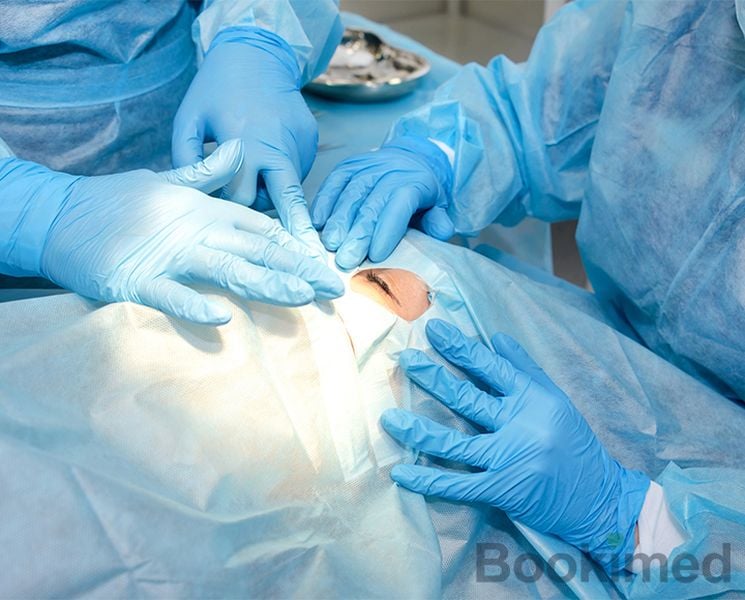
Strabismus surgery
Strabismus surgery involves adjusting the muscles of the eyes to improve alignment and correct vision issues.
FAQ about Strabismus surgery in Italy
Is strabismus surgery safe, and what are the main risks?
Strabismus surgery is exceptionally safe for children and adults, with high success rates between 80% and 90%. Serious complications are rare, impacting fewer than 1 in 2,400 cases. Most risks involve minor alignment adjustments or temporary double vision as the brain adapts to new eye positions.
- Alignment precision: Over-correction or under-correction occurs in 20% to 30% of adult cases.
- Vision changes: Temporary double vision is common; persistent diplopia affects only 0.8% of patients.
- Surface irritation: Patients often report a temporary gritty sensation similar to sandpaper on the eyes.
- Muscle stability: Rare risks include a slipped muscle, affecting approximately 0.04% to 0.07% of surgeries.
Bookimed Expert Insight: Italian research hospitals like San Raffaele perform over 52,000 operations annually, offering high-volume expertise often missing in smaller clinics. Data suggests choosing surgeons handling 100+ cases yearly significantly reduces revision risks. High-volume centers often provide specialized anesthesia teams for children, ensuring safer outcomes for pediatric patients.
Patient Consensus: Many patients find the first week rough but report that pre-operative prism glasses helped predict their results. Most recommend tracking progress with photos and preparing for several months of vision stabilization.
What qualifications should I look for in an Italian surgeon for strab surgery?
Qualified Italian surgeons for strabismus surgery must hold a university degree in medicine and complete a 6-year specialization in ophthalmology. Seek doctors registered with the Ordine dei Medici Chirurghi (OMCeO) and preferably certified by the European Board of Ophthalmology (EBO) for validated international standards.
- Specialist accreditation: Must hold an Ophthalmology Diploma from an accredited Italian university.
- Surgical volume: Professional success correlates with surgeons performing 50 or more strabismus procedures annually.
- Fellowship training: Prioritize specialists with dedicated pediatric ophthalmology or adult strabismus fellowships.
- Clinical setting: Select facilities with Italian Ministry of Health IRCCS or JCI accreditation.
Bookimed Expert Insight: Italian eye care distinguishes itself through high-volume research hospitals like San Raffaele in Milan. These centers perform over 52,000 operations annually across various specialties. While general clinics exist, choosing a research-heavy hospital often provides access to more precise diagnostic tools like Synoptophores. This technical infrastructure is vital for complex adult cases where double vision risk is higher.
Patient Consensus: Experienced patients suggest requesting specific reoperation rates and pre-operative prism testing. Many recommend seeking specialized private clinics if you wish to avoid trainee involvement in your alignment procedure.
abismus surgery done in Italy, laparoscopic or open?
Strabismus surgery in Italy is performed as an open ophthalmic procedure, not laparoscopically. Surgeons access the eye muscles through small incisions in the conjunctiva, the thin membrane covering the white of the eye. This specialized extraocular approach allows precise muscle realignment without entering internal body cavities.
- Surgical approach: Italian clinics use traditional open extraocular muscle realignment techniques.
- Access method: Surgeons reach muscles through small `keyhole` incisions in the conjunctiva.
- Procedure location: Operations occur on the eyes surface at the extraocular muscle level.
- Advanced options: Milan clinics like San Raffaele offer adjustable sutures for precision adult care.
Bookimed Expert Insight: While patients often search for laparoscopy because it sounds less invasive, it is physically impossible for eye surgery. San Raffaele in Milan maintains high safety standards by performing over 52,000 annual operations across all specialties. Choosing research hospitals like this ensures access to surgeons who use small-incision techniques that mimic the recovery benefits of laparoscopy.
Patient Consensus: Patients find that although the term open surgery sounds significant, the reality involves tiny incisions. Many report that the procedure feels minimally invasive with a manageable recovery time.
How long does recovery take and when can I fly home?
Most patients recover from strabismus surgery within 1 to 2 weeks. You should typically wait 7 to 10 days before flying home from Italy. This timeframe ensures stability, allows initial swelling to subside, and permits a crucial follow-up exam with your ophthalmologist in Milan.
- Initial recovery: Most patients return to light activities within 3 to 7 days.
- Flying window: Surgeons recommend waiting 7 to 10 days to avoid pressure complications.
- Activity restrictions: Avoid heavy lifting, swimming, and strenuous exercise for 2 to 4 weeks.
- Symptom management: Peak swelling occurs on days 2 to 3 and fades by day 14.
Bookimed Expert Insight: Italian clinics like San Raffaele in Milan manage over 300,000 patients annually. They prioritize long-term stability over quick discharges. Data shows that staying 10 days instead of 5 significantly reduces irritation from dry cabin air. This extra time allows surgeons to confirm alignment remains perfect before you face cabin pressure changes.
Patient Consensus: Patients recommend staying in Italy for 2 weeks to ensure a comfortable flight. Many suggest bringing dark sunglasses and extra eye drops because cabin air severely dries out healing eyes.
Am I a good candidate for strabismus surgery?
You are a good candidate for strabismus surgery if you have eye misalignment that persists despite non-surgical options like prisms or vision therapy. Ideal candidates include adults or children experiencing double vision, eye strain, or significant cosmetic concerns that impact daily life.
- Visual symptoms: Frequent double vision, headaches, or loss of depth perception indicate functional candidacy.
- Misalignment severity: Patients with 15–40 prism diopters of deviation typically report the highest satisfaction.
- Stability: Successful candidates have stable vision and no active eye infections or inflammation.
- Primary cause: Comitant strabismus often leads to clearer surgical outcomes than restrictive or paralytic types.
Bookimed Expert Insight: Italian centers like San Raffaele emphasize research-driven diagnostics, such as IRCCS-certified motility testing. Choosing a high-volume facility with 50,000+ annual operations ensures access to surgeons experienced in complex adult cases. Patients often find private Italian clinics provide significantly faster evaluations than the public healthcare system.
Patient Consensus: Many adults emphasize the psychological relief of correcting eye turns, even when depth perception isn't fully restored. Patients recommend treating lazy eye before surgery to ensure the best possible long-term alignment.
Is the procedure inpatient or outpatient, and how many days should I stay in Italy?
Strabismus surgery in Italy is performed as an outpatient procedure with same-day discharge being the standard protocol. Patients should plan a total stay of 4 to 5 days in Italy. This timeframe allows for the 30–60 minute operation, immediate monitoring, and initial recovery before air travel.
- Procedure type: Outpatient surgery usually allows discharge 2–4 hours after waking from anesthesia.
- Hospital stay: Most patients leave the same day; 1 night is rare for children.
- Total Italy stay: Plan 4–5 days total to cover peak swelling and initial follow-up.
- Travel readiness: International travel is feasible 48 hours post-op if no complications occur.
Bookimed Expert Insight: Italian IRCCS-accredited centers like San Raffaele handle over 52,000 annual operations, ensuring high surgical volume. While travel is medically possible after 48 hours, staying 5 days provides a safety buffer. This extra time allows the initial double vision to stabilize before navigating busy international airports.
Patient Consensus: Patients recommend arranging local transport and assistance for the first 48 hours. Post-operative nausea and temporary eye patches make independent movement difficult immediately after the procedure.