Cataract surgery (one eye) in Austria — get 3 personalized clinic matches
Bookimed lists 3 cataract surgery clinics in Austria, in Vienna and Graz, including ISO-certified clinics. These clinics are rated 4.6/5 in 194 verified patient reviews on Bookimed.

Medically reviewed by
Ergin Er
How it works
How Much Does Cataract surgery (one eye) Cost in Austria?
Cataract surgery (one eye) in Austria typically costs from $2,300 to $3,800. The total price depends on the chosen lens type, clinical tier, and the surgeon's expertise. Standard surgical fees in Austrian private clinics generally include the intraocular lens, local anesthesia, and basic medical supplies.
- Standard monofocal lenses: These typically range from $2,300 to $3,800 for one eye.
- Premium multifocal options: Choosing lenses that correct both distance and reading vision adds significant costs.
- Clinic location: Major medical hubs for this procedure include Vienna and Graz.
- Private facility fees: High-end private hospitals in Vienna often charge higher premiums for luxury amenities.
Bookimed Expert Insight: Choosing a specialist in Vienna offers access to world-class expertise at competitive European rates. Wiener Privatklinik features surgeons like Rupert Menapace. He is ranked among the top five cataract specialists globally by Expertscape. Such high-level expertise is available in private settings where wait times are minimal. This contrasts with public hospitals where wait times are often three times longer. Clinics like Leech Private Clinic in Graz provide modern ISO-certified environments for those seeking care outside the capital.
| Turkey | Austria | Spain | |
|---|---|---|---|
| Cataract surgery (one eye) | from $800 | ≈ $2,300 | from $1,900 |
Discover the Best Cataract surgery (one eye) Clinics in Austria: 3 Verified Options and Prices










Leech Private Clinic
Cataract surgery (one eye) Overview in Austria
- Cataract surgery (both eyes) - from $6,000Cloudy lenses removal in both eyes, replacing them with artificial ones to enhance vision clarity and quality.
Day 1: Arrival
- Transfer from the airport is not provided by the clinic.
- Upon arrival at the clinic, you"ll be registered.
- A translator will be provided if needed.
Day 2: Pre-Operation
- You"ll consult with an ophthalmologist.
- Autorefractometry will be performed to measure eye refraction.
- You"ll have other necessary medical tests.
Day 3: Cataract Surgery
- You"ll be given local anesthesia.
- The operation lasts around 1-2 hours.
- The surgeon will replace your cloudy lens with a clear one.
Day 4: Post-Operation
- After surgery, you"ll be monitored for complications.
- Overnight hospitalization may be required, based on your condition.
Day 5: Discharge
- You"ll be discharged from the hospital.
- A follow-up appointment will be scheduled.
Week 1-2: Rehabilitation
- Avoid strenuous activities and heavy lifting.
- Wear sunglasses to protect your eye.
Week 3-4: Rehabilitation
- You can return to work and resume normal activities.
- Follow-up with your ophthalmologist.
Please note that each case is individual and the timeline may vary based on your personal condition and recovery speed.
- Bookimed deposit: $200 or €200.
- Clinic deposit: Pay a set percentage in advance.
As the leading global medical tourism platform, we have huge responsibility before our clients — both patients and medical centers. All the information provided on Bookimed.com is grounded in research, foresight, and expertise and meets high interest related to the product and follows:
Smart automatic ranking system
We form our listings of clinics and doctors with strict regulations of our smart automatic ranking system. The system is based on real Bookimed patient rates to provide the most objective and transparent information about clinics and medical services there.
Our experienced data scientist collects data daily, monitors and optimizes the ranking system using machine learning and artificial intelligence to ensure that the ranking system is up-to-date and provides accurate results.
Real people"s experience only
We collect the opinions of Bookimed clients only after getting medical experience with the clinic — so everyone on the platform can trust the facility they choose. We strive to make the content on our platform as useful as possible and ensure the freedom to express critical opinions. Thus, we publish positive and negative reviews, aiming at being a source for informed decision-making for our future clients.
Topics with high levels of expertise, authority, and trustworthiness
On Bookimed.com you may find choice and convenience to find the best medical solutions from top medical services providers just in one place, and often at competitive prices. Making sure to deliver the freshest information, the clinic’s representatives update doctors’ CVs, clinics’ capacities, before-after pictures, prices, packages, and specials by themselves shortly. You may meet the clinic’s representative and check the date of updated content at every clinic’s page to make sure of its trustworthiness.
Our blog and supportive pieces are created by professional authors with at least 3-year experience in medical writing and edited by medical specialists with relevant clinical and research expertise — all carefully recruited to the team. We strive to enhance patient access to health information, making it expert but easy to understand. All pieces follow the Bookimed’s Editorial Guidelines.
Bookimed values
We are made of people and for people — and that"s our core value. That"s why all the data presented on the platform is collected, edited, reviewed, and updated regularly by our patients, our partner clinics, and our team, including the Bookimed Medical Advisory Board, which consists of the world-renowned doctors with value expertise over 20 years of practice, and a positive reputation. Learn more about us and our mission.
In case you find any mistake or have any questions on the information presented on Bookimed.com, please feel free to contact us at marketing@bookimed.com.
Our Doctors
View all Doctors
Stefan Pieh
Prof. Stefan Pieh is a leading ophthalmologist specializing in cataract surgery and corneal procedures at Wiener Privatklinik.
- Decades of experience in refractive and cataract surgery
- Former Head of Ophthalmology at Medical University of Vienna
- Expert in advanced intraocular lens implantation
- Published extensively on visual optics and surgical precision

Rupert Menapace
Prof. Menapace pioneered modern IOL surgery – his techniques and research set global standards for cataract procedures.
- 45 years specializing in cataract and intraocular lens surgery
- Professor of Ophthalmology at Medical University of Vienna
- Authored hundreds of publications on surgical techniques and lens design
- Senior consultant at Wiener Privatklinik and Vienna General Hospital

Stefan Sacu
Prof. Sacu specializes in cataract surgery with decades of expertise at the Medical University of Vienna and Wiener Privatklinik.
- Focuses on complex cases requiring retinal and vitreoretinal expertise
- Professor of Ophthalmology with extensive surgical experience
- Member of international ophthalmic research collaborations
- Pioneer in advanced retinal imaging techniques

Michael Georgopoulos
Professor Michael Georgopoulos specializes in combined cataract and retinal surgeries – performing delicate eye procedures at Vienna General Hospital.
- Senior Consultant in Vitreoretinal Surgery at Medical University of Vienna
- Focuses on macular issues like retinal detachment and vitreous disorders
- Uses high-resolution OCT for precise pre- and post-operative care
- Published research on vitreoretinal surgery outcomes and techniques
- Performs seamless transconjunctival vitrectomy with additive VEGF therapy
Video Stories from Bookimed Patients
Reviews about Bookimed: Discover Patients' Insights
All reviewsShare this content
 Anna Leonova

Fast Facts about Cataract surgery (one eye)
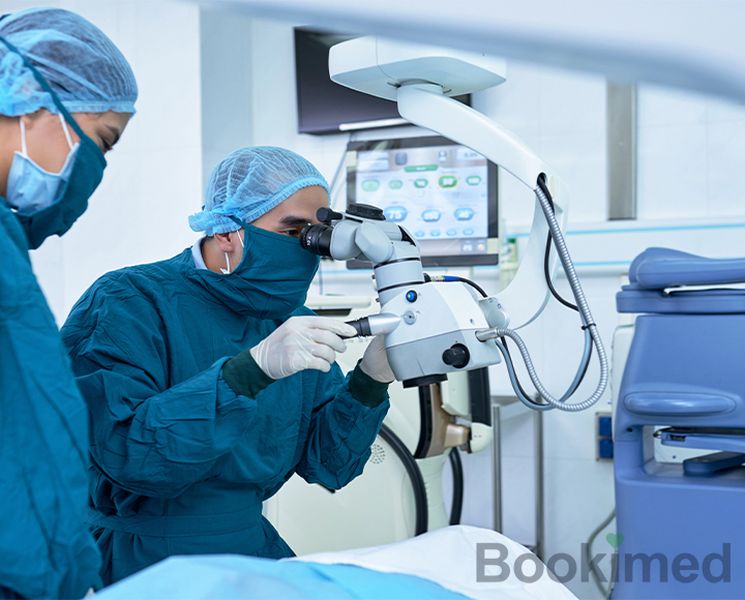
Cataract surgery (one eye)
This ophthalmology procedure involves removing the cloudy lens from one eye and replacing it with a clear artificial intraocular lens to restore vision.
FAQ about Cataract surgery (one eye) in Austria
Is single-eye cataract surgery covered by public healthcare in Austria?
Single-eye cataract surgery is fully covered by Austrian public healthcare funds like the Osterreichische Gesundheitskasse (OGK). Coverage requires an ophthalmologist to confirm medical necessity, ensuring visual impairment restricts daily life. Standard phacoemulsification with a monofocal lens is fully reimbursed at public hospitals or contracted clinics.
- Coverage scope: Public insurance covers standard surgery and basic monofocal intraocular lenses entirely.
- Medical necessity: Patients must prove vision cannot be corrected through standard eyeglasses alone.
- Potential deductibles: Daily hospital stay fees typically range from $8 to $10 per day.
- Premium upgrades: Patients pay out-of-pocket for multifocal lenses or laser-assisted femtosecond technology.
Bookimed Expert Insight: While public hospitals like Vienna General Hospital (AKH) provide full coverage, patients seeking specialized care often choose Wiener Privatklinik (WPK). At private centers, professors like Rupert Menapace offer refined phacoemulsification. However, insurers may only reimburse a small portion of private fees, leaving significant out-of-pocket balances.
Patient Consensus: Patients emphasize that securing a detailed ophthalmology report is vital for insurance approval. Many advise confirming prior authorization requirements with insurers to avoid unexpected costs when using non-contracted doctors.
How long does the one-eye procedure and hospital stay take?
Cataract surgery in Austria is a rapid outpatient procedure. The actual microsurgery takes 5 to 15 minutes per eye. Patients typically spend 2 to 3 hours total at the clinic to complete pre-operative preparations, local anesthesia administration, and a brief post-operative monitoring period.
- Hospital stay: Same-day discharge is standard as no overnight stay is medically required.
- Surgical technique: Surgeons primarily use phacoemulsification or ultrasound-assisted lens breakdown for efficiency.
- Anesthesia type: Local anesthesia with light sedation ensures patient comfort during the brief session.
- Immediate recovery: Patients must arrange a driver since vision remains blurry for several hours.
Bookimed Expert Insight: While the surgery is fast, choosing a university-affiliated center like Vienna General Hospital (AKH) provides access to advanced imaging like HR-OCT. This technology allows surgeons to map the eye with extreme precision before the 15-minute procedure begins. High-volume clinics in Vienna often manage over 6,500 patients annually, ensuring refined protocols for international arrivals.
Patient Consensus: Patients often find the pre-operative preparation and administrative check-in feel longer than the surgery itself. Most report being surprised by how quickly they are discharged and ready to rest at home.
Can I choose to do just one eye at a time?
Yes, treating one eye at a time is the standard medical practice for cataract surgery in Austria. Ophthalmologists typically space procedures 1 to 4 weeks apart to ensure the first eye heals properly, minimize bilateral infection risks, and maintain functional vision during recovery.
- Standard approach: Surgeons usually operate on the eye with poorer vision first to improve quality of life.
- Safety protocol: Staggered surgery prevents rare, simultaneous complications and allows for precise healing monitoring.
- Vision adjustment: The 5–6 week interval helps doctors fine-tune lens selection for the second procedure.
- Local expertise: Leading Vienna clinics like Wiener Privatklinik employ professors who pioneered advanced phacoemulsification techniques.
Bookimed Expert Insight: Austria's university-affiliated clinics offer a unique safety advantage for complex cases. Surgeons like Dr. Michael Georgopoulos at Vienna General Hospital use seamless 23-G transconjunctival vitrectomy. This allows for combined anterior and posterior eye surgery if your cataract is complicated by retinal issues, often saving patients multiple separate operations.
Patient Consensus: Most patients value the flexibility of staggered surgery. Many suggest using a contact lens in the unoperated eye between procedures to manage the temporary vision gap comfortably.
Where are the main medical hubs for cataract surgery in Austria?
Vienna serves as Austria primary medical hub for cataract surgery, hosting elite university infrastructure and high-volume private facilities. Graz and Innsbruck act as secondary regional centers, while Linz provides specialized laser eye options. These hubs prioritize phacoemulsification and premium intraocular lens implantation.
- Academic leadership: Vienna General Hospital (AKH) leads national research with 1,600 doctors and ISO-certified care.
- Private excellence: Wiener Privatklinik (WPK) features world-renowned professors specializing in micro-incisional and multifocal lens surgery.
- Regional centers: Leech Private Clinic in Graz utilizes 67 university professors as consultants for microsurgery.
- Western access: Innsbruck anchors care for the Alpine region through specialized centers like Augenzentrum Kettenbrucke.
Bookimed Expert Insight: While Vienna General Hospital (AKH) manages the highest patient volume, the city private sector offers unique surgical access. Professor Rupert Menapace and Professor Stefan Pieh at Wiener Privatklinik (WPK) are global pioneers in lens technology. Patients often choose these private hubs to skip long academic waiting lists while retaining access to the same university-level expertise.
Patient Consensus: Patients prioritize the individual surgeon reputation over city location but often find Vienna most convenient for comprehensive follow-up care. Many travelers also consider nearby Bratislava as a high-volume, cost-effective alternative for the same advanced lens procedures.