Cataract Surgery with Multifocal Lens Implant in Austria — Get 3 Top Clinic Matches with Costs
Bookimed lists 3 cataract surgery with multifocal lens implant clinics in Austria, in Vienna and Graz, including ISO-certified clinics. These clinics are rated 4.6/5 in 194 verified patient reviews on Bookimed.

Medically reviewed by
Ergin Er
How Much Does Cataract Surgery with Multifocal Lens Implant Cost in Austria?
Cataract surgery with a multifocal lens implant in Austria typically costs between $3,600 and $5,800. Prices depend on the clinic tier, surgeon expertise, and the specific multifocal technology selected. In the United States, similar procedures cost around $6,300 on average. Patients can save approximately 25% by choosing Austrian medical centers. Medical hubs for these procedures include Vienna and Graz.
- Cataract surgery (one eye): $2,300 to $3,800 for the standard procedure.
- Cataract surgery (both eyes): $6,000 to $6,800 for bilateral treatment.
- Premium lens upgrade: Multifocal implants add a significant premium over standard monofocal options.
- Laser-assisted techniques: Using femtosecond lasers typically increases the surgical fee by 20-30%.
Bookimed Expert Insight: Choosing a university-affiliated hospital provides access to research-driven protocols and academic expertise. Vienna General Hospital (AKH) serves nearly 600,000 patients annually and is ISO certified. Alternatively, Wiener Privatklinik offers a boutique experience with professors from the Medical University of Vienna. For those seeking specialized care, Dr. Pavol Vesely brings over 20 years of surgical experience. His clinic focus includes advanced refractive lens exchange and pioneering laser techniques.
| Turkey | Austria | Spain | |
|---|---|---|---|
| Cataract Surgery with Multifocal Lens Implant | from $1,200 | ≈ $3,600 | from $3,600 |
| Cataract surgery (one eye) | from $800 | ≈ $2,300 | from $1,900 |
| Cataract surgery (both eyes) | from $1,500 | from $6,000 | from $9,900 |
Your Benefits and Guarantees with Bookimed
Transparent Prices & Flexible Installments
No hidden fees – just official clinic prices. Pay at the clinic for Cataract Surgery with Multifocal Lens Implant upon arrival and use a flexible installment plan if needed.
Verified Clinics & Doctors Only
Bookimed is committed to your safety. We only work with medical institutions that maintain high international standards in Cataract Surgery with Multifocal Lens Implant and have the necessary licenses to serve international patients worldwide.
Free 24/7 Assistance
Bookimed offers free expert assistance. A personal medical coordinator supports you before, during, and after your treatment, solving any issues. You're never alone on your Cataract Surgery with Multifocal Lens Implant journey.

Your personal Bookimed medical coordinator
- Supports you at every stage
- Helps choose the right clinic and doctor
- Ensures quick and convenient access to information
Discover the Best Cataract Surgery with Multifocal Lens Implant Clinics in Austria: 3 Verified Options and Prices









Leech Private Clinic
Cataract Surgery with Multifocal Lens Implant Overview in Austria
- Cataract surgery (both eyes) - from $6,000Cloudy lenses removal in both eyes, replacing them with artificial ones to enhance vision clarity and quality.
Day 1 - Arrival
- Reach the country where the surgery will take place.
- Check into the 4* hotel provided in the package.
Day 2 - Pre-operation
- Meet the ophthalmologist for consultation.
- Undergo Autorefractometry test.
- Complete any additional tests if prescribed by the specialist.
Day 3 - Cataract Surgery with Multifocal Lens Implant
- Arrive at the clinic for the surgery.
- The procedure takes about 1-2 hours.
- Local anesthesia is used during the procedure.
- Post-surgery, you"ll stay in the clinic for observation.
Day 4 - Post-operation
- Stay in the clinic for monitoring and recovery.
- Get discharged if the specialist approves.
Week 1 - Rehabilitation
- Rest and recover post-surgery.
- Use prescribed eye drops to prevent infection and inflammation.
Week 2 - Follow-up
- Visit the ophthalmologist for a follow-up check.
- Resume light daily activities if approved by the specialist.
Week 3-4 - Final Result
- Experience improved vision as the eyes heal.
- Resume work and sport activities with specialist"s approval.
Please note that this is a general plan and the actual process might vary depending on individual needs and medical conditions.
- Bookimed deposit: $200 or €200.
- Clinic deposit: Pay a set percentage in advance.
As the leading global medical tourism platform, we take great responsibility for providing reliable information to our clients, both patients and medical centers. All the information provided on Bookimed.com regarding Cataract Surgery with Multifocal Lens Implant in Austria is grounded in research, foresight, and expertise and meets high interest related to the product and follows:
Smart automatic ranking system
We form our listings of clinics and doctors with strict regulations of our smart automatic ranking system. The system is based on real Bookimed patient rates to provide the most objective and transparent information about clinics and medical services there.
Our experienced data scientist collects data daily, monitors and optimizes the ranking system using machine learning and artificial intelligence to ensure that the ranking system is up-to-date and provides accurate results.
Real people"s experience only
We collect the opinions of Bookimed clients only after getting medical experience with the clinic — so everyone on the platform can trust the facility they choose. We strive to make the content on our platform as useful as possible and ensure the freedom to express critical opinions. Thus, we publish positive and negative reviews, aiming at being a source for informed decision-making for our future clients.
Topics with high levels of expertise, authority, and trustworthiness
On Bookimed.com you may find choice and convenience to find the best medical solutions for Cataract Surgery with Multifocal Lens Implant from top medical services providers in Austria, just in one place, and often at competitive prices. Making sure to deliver the freshest information, the clinic’s representatives update doctors’ CVs, clinics’ capacities, before-after pictures, prices, packages, and specials by themselves shortly. You may meet the clinic’s representative and check the date of updated content at every clinic’s page to make sure of its trustworthiness.
Our blog and supportive pieces are created by professional authors with at least 3-year experience in medical writing and edited by medical specialists with relevant clinical and research expertise — all carefully recruited to the team. We strive to enhance patient access to health information, making it expert but easy to understand. All pieces follow the Bookimed’s Editorial Guidelines.
Bookimed values
We are made of people and for people — and that"s our core value. That"s why all the data presented on the platform is collected, edited, reviewed, and updated regularly by our patients, our partner clinics, and our team, including the Bookimed Medical Advisory Board, which consists of the world-renowned doctors with value expertise over 20 years of practice, and a positive reputation. Learn more about us and our mission.
In case you find any mistake or have any questions on the information presented on Bookimed.com, please feel free to contact us at marketing@bookimed.com.
Our Doctors
View all Doctors
Rupert Menapace
Dr. Rupert Menapace is a pioneering ophthalmologist at Wiener Privatklinik in Vienna. He specializes in intraocular lens implantation and surgical cataract treatment. Dr. Menapace is a Professor of Ophthalmology at the Medical University of Vienna. He has authored hundreds of scientific papers on eye surgery optimization.
- Refined phacoemulsification techniques to improve cataract surgery safety.
- Treats complex conditions including glaucoma, strabismus, and keratoconus.
- Performs laser eye procedures like LASIK and LASEK.
- Works at Wiener Privatklinik, ranked among the world's best hospitals by Newsweek.

Stefan Sacu
Dr. Stefan Sacu is a specialist in ophthalmology and optometry at Vienna General Hospital. He serves as a resident at the Medical University of Vienna. Dr. Sacu specializes in cataract and retinal surgery. He also treats complex macular and retinal diseases. His research focuses on new therapies for exudative macular degeneration.
- Winner of the Theodor-Koerner Science Prize for his research contributions.
- Develops genetic therapies for hereditary retinal diseases with the University of Pennsylvania.
- Member of the European Society of Cataract and Refractive Surgeons (ESCRS).
- Performs mutation analysis and genetic mapping for different retinal dystrophies.
Video Stories from Bookimed Patients
Reviews about Bookimed: Discover Patients' Insights
All reviewsShare this content
 Anna Leonova

Our Cataract Surgery with Multifocal Lens Implant Techniques: What Suits You Best?
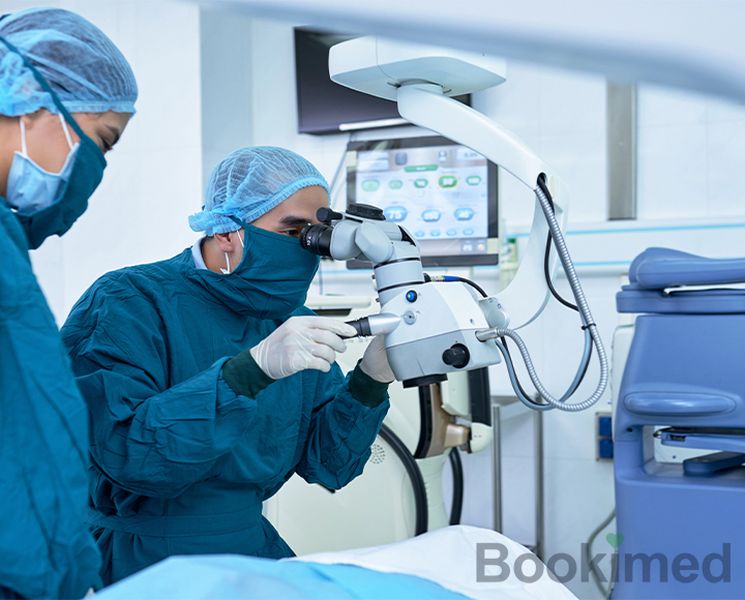
When considering Cataract Surgery with Multifocal Lens Implant, it’s important to understand the different techniques and which is best suited for you. Here’s a concise comparison of popular options:
Cataract surgery (one eye)
This ophthalmology procedure involves removing the cloudy lens from one eye and replacing it with a clear artificial intraocular lens to restore vision.

Cataract surgery (both eyes)
This ophthalmology procedure involves replacing the cloudy lenses in both eyes with clear intraocular lenses to restore vision.
FAQ about Cataract Surgery with Multifocal Lens Implant in Austria
What is a multifocal lens implant used in cataract surgery?
A multifocal lens implant is an advanced artificial intraocular lens used during cataract surgery to replace a clouded natural lens. Unlike standard monofocal lenses, multifocals feature specialized concentric zones that distribute light. This allows patients to see clearly at near, intermediate, and far distances simultaneously.
- Visual range: Provides clear vision for reading, computer work, and driving without external eyewear.
- Specialized techniques: Often used during refractive lens exchange to correct age-related vision loss.
- Adaptive period: Requires neuroadaptation as the brain learns to process multiple focal points automatically.
- Facility standards: Available in ISO-certified Austrian hospitals like Wiener Privatklinik and Vienna General Hospital.
Bookimed Expert Insight: While many choose multifocals to eliminate glasses, surgeon selection is the real performance driver. In Austria, clinics like Leech Private Clinic utilize university professors as consultants. This academic expertise is vital because these lenses require precise centration to prevent permanent visual ghosting.
Patient Consensus: Most patients enjoy freedom from glasses but notice halos or starbursts around headlights at night. Success often depends on discussing lens intolerance policies with your surgeon before the procedure.
What are the common side effects or drawbacks of multifocal lenses?
Multifocal lenses provide clear vision at multiple distances by splitting light, which often results in visual artifacts. Common drawbacks include night halos around headlights, glare, and reduced contrast sensitivity in dim lighting. Most patients adapt through neuroadaptation within three to six months after surgery.
- Visual artifacts: Patients often see halos, glare, or starbursts around artificial light sources.
- Contrast sensitivity: Fine differences in shades may appear gray or less crisp.
- Night driving: Glare and ghosting can make driving in rain or darkness challenging.
- Neuroadaptation period: The brain requires several months to adjust to multiple focal points.
- Pre-existing conditions: Severe dry eye or previous refractive surgeries can worsen visual blurriness.
Bookimed Expert Insight: While Vienna General Hospital (AKH) leads in volume, Wiener Privatklinik offers a higher ratio of personalized care for premium lens selection. Choosing a clinic with an integrated eye laser center, like Leech Private Clinic in Graz, ensures precise corneal measurements. This precision is vital because multifocal lenses are highly sensitive to even minor residual astigmatism.
Patient Consensus: Many patients find the trade-off worth the freedom from glasses, despite initial frustration with traffic light halos. Proper screening for dry eye is essential to prevent long-term dissatisfaction with visual clarity.
How long is the recovery time after the procedure?
Recovery after cataract surgery with multifocal lens implants in Austria generally achieves 90% stability within 3 weeks. Full physical healing occurs by 5 to 6 weeks. While daily activities resume quickly, the brain requires several months for neuroadaptation to the new multifocal optics.
- Initial healing: Most patients return to light daily tasks within a few days post-surgery.
- Vision stabilization: Major clarity milestones are reached at 3 weeks and 6 weeks post-op.
- Neuroadaptation phase: Adjusting to multifocal lens light patterns can take several months for full comfort.
- Final prescription: Doctors recommend waiting 6 weeks after the second eye for new glasses.
Bookimed Expert Insight: While Vienna General Hospital (AKH) serves 630,000 patients annually, private facilities like Wiener Privatklinik offer faster access to specialists. Data suggests healing is rarely symmetrical. Patients often notice one eye stabilizes faster than the other during the 6-week window.
Patient Consensus: Expect rapid physical recovery, but do not judge your final visual outcome too early. Insights show that 2 weeks is often too soon to assess the full benefit of multifocal lenses.
Are multifocal lens implants covered by the Austrian public health insurance?
Austrian public health insurance, such as the Osterreichische Gesundheitskasse (OGK), does not cover multifocal lens implants. While insurance fully funds standard cataract surgery with monofocal lenses, patients must pay the premium lens surcharge out-of-pocket, typically ranging from $600 to over $1,500 per eye.
- Standard coverage: Insurance covers monofocal lenses, hospital stays, and all necessary medical follow-up care.
- Premium surcharge: Multifocal, trifocal, and EDOF lenses are classed as elective comfort-tier technology upgrades.
- Private insurance: Supplementary policies (Zusatzversicherung) may reimburse costs for premium lenses and private doctors.
- Cost estimates: Cataract surgery with multifocal lenses in Austria costs $3,600 to $5,800.
Bookimed Expert Insight: Choosing a university hospital like Vienna General Hospital (AKH) ensures access to the latest refractive microsurgery techniques. While you still pay the lens surcharge, these high-volume centers often provide superior diagnostic imaging included in the base hospital rate. For those seeking private care, surgeons like Pavol Vesely at specialized eye clinics offer more flexible scheduling for refractive lens exchange.
Patient Consensus: Patients recommend requesting a written estimate specifically for the lens upgrade difference. Most find that insurance support is strictly limited to medical necessity rather than achieving glasses-free vision.
Where are the top locations or clinics for this surgery in Austria?
Top locations for cataract surgery with multifocal lens implants in Austria include Vienna and Graz. Leading facilities like Vienna General Hospital (AKH) and Wiener Privatklinik offer advanced refractive lens exchange, while specialized centers like VESELY Eye Clinic provide experienced surgeons for complex vision correction.
- Clinic hub: Vienna hosts Newsweek-ranked hospitals like Vienna General Hospital and Wiener Privatklinik.
- Specialized centers: Leech Private Clinic in Graz features an eye laser center and university-level consultants.
- Surgeon expertise: Dr. Pavol Vesely in Vienna has 20 years of experience in refractive microsurgery.
- Standards: Facilities maintain high quality through ISO certifications and Medical University of Vienna affiliations.
Bookimed Expert Insight: While large university hospitals like AKH serve 630,000 patients annually, private clinics often provide more personalized care for elective vision procedures. Leech Private Clinic differentiates itself by employing 67 university professors as consultants, bridging the gap between academic expertise and private comfort.
Patient Consensus: Patients often recommend choosing specialized private laser centers in Vienna over general hospital departments for better accessibility. Many suggest prioritizing a surgeon’s specific track record with multifocal lenses and ensuring precise pre-operative measurements are conducted.