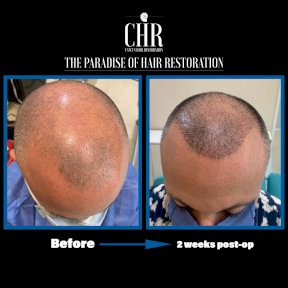
What Is a Hair Transplant?
A hair transplant, or hair restoration, is a surgical procedure that moves healthy hair follicles from a donor area (usually the back or sides of the head) to bald or thinning areas. It's a permanent solution for hair loss caused by genetics, aging, or medical conditions.
Why get a hair transplant?
✔ Restores natural hair growth.
✔ Permanent results.
✔ No visible scars.
✔ Works for hairline, crown, and even beard or eyebrows.
✔ Self-esteem, satisfaction with appearance, and quality of life increased by over 30% after the procedure.
✔ Makes you appear more attractive—a survey by Johns Hopkins University confirmed that other people perceive men after hair restoration as younger, more attractive, and successful.
![faq image]()
Why Get a Hair Transplant in Mexico?
1. Savings of up to 75%
In Mexico, hair restoration surgery costs 66%–80% less than in the US or Canada. Hair restoration in Mexico costs between $3,000 and $4,090, while US prices range from $8,000 to $17,000 for the same procedure. The savings come from lower labor costs, overhead expenses, and favorable exchange rates—not from cutting corners.
Think of it this way: A cup of coffee in the U.S. can cost $5–6, while the same quality coffee in Mexico is $2–3. The difference isn't in the coffee itself, but in the cost of running the business. The same logic applies to hair restoration. According to patient reviews, you get the same skilled doctors and modern techniques, just without the inflated costs.
A patient from France who underwent medical treatment shared about their experience: "The quality of the hospital service is second to none, the hospitals are like luxury hotels, you feel good, you are looked after and followed throughout your stay."
2. Fast, low-cost travel—like getting it done at home
- From the US: Mexico's best clinics are just across the border, including Alice Beauty Clinic (4.3/5) in Tijuana and Hospital de la Familia (4.2/5) in Mexicali. You can drive from San Diego to Tijuana in under 30 minutes or take a short flight to cities like Cancun or Mexico City. Some clinics even provide cross-border shuttles or airport pickups.
- From Canada: Direct flights make getting to Mexico as easy as flying to another province, often cheaper than domestic Canadian flights.
3. Expert surgeons & advanced techniques
According to Bookimed data as of December 10, 2025, Mexico has 140+ clinics offering hair transplant procedures, with board-certified specialists performing thousands of procedures every year. They are trained in the US and Europe and are members of organizations like:
- International Society of Aesthetic Plastic Surgery (ISAPS);
- International Society of Hair Restoration Surgery (ISHRS).
According to the 2025 ISHRS Practice Census, qualified ISHRS members perform an average of 15 hair restoration surgeries per month.
Leading specialists include Dr. Mariana Serratos at Hair In 1 Day Monterrey, who has completed over 3,000 procedures specializing in natural-looking hair transplants, Dr. Uriel Muñoz in Puerto Vallarta, and Dr. Edmundo Pichardo at DR. IRERI ASTEINZA Clinic in Mexico City.
The best clinics in Mexico follow strict safety and sanitary protocols, aligning with governmental or international standards (e.g., COFEPRIS). They use sapphire-tipped instruments for precise incisions and PRP therapy to boost hair regrowth.
4. Comprehensive treatment packages
Mexican packages bundle surgery, medical care, and follow-ups into one price. They often include hotel stays and airport transfers. You know exactly what you're paying for—no hidden fees.
Types of Hair Transplant Surgery in Mexico
![faq image]()
- FUE (Follicular Unit Extraction). The most popular method. This technique uses precision micro-punches of 0.8–1.0mm diameter to extract individual hair follicles from the donor area and transplant them to bald spots. Modern FUE techniques achieve 85–95% graft survival rates when performed by experienced surgeons.
- DHI (Direct Hair Implantation). A variation of the FUE technique where follicles are implanted immediately using a special pen. Ensures higher survival rates of 90–97% and denser results.
- FUT (Follicular Unit Transplantation). Also called the strip method, it removes a thin strip of scalp from the donor area. More invasive but ideal for large transplants.
- Sapphire FUE. Uses sapphire-tipped blades instead of steel for smaller incisions and less tissue damage.
- Robotic & automated procedures. Clinics may use NeoGraft or ARTAS robotic systems to speed up extraction, improve follicle survival, and ensure even distribution.
- Body Hair Transplant (BHT). Uses hair from the beard, chest, or back when scalp donor supply is limited.
Mexican clinics often enhance hair implants with PRP (platelet-rich plasma), stem cells, or patients' own fat cells to stimulate regrowth and follicle survival.
Hair Transplant vs. Other Hair Restoration Procedures
Hair transplants are the only permanent solution for hair loss, but other treatments exist. Here's how they compare:
|
Procedure
|
What It Does
|
Best For
|
Longevity
|
|
Hair transplant
|
Moves healthy follicles to bald areas
|
Moderate to severe hair loss
|
Permanent
|
|
Scalp micropigmentation (SMP)
|
Tattoos tiny dots to mimic shaved hair
|
Thinning hair, shaved look
|
Semi-permanent (5+ years)
|
|
PRP therapy
|
Injects platelet-rich plasma to stimulate follicles
|
Early-stage hair loss, thinning
|
Temporary (up to 2 years)
|
|
Medications (Finasteride, Minoxidil)
|
Slows hair loss, may regrow hair
|
Mild to moderate hair loss
|
Stops working if discontinued
|
Who Is a Good Candidate for Hair Restoration in Mexico?
Hair restoration can help:
✔ Those over 25 (hair loss patterns should be stable before surgery)
✔ Men with male pattern baldness
✔ Women with female pattern baldness
✔ People with hair loss from injury or surgery
✔ Anyone seeking beard, eyebrow, or mustache restoration (transplants work for facial hair, too)
✔ Those with a healthy scalp and no uncontrolled health conditions
![faq image]()
How Does a Mexican Hair Transplant Work?
Preparation
- Medical evaluation. A doctor assesses hair loss and donor area to determine the number of grafts needed. First-time procedures require 2,176 grafts on average, while subsequent procedures need 1,641 grafts.
- Pre-op tests & instructions. Stop smoking, avoid alcohol, and discontinue blood thinners for at least 2 weeks before surgery. Clinics usually need lab tests (e.g., blood work), and patients may need to fast beforehand.
- Shaving (if needed). Some techniques require the donor area to be shaved. However, no-shave procedures are also available.
Hair transplantation steps
Hair restoration procedures are outpatient treatments that take 4–8 hours, depending on the technique and number of grafts.
1️⃣ Anesthesia. Local anesthesia numbs the scalp. Patients might feel mild pressure or tugging during the procedure but no pain.
2️⃣ Graft extraction. Hair follicles are removed from the donor area (usually the sides or back of the head). Surgeons spread them out to avoid making the donor area look too thin.
3️⃣ Recipient site preparation. Tiny incisions are made in the thinning or balding areas.
4️⃣ Implantation. Grafts are placed into the incisions, following the natural hair direction. For optimal results, surgeons implant 35–40 follicular units per cm² for frontal areas and 20–25 units per cm² for the vertex.
5️⃣ Final touches. The scalp is cleaned and bandaged.
Hair Transplant Recovery
Most patients stay in Mexico for 3–7 days after surgery for post-op checkups before flying home.
Hair transplant recovery follows a predictable timeline:
| Timeframe |
What to Expect |
| Days 1–3 |
Redness, swelling, and scabbing appear. Swelling peaks in 70% of FUE patients around day 3–4. |
| Days 3–5 |
Most patients can return to work. |
| Days 10–14 |
Scabs fall off completely. |
| Weeks 2–24 |
"Shock loss" phase: temporary hair thinning occurs in 40% of scalp grafts before regrowth starts. |
| Month 3 |
Clinical data shows that approximately 30% of transplanted hairs begin emerging from the scalp. |
| Month 6 |
60–70% of hairs have penetrated through, though they remain thin and immature. |
| Month 9 |
90–100% of hairs have emerged, with significant thickening and darkening occurring. |
| Month 12 |
Full maturation with 100% of hairs, though some patients see continued improvement until month 18. |
Recovery tips
✅ Sleep with your head elevated for at least 1 week. Use a neck pillow to prevent accidental rubbing.
✅ No sun, sweating, or extreme temperatures for at least 2 weeks.
✅ Most surgeons allow gentle washing after 48 hours using a mild shampoo. Avoid strong water pressure and scrubbing.
✅ Skip alcohol and smoking for 2–4 weeks.
✅ Avoid intense workouts for at least 1 month.
A Canadian patient reported about their hair transplant experience: "My hair transplant experience was excellent – great medical service and professional staff. Just make sure you can communicate in English."
Hair Transplant Risks & Complications
Hair restoration in Mexico is safe when performed by experienced, board-certified surgeons. A peer-reviewed study on complications found that serious infection rates remain below 1% with proper protocols. However, minor complications are more common and typically resolve on their own:
| Risk |
Prevention & Management |
| Scarring |
Minimized with FUE/DHI techniques that leave very little scarring. |
| Loss of sensation |
Nerve endings regenerate over time. |
| Infection (less than 1%) |
Prevented with sterile tools and antibiotics. |
| Folliculitis (up to 20%) |
Managed with proper wound care and medicated shampoo. |
| Uneven or patchy hair growth |
Prevented by precise graft placement. |
| Poor graft survival |
Avoiding smoking and alcohol maximizes graft retention. PRP therapy can enhance results. |
🛡️ Risk prevention starts with choosing the right clinic. Bookimed can help you get the best treatment by connecting you with verified specialists.
Hair Transplant Success Rates in Mexico
Modern hair transplant techniques in Mexico achieve high success rates when performed by qualified surgeons.
Graft survival rates:
- FUE (Follicular Unit Extraction): 85–95% survival rate
- DHI (Direct Hair Implantation): 90–97% survival rate due to immediate implantation
- FUT (Follicular Unit Transplantation): 85–95% survival rate
Patient satisfaction:
A 2020 study of 820 FUE cases found 94% patient satisfaction at 12 months. The average satisfaction rating across multiple studies is 8.3 out of 10 at 3-year follow-up.
Factors affecting success:
Surgeon expertise, proper graft handling, and post-operative care significantly influence outcomes. Clinics following international protocols achieve the highest success rates, while proper aftercare can improve survival rates from 85% to 95%.
Hair Transplant Results
✔ Natural look & hair density. Transplanted hair grows in a natural pattern, blending seamlessly with existing strands. A single session restores 50–70% of natural density. However, if hair loss is advanced, you may need a second session.
✔ Permanent results. Once the transplanted hair takes root, it stays for life.
✔ Donor area stays intact. The extracted follicles do not grow back, but the area is carefully harvested to ensure no visible thinning.
![faq image]()
Important Considerations Before Traveling to Mexico for a Hair Transplant
➤ Visa. Travelers from the US, Canada, UK, and EU do not need a visa for stays of up to 180 days.
➤ Arrival & pre-op schedule. Most clinics require patients to arrive at least 1 day before surgery for medical evaluations and final consultations.
➤ Length of stay. Patients typically need to plan for 4–10 days. Booking flexible return flights is recommended in case you need additional follow-ups.
➤ Payment & deposits. Clinics accept USD and Mexican Pesos (MXN). Payment methods include credit cards, wire transfers, PayPal, and cash. A deposit (usually 10–15%) is required to secure a surgery date.
➤ Transfers & accommodation. Mexican clinics offer free airport pickups and local transfers between hotels and medical facilities. They can either include hotel stays in the package or assist with bookings at special rates.
➤ Packing essentials. Loose, button-up clothing, a travel pillow to protect the scalp, and gentle shampoo (if not provided by the clinic) can make post-op care easier.
How Much Does a Hair Transplant Cost in Mexico?
Hair restoration in Mexico costs between $3,000 and $4,100. This is 66%–80% more affordable than in the US, where prices range from $8,000 to $17,000 for the same procedure.
What's included in the treatment package?
All-inclusive packages in Mexico usually cover:
- Free online consultations for international patients
- Surgeon, anesthesia, and hospital fees
- Pre-op evaluations (e.g., scalp assessment, basic lab tests)
- Post-op medications and aftercare washes
- Follow-up consultations
- Hotel stay
- Airport pickup and local transfers
A US patient shared about their medical tourism experience: "I underwent a hair transplant and Bookimed made the experience just perfect. The medical care was of the highest standard."
Additional costs to consider
- Flights ($200–$300 for a round-trip from the U.S. or Canada)
- Extra hotel nights ($80–$150 per night if needed)
- Additional medications (e.g., antibiotics, painkillers—around $100–$120)
- Additional tests (e.g., cardiologist consultation, blood work—$80–$100)
In line with its Finance Policy, Bookimed provides direct prices from the best clinics—no hidden fees or markups.
Top-Rated Hair Transplant Clinics in Mexico
According to Bookimed data, Mexico has 140+ clinics offering hair transplant procedures, with top-rated facilities including:
All clinics are verified through Bookimed's rigorous quality assessment process outlined in the Clinic Ranking Policy.
Resources
- Cleveland Clinic. (2021). Hair Transplant.
- WebMD. (2024). Hair Transplants: What to Expect.
- Journal of Cosmetic Dermatology. (2023). Assessment of quality of life and self-esteem in male patients with androgenetic alopecia before and after hair transplantation.
- Johns Hopkins University School of Medicine. (2017). Perception of Hair Transplant for Androgenetic Alopecia.
- PMC. (2020). Approach to Hair Transplantation in Advanced Grade Baldness by Follicular Unit Extraction: A Retrospective Analysis of 820 Cases.
- PMC. (2019). Complications in Hair Transplantation.